

What if the most expensive part of your Dubai expansion isn’t the license fee, but the administrative oversights you didn’t plan for? It’s a common concern for many entrepreneurs who find themselves caught between conflicting price lists and unexpected government mandates. When you’re calculating the cost of setting up a business in dubai, it’s easy to focus on the initial registration while overlooking the vital layers of visas, office requirements, and operational compliance.
We understand that financial clarity is the foundation of any successful venture. You deserve a transparent roadmap that demystifies the 2026 pricing landscape without the usual jargon or hidden surprises. This guide provides a comprehensive breakdown of current expenses, comparing mainland and free zone jurisdictions to reveal where the best value lies. From initial licensing and establishment cards to the latest corporate tax registration requirements, you’ll gain the knowledge needed to build a precise, realistic budget for your new UAE enterprise.
Key Takeaways
- Identifying whether a Mainland or Free Zone jurisdiction suits your specific business activity is the first step in creating a precise and efficient setup budget.
- Calculating the true cost of setting up a business in dubai involves accounting for mandatory trade name reservations, initial approvals, and recurring annual license fees.
- Learn why “all-in-one” Free Zone packages require careful scrutiny, as they may exclude essential costs like establishment cards or visa processing fees.
- Budgeting for post-license operational needs, such as corporate bank account opening and PRO services, is vital for maintaining compliance and ensuring long-term stability.
- Partnering with a strategic advisor helps you navigate the 2026 administrative landscape with transparency, effectively removing the risk of unexpected government fees.
Understanding the Cost Landscape of Dubai Business Setup
Mainland, Free Zone, or Offshore: The Core Cost Drivers
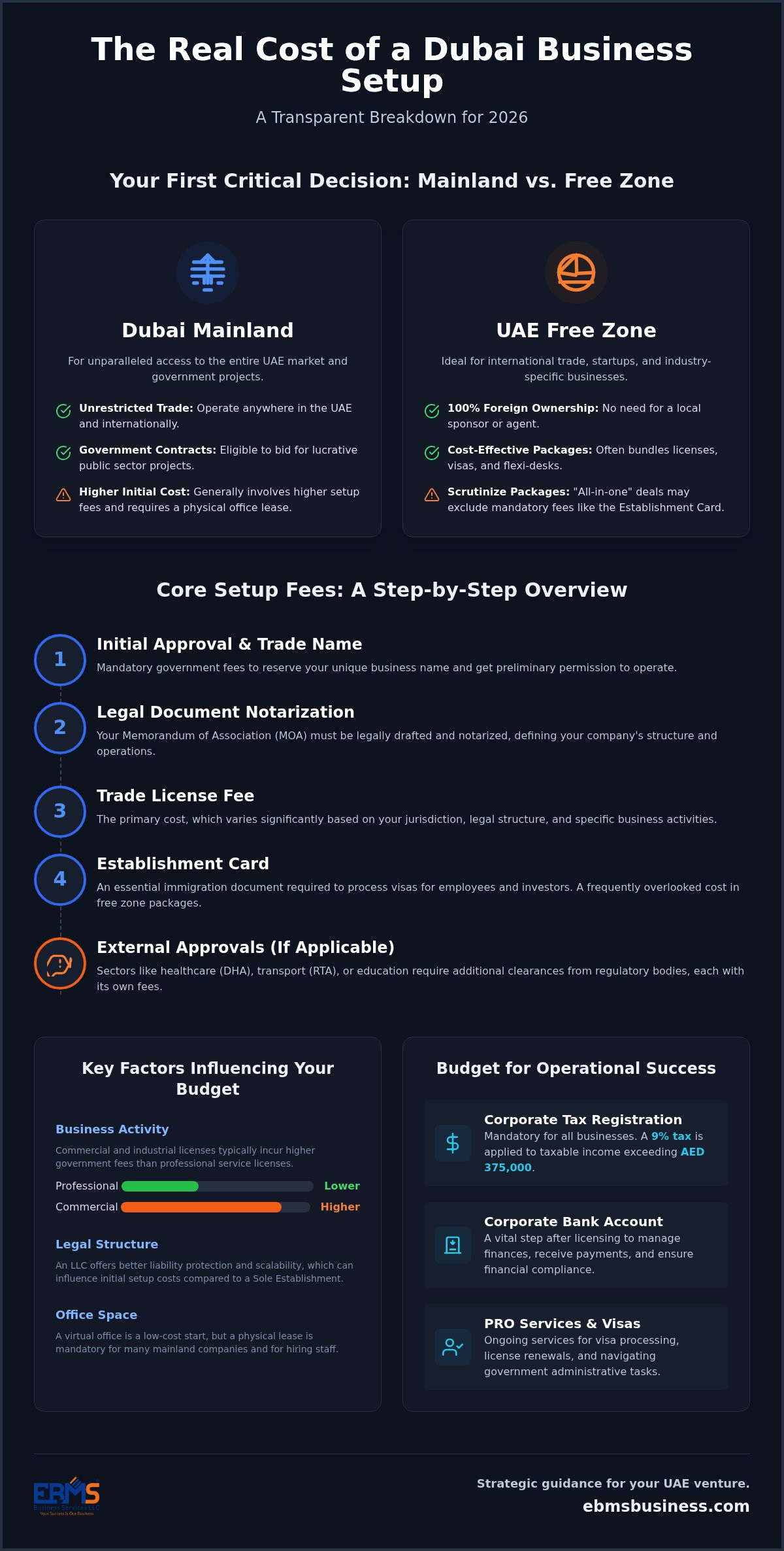
The geographic location of your license serves as the primary driver of your budget. A Dubai Mainland company formation offers unparalleled flexibility, allowing you to trade anywhere in the UAE and bid for lucrative government contracts. These licenses are issued by the Department of Economy and Tourism (DET), where pricing is influenced by your chosen trade activities and office space requirements. While mainland setups often involve higher initial costs, the ability to access the local market directly is a significant advantage.
If your model focuses on international trade or specific niches like technology or media, Free Zones offer a cost-effective alternative with 100% foreign ownership. While initial packages might seem lower, you must account for specific zone regulations and “all-in” deals that may exclude mandatory fees like establishment cards. For those seeking a vehicle purely for international asset holdings, offshore setups remain the most economical route, though they don’t allow for local operations. Understanding Dubai’s economic landscape helps you align your jurisdiction with the sectors driving growth this year.
The Impact of Legal Structure on Your Budget
Does a Limited Liability Company (LLC) cost more than a Sole Establishment? Often, the answer depends on your activity list rather than just the license type. Commercial and industrial licenses generally carry higher fees than professional licenses because they involve more complex approvals and infrastructure needs. Your chosen legal structure will define your liability and your ability to add partners in the future, making it a vital part of your financial planning.
Understanding the financial requirements for a new venture starts with distinguishing between the capital you need today and the expenses you’ll face every year. When evaluating the cost of setting up a business in dubai, many investors focus solely on the license fee. However, the process begins with initial approvals and trade name reservations, which are essential key steps for setting up a business. These preliminary government fees secure your legal identity before the actual license is issued. You must also budget for the notarization of the Memorandum of Association (MOA), a mandatory legal document that defines your company’s operational framework.
Specialized activities often require a larger budget due to external approvals. If you’re entering sectors like healthcare, transport, or education, you’ll need clearances from specific regulatory bodies such as the Dubai Health Authority or the RTA. These third-party approvals carry their own administrative costs and can influence your setup timeline. It’s vital to identify these requirements early to avoid “hidden” fees that can disrupt your initial cash flow projections.
Licensing and Registration Essentials
Your choice between a virtual or physical office significantly shifts your first-year budget. While a virtual office is an excellent entry point for digital nomads and consultants, mainland companies must eventually secure a physical lease to comply with local regulations. Freezone business licenses often bundle these costs into “flexi-desk” packages. You should always verify if government levies, such as the Knowledge and Innovation Dirham, are included in your quote. These small but mandatory fees fund UAE public initiatives and are applied to almost every government transaction.
Visa and Immigration Costs
How many employees do you plan to sponsor in your first year? Each visa involves a multi-step process including medical fitness tests, Emirates ID applications, and mandatory health insurance coverage. Investor visas typically require a higher initial outlay but offer longer residency periods. For those seeking maximum stability, the UAE Golden Visa has become a highly sought-after option in 2026. While the upfront investment is higher, it provides ten years of residency and removes the need for frequent renewals, which can be more cost-effective over a decade. If these administrative layers feel complex, you can speak with a consultant for a transparent breakdown of current government rates tailored to your specific head count.
Mainland vs. Free Zone: A 2026 Cost Comparison
Why do some “all-in-one” packages seem too good to be true? In 2026, many entrepreneurs gravitate toward jurisdictions like IFZA Dubai or Meydan Free Zone because of their competitive entry-level pricing. These zones are excellent for startups and digital consultants who don’t require a physical retail presence. However, you must be cautious with packages that appear exceptionally cheap; they often exclude the mandatory Establishment Card or medical insurance, which are non-negotiable for visa processing.
If you’re focused on industrial or large-scale trading, the RAKEZ advantage lies in its specialized infrastructure and lower warehouse costs. When comparing these options, always ask for a breakdown of renewal fees. While the first-year setup might be discounted, recurring annual costs for license renewal and office lease can vary significantly between zones. A “zero-visa” package is a budget-friendly way to start, but remember that adding visas later involves additional government file opening fees that you should account for in your year-two projections.
Mainland Flexibility and Market Access Costs
Does the higher price tag of a mainland license justify the investment? For many, the answer is yes because mainland permits unlimited trade within the UAE and the ability to bid for government contracts. Unlike Free Zones, mainland companies require a physical office space verified by an Ejari (tenancy contract). This adds a layer of rental and utility costs to your budget, but it also removes the geographic restrictions on where you can operate.
Banking and Financial Infrastructure
The critical step of corporate bank account opening in the UAE often presents a significant administrative hurdle for new owners. Most local banks require a minimum average balance, which can range from AED 25,000 to over AED 200,000 depending on the account type and bank tier. Professional assistance in this phase is invaluable; it ensures your documentation meets strict “Know Your Customer” (KYC) requirements, reducing the risk of application delays. You must also budget for accounting and bookkeeping software. Since the UAE has fully matured its corporate tax system, maintaining audited financial statements is no longer optional for those seeking the 0% rate in Free Zones.
PRO Services and Administrative Support
How do you protect your investment from avoidable administrative penalties? Utilizing professional PRO services helps you manage ongoing government relations, from visa renewals to document attestations and legal translations. For example, a late registration for corporate tax now carries a strict AED 10,000 penalty, making early compliance a cost-saving measure rather than an optional expense.
Your digital infrastructure is equally vital. Budgeting for IT services, including secure business email, domain hosting, and basic cybersecurity, ensures your operations remain stable from day one. Additionally, if your revenue is expected to exceed the mandatory threshold, engaging VAT registration services in Dubai is a priority. These services ensure your tax invoices and records comply with Federal Tax Authority standards, preventing costly errors during future audits. If you need help mapping out these operational requirements, reach out to our consultants for a detailed breakdown of the support services your specific activity requires.
Optimizing Your Investment with EBMS Business Services
Why is transparency the most valuable asset in your setup process? Our team focuses on removing the “hidden” elements from your financial planning. By consolidating your corporate formation, PRO services, and digital infrastructure under one roof, you gain a clear, itemized view of your investment. Whether you need assistance with IT services to secure your digital presence or professional guidance on bank account opening in the UAE, we ensure every dirham is accounted for. This holistic approach is why startups, SMEs, and international investors have trusted our Sheikh Zayed Road headquarters for over a decade. We prioritize long-term stability over quick fixes, positioning your venture for growth in a mature, tax-compliant market.
Ready to Start Your Dubai Journey?
Are you ready to secure your long-term residency alongside your business? The 2026 environment offers unique opportunities, such as the expanded UAE Golden Visa program, which has already seen over 250,000 approvals by the start of this year. We help you evaluate whether these long-term residency options offer better value than traditional two-year visas based on your specific investment level. Moving from a budgeting guide to a live operation requires precision, especially regarding the Small Business Relief provisions available for tax periods ending on or before December 31, 2026. This relief can be a vital component of your early-stage financial strategy if your revenues remain at or below the AED 3 million threshold.
The cost of setting up a business in dubai shouldn’t be a source of stress or uncertainty. We invite you to request a personalized cost breakdown that reflects the most current government fees and regulatory mandates for your specific activity. Contact EBMS Business Services today to speak with an expert consultant who can turn your business plan into a compliant, operational reality. Let’s build your UAE future on a foundation of clarity and professional support.
Building Your UAE Future with Financial Clarity
Launching a venture in a global hub requires more than just an initial license; it demands an understanding of how the cost of setting up a business in dubai scales with your specific growth ambitions. We’ve explored the strategic importance of choosing the right jurisdiction, the nuances of mandatory administrative fees, and the vital role of “day two” operational compliance. Whether you prioritize the unrestricted market access of the mainland or the focused incentives of a free zone, your success depends on a transparent and realistic financial roadmap that accounts for every variable.
Since 2015, EBMS Business Services has provided comprehensive support for both mainland and free zone formations from our headquarters on Sheikh Zayed Road. Our multilingual team offers the professional guidance needed to navigate the 2026 regulatory landscape with absolute confidence. We handle the complexities of licensing, visas, and PRO services so you can focus on building your brand. Ready to move from budgeting to a live operation? Contact EBMS Business Services for a personalized Dubai setup cost breakdown today. We’re here to ensure your transition into the UAE market is smooth, stable, and strategically sound. Your entrepreneurial journey in Dubai is within reach, and we’re excited to help you launch it with precision.
Frequently Asked Questions
What is the absolute minimum cost to start a business in Dubai in 2026?
The absolute minimum cost for a professional license in the mainland typically ranges from AED 10,000 to AED 18,000; meanwhile, certain free zones like IFZA offer packages starting at approximately AED 12,900 for a license without visas. These figures represent the base license fee. You should always account for additional mandatory expenses such as trade name reservation and initial approval fees to get a realistic view of the total capital required for your specific activity.
Are there any hidden fees in Dubai free zone setup packages?
While packages are often marketed as “all-inclusive,” entrepreneurs frequently encounter additional costs for the mandatory Establishment Card, which can range from AED 1,000 to AED 2,000. Other common expenses include e-channel registration, medical fitness tests, and mandatory health insurance for visa holders. It’s vital to confirm whether your chosen package includes these government levies or if they’ll be invoiced separately during the final stages of your company formation process to avoid surprises.
How much does a Dubai trade license renewal cost compared to the initial setup?
Annual renewal fees are generally lower than the initial setup because one-time registration and trade name reservation fees are removed. However, you must factor in recurring costs like the annual license fee, office rent, and any mandatory chamber of commerce memberships. In the mainland, the cost of setting up a business in dubai also includes a 2.5% or 5% market fee based on your annual office rent, which remains a consistent recurring expense.
Do I need a large amount of share capital to open a company in Dubai?
Most standard company structures in the UAE don’t require you to deposit a large amount of paid-up share capital into a bank account during the initial setup. While your Memorandum of Association will specify a share capital amount, such as AED 50,000 or AED 100,000, this is often just a “paper value” for many license types. However, certain specialized activities or specific free zones may still require proof of capital, so it’s best to verify this with a consultant.
What are the ongoing costs of maintaining a business in the UAE?
You can significantly reduce your initial investment by choosing a free zone package that includes a “flexi-desk” or virtual office solution. These options are ideal for consultants and digital startups who don’t need a physical storefront. In contrast, mainland licenses require a physical office space verified by an Ejari contract. While virtual options are cheaper, you must ensure your chosen office type allows for the number of residency visas your business requires to operate legally.
How much should I budget for employee visas and Emirates IDs?
You should budget between AED 3,000 and AED 7,000 per person for investor or employment visa processing. This range covers the government application fees, medical fitness tests, and the Emirates ID application. Keep in mind that high-tier health insurance is also a mandatory requirement for visa stamping. If you’re planning for long-term residency, the 10-year Golden Visa requires a higher upfront investment but offers greater cost stability by removing frequent renewal fees over the next decade.