
For a short-term rental business setup in Dubai, furnished stays of less than six months are treated as holiday homes, and each unit needs a holiday-home licence before accepting guests. Through expert guidance from EBMS Business Services LLC, navigating these regional requirements becomes seamless. The rental must cover the whole unit, not a private or shared room. If you’re a tenant, you also need the landlord’s no-objection certificate before subletting the property.
It’s natural to focus first on location and potential income, but eligibility and operating rules shape the plan from the outset. A property must be licensed and registered before it’s listed or hosted, and the right business structure depends on how many units you plan to operate across the wider UAE market.
This guide covers the main setup steps, cost and return considerations, operator limits, insurance and community rules. It also explains how to assess whether a holiday-home model suits your property and business plans before moving forward.
Key Takeaways
- Confirm the property is eligible: Dubai holiday homes must be licensed before hosting, and rentals must cover the entire unit.
- Choose a business structure that fits your ownership, operating plans and intended number of properties.
- Assess potential returns against occupancy, seasonality and operating expenses, not rental income alone.
- Understand the operator limit: an individual holiday-home licence covers up to 8 properties; more requires a commercial trade licence.
- Plan for suitable insurance and review community rules before committing to a property.
Eligibility and whole-unit rental requirements
In Dubai, furnished stays of less than six months are treated as holiday homes, and each unit needs a licence. Register the property before accepting guests or listing it on a booking platform.
-
Confirm Eligibility for Whole-Unit Rentals
Check that the property can be offered as a complete, furnished unit. Dubai holiday-home operators must rent the whole unit; private rooms and shared-room rentals aren’t permitted. A studio, apartment or villa is assessed as one holiday-home unit, not as separate guest rooms.
Confirm the intended stay period, too. Holiday-home stays lasting one to six months use the same DET permit as shorter stays. Tenancies of 12 months or more fall under RERA and use Ejari registration. Treat each unit separately when planning permissions and licensing.
-
Obtain the Landlord’s NOC
If you rent the property, obtain the landlord’s no-objection certificate before subletting it for short stays. The NOC documents the landlord’s consent for holiday-home use. Keep the written approval with your lease and ensure it applies to the property you intend to register.
Owners don’t need a landlord’s NOC for their own property, but tenants do. Don’t assume a residential lease permits short-term subletting. Confirming consent early can prevent you from preparing an application for a property without the owner’s approval.
-
Register the Holiday Home with Dubai DET
Submit the unit through the Holiday Homes portal on the Department of Economy and Tourism (DET) website. Applicants provide the owner’s Emirates ID and the property title deed or lease agreement. A tenant should also have the landlord’s NOC ready. Complete registration before advertising or hosting guests.
The listed holiday-home registration fee is د.إ1,520, including knowledge and innovation fees. Annual permit fees are د.إ300 per bedroom, capped at د.إ1,200 per holiday home; licence issuance or renewal costs د.إ500. Initial approval is د.إ100, while classification and inspection fees are د.إ50 and د.إ300 respectively. The e-Programme subscription is د.إ1,500. Check the current DET fee schedule when budgeting, as charges can change.
Budget for guest charges and tax obligations as well. The Tourism Dirham is د.إ10 per occupied bedroom per night for standard homes and د.إ15 for deluxe homes; operators remit collections monthly, before the 16th of the following month. Guests stop paying after their first 30 nights. According to the Federal Tax Authority, VAT registration is required when taxable supplies exceed د.إ375,000 over any trailing 12 months; registered operators charge 5% VAT on taxable supplies. For a business entity, compare setup options such as Dubai free zone company setup alongside the separate holiday-home permit process.
Business legal structures
A short-term rental business setup in Dubai starts with matching the legal structure to the activity and planned scale. The business trade licence and holiday-home permit serve different purposes, so plan for both.
- Define the operating model. Decide whether you’ll operate as an individual owner or through a company. Then identify whether the activity is furnished holiday-home rentals or hotel-apartment rental. These distinctions affect the applicable business activity and approvals. A company licence establishes the activity the business may conduct, while property-level permissions cover the rental unit itself.
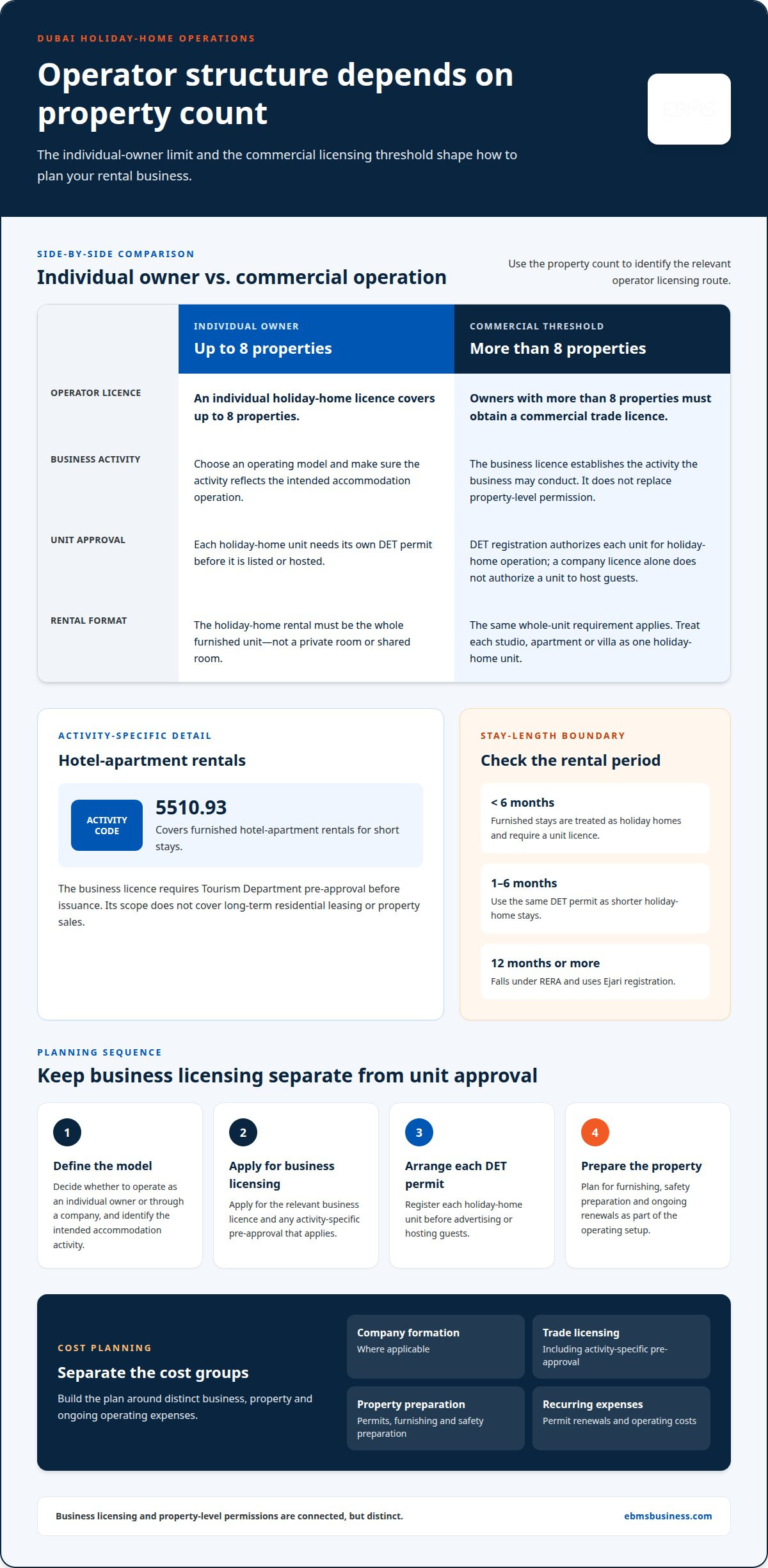
- Match the licensed activity to the accommodation. For hotel-apartment rental through EBMS Business Services LLC, activity code 5510.93 covers furnished hotel-apartment rentals for short stays. The business licence requires Tourism Department pre-approval before issuance. Its scope doesn’t cover long-term residential leasing or property sales, so select an activity that reflects the intended operation.
- Separate company formation from property approval. Treat business licensing and holiday-home permits as connected but distinct steps. The company’s approved activity establishes what the business may do; DET registration authorizes each unit for holiday-home operation. Incorporating a company, for example, doesn’t by itself authorize a furnished apartment to host holiday guests.
- Map the approval sequence before committing to costs. First choose the activity and legal structure, then apply for the relevant business licence and any required pre-approval. Next, arrange the property-level DET permit and prepare the unit for operation. This sequence helps distinguish operator approvals from requirements for each property.
- Build a cost plan around separate cost groups. For a short-term rental business setup in Dubai, budget for company formation and trade licensing, activity-specific pre-approval, property permits, furnishing, safety preparation and ongoing renewals. Applicable costs depend on the legal route, activity, unit and property readiness. Keep business licensing separate from property-level and recurring operating expenses.
- Check whether the model fits your intended scale. A Dubai holiday-home licence allows an owner to register up to 8 properties; owners with more properties must obtain a commercial trade licence. Use this threshold to assess whether an individual-owner arrangement fits your plan or a company structure better suits the intended operation. A property permit doesn’t replace the required commercial licence.
Required authorizations may include a business trade licence, activity-specific pre-approval where applicable, and a DET holiday-home permit for each unit. Estimate setup costs by separating company formation, licensing, property preparation and recurring permit expenses rather than treating them as one fee.
Expected rental yields and profitability
Estimate profit using booked nights and operating costs, not the nightly rate alone. Visitor demand supports holiday-home activity in Dubai, but each property’s location, pricing and expenses shape its results.
- Assess demand for the property’s area. There isn’t one best area for every holiday home. Compare how a location serves its likely guests, such as leisure visitors seeking attractions or business travellers prioritising transport and work districts. Dubai welcomed 19.59 million international overnight visitors in 2025, but that citywide figure doesn’t predict occupancy for an individual unit.
- Build a realistic nightly-income estimate. Compare furnished units with similar size, quality, amenities and location, and allow for quieter periods. Nightly rates and occupancy vary by property and booking dates. Base your estimates on the unit’s competitive position and expected guest demand, rather than applying a citywide average.
- Include stay length and seasonality. Dubai’s average short-term rental stay reached six nights in 2026. Leisure travel peaks between November and March, while holiday-home demand also increases between February and April. Use seasonal assumptions when forecasting booked nights, and don’t treat peak-period income as representative of the full year.
- Deduct operating expenses before judging returns. List recurring costs such as housekeeping, maintenance, utilities, replacement items, licensing and property management. Holiday-home management typically costs 15% to 25% of rental revenue. Apply the relevant management charge to projected bookings, then subtract other expenses to estimate operating income.
- Compare short-term and long-term use. Compare expected holiday-home income with the property’s alternative rental use, accounting for vacancy, turnover and operating responsibilities. Use the same period and include costs on both sides. A higher nightly rate alone doesn’t mean a better return if fewer nights are booked or expenses increase.
- Test the forecast before committing. Prepare conservative, expected and stronger booking scenarios using different occupancy assumptions, nightly prices and management costs. Check whether the business remains viable in the conservative case. Keep licensing and operating expenses separate, so changes in bookings don’t obscure the costs of keeping the unit running.
Dubai’s 78% hotel occupancy in 2024 and its visitor growth provide context for tourism demand, not a guaranteed holiday-home result. Use property-level assumptions to assess income, then revisit the forecast as actual bookings and expenses accumulate.
Individual versus company operator limits
Choose an operating model by counting properties and deciding who will handle daily guest operations. Dubai’s individual-owner limit and commercial licensing threshold affect how you plan for growth.
- Count the properties you plan to operate. An individual Dubai holiday-home licence allows an owner to register up to 8 properties. Owners with more properties must obtain a commercial trade licence. Use the number of intended units, not only the first property, to assess which route fits your business plans.
The ceiling applies to the owner’s registration limit; it doesn’t mean one property permit covers multiple apartments. Plan licensing for each unit separately, and account for future additions before expanding a tourism or travel accommodation operation.
- Choose individual ownership for a limited operation. An owner managing a smaller portfolio may prefer a direct setup, taking responsibility for guest communication, cleaning coordination and maintenance. Consider the time required for check-ins, booking changes, records and annual renewals. These tasks continue even as travel demand shifts between busy and quieter periods.
Organize the work from the first booking. Assign clear responsibility for guest messages, housekeeping schedules and repair follow-up, rather than leaving each task to whoever is available.
- Use a company structure for commercial scale. If your planned portfolio exceeds the individual limit, arrange the required commercial trade licence. Align the company’s licensed activity with its intended holiday-home operation, and keep business licensing distinct from permits for individual apartments. A company structure can support organized operations, but it doesn’t remove unit-level requirements.
Include the workload in your decision. A company operating several holiday homes needs consistent processes for bookings, cleaning, maintenance and owner reporting, alongside its licensing responsibilities.
- Decide who will manage daily operations. Self-management suits an owner who can coordinate guest communication, housekeeping and maintenance. A property management company can handle daily tasks, including guest contact, cleaning, maintenance coordination, inventory and reporting. Owners living abroad can delegate these operational duties.
Choose based on your availability and capacity, not only the number of apartments. If you’re often away, delegated guest support and cleaning coordination may make operations more manageable.
- Document operational responsibilities. Dubai holiday-home operators must provide guests with 24-hour maintenance contact details at the property. Include guest identification and recordkeeping in your operating procedures, and check the applicable requirements. Assign each duty to a named person or management function.
Review the arrangement whenever your portfolio changes. A clear division of responsibilities between the owner, company and manager helps prevent missed bookings, incomplete guest records or delayed maintenance across multiple units.
Insurance and community rules
Protect the furnished property, prepare for guest safety checks and account for building rules before opening. Insurance, maintenance arrangements and accurate occupancy records all support responsible holiday-home operations in Dubai.
- Arrange suitable insurance. Dubai short-term rental owners are advised to carry comprehensive cover for property damage, guest injuries and other disruptions. Estimated holiday-home insurance costs range from د.إ1,500 to د.إ3,000 per year, with minimum coverage of د.إ500,000. Review the policy scope against the property’s furnishings, guest use and potential repair exposure.
Don’t assume a standard real estate policy covers guest stays. Check that the insured use reflects furnished short-term accommodation, and keep the policy with the property’s operating documents.
- Prepare the unit for inspection. Dubai holiday-home authorities may inspect a property to confirm it matches its description and meets safety standards. Keep the listing accurate, furnishings usable and the unit ready for guests. A mismatch between advertised features and the actual apartment can create avoidable issues.
Organize safety information and the maintenance process before the first booking. An inspection is a practical reason to keep the property, its description and operating arrangements aligned.
- Set clear guest-service arrangements. Holiday-home operators must provide 24-hour maintenance contact details at the property. Make the information visible to guests and ensure the contact route connects them with someone able to respond to a maintenance issue. Define who handles urgent repairs, routine cleaning and replacement of damaged furnishings.
For example, a guest reporting a faulty appliance should know how to reach the maintenance contact, while the operator records the issue and its resolution. Clear responsibilities provide support without leaving guests unsure whom to contact.
- Review community and building rules. Before hosting, understand the building’s procedures for guest access, shared facilities, deliveries and noise. Give guests relevant instructions before arrival, and keep them consistent with the booking information. Community expectations can affect how smoothly visitors use entrances, lifts and shared areas.
Keep building guidance separate from holiday-home licence requirements. A DET permit doesn’t replace the need to follow the community’s property-use procedures.
- Keep records and address violations promptly. Maintain an occupancy record, guest communications, maintenance actions and incident details. Repeat violations of Dubai holiday-home rules within a year may result in doubled fines, capped at د.إ100,000. A documented response helps identify recurring issues and supports consistent operating decisions.
Review complaints and maintenance records after each relevant incident. If the same access or noise concern recurs, revise guest instructions and operating procedures before the next booking.
EBMS Business Services LLC
EBMS Business Services LLC can help you assess the company formation route for your business plans. If you’re preparing to operate holiday homes through a company, its Free Zone Company Setup and Mainland Company Setup services support the business setup stage.
Choosing a legal structure is separate from securing property-level holiday-home approvals. Consider your intended activity, ownership plans and operating scale when deciding which formation route to pursue. EBMS Business Services LLC can guide you through company setup considerations; Dubai’s holiday-home licensing requirements remain a separate step for each unit.
Contact EBMS Business Services LLC to discuss the business setup requirements for your plans.
Take the Next Step with a Clear Business Plan
A short-term rental business setup in Dubai involves decisions that connect your property plans with the wider business. Before moving ahead, clarify your operating model, responsibilities and priorities. A well-defined plan gives you a practical basis for organizing the next steps.
EBMS Business Services LLC can assist with business setup planning and help you consider how your company structure aligns with your objectives. Its support covers the business formation side, helping you approach the separate property requirements with a clearer plan.
Discuss your business plans with EBMS Business Services LLC. Contact EBMS Business Services LLC to explore personalized business setup assistance and take your next step with greater clarity.
Frequently Asked Questions
What Are Short-Term Rentals in Dubai?
Holiday homes provide furnished accommodation for visiting guests on a temporary basis, rather than for ordinary residential use. A booking may cover a short visit or a longer temporary stay, with the property and booking terms shaping how it operates. For owners, the key distinction is the guest-stay purpose, not whether bookings come through a particular website or platform.
Can I rent out my property short term while living abroad?
Yes. Living abroad doesn’t prevent an owner from arranging short-term stays, but daily operations need a clear point of contact. Before accepting bookings, decide who will handle guest questions, urgent property issues and communication with building staff. Agree how the owner will receive updates and review activity remotely, so decisions don’t stall across time zones.
Can you legally run an Airbnb in Dubai in 2026?
Yes, an Airbnb listing can be part of a lawful Dubai holiday-home operation. The platform helps reach guests but doesn’t replace compliance with Dubai’s applicable requirements. Plan the listing around the actual property, booking terms and guest-service arrangements, and ensure the platform information reflects how the accommodation will be provided.
Can you rent out just one room in your Dubai apartment on Airbnb?
No. Dubai holiday-home rentals must be offered as a complete unit, not as an individual room. If you want to use the apartment at certain times, make it available to guests only when the whole unit can be offered. Don’t create separate room listings or describe shared accommodation as a private holiday home.
Does Dubai Strictly Enforce STR Rules?
Dubai has operating requirements for holiday homes, so treat compliance as part of routine property management, not a one-time setup task. Set reminders for permit-related deadlines, organize guest and maintenance records, and respond promptly to building or authority communications. Consistent procedures make it easier to spot gaps before they affect upcoming bookings.
What are the rules for renting out a property you own versus a leased property in Dubai?
Owners can arrange holiday-home use for their own property; tenants need the landlord’s consent before subletting. For a leased apartment, align the lease dates, landlord approval and planned booking periods before taking reservations. For an owned property, keep ownership documents available for the relevant administrative process and clarify any co-owner or representative arrangements.