

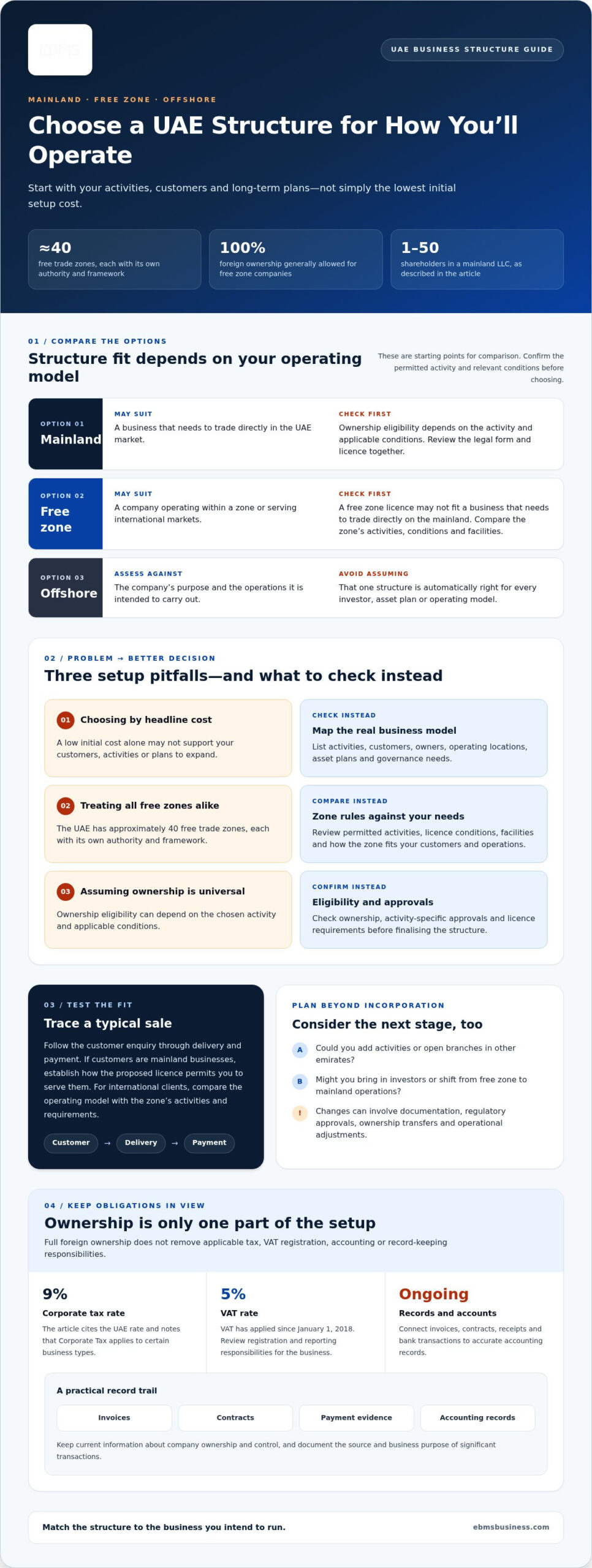
The right UAE structure is the one that fits your business activity, target market and long-term plans, not simply the one with the lowest initial cost. Common pitfalls for foreign investors in the UAE include choosing between mainland, free zone and offshore structures without weighing ownership eligibility, required approvals, capital expectations and ongoing compliance. Many activities allow 100% foreign ownership, subject to activity-specific conditions and approvals.
It’s understandable to focus first on getting a company established, but the decision also shapes how the business can operate and what it must do after formation. The UAE corporate tax rate is 9%, according to the UAE Federal Tax Authority, and full foreign ownership doesn’t remove applicable tax, VAT registration, accounting or record-keeping obligations.
This article explains how to compare business structures, review ownership and licensing requirements, plan for capital and approvals, and prepare for tax and accounting responsibilities. Matching the setup to your actual operating model can help you avoid preventable changes later.
Key Takeaways
- Compare mainland, free zone and offshore structures against your target market, activities and long-term plans, not just initial setup considerations.
- Confirm ownership eligibility and any activity-specific approvals before choosing a licence or finalising your company structure.
- Build capital expectations, formation requirements and possible approval steps into your setup plan from the outset.
- Prepare for ongoing tax, VAT and accounting responsibilities, and keep accurate business and financial records after formation.
- Choose a setup route that supports how your business will operate and grow, rather than relying on a headline benefit alone.
1. Choosing between onshore, free zone and offshore structures
Start with the business you plan to run, not the lowest advertised setup cost. List your activities, customers, asset plans, owners, operating locations and governance needs. A technology startup seeking investment, an investor acquiring assets and a multinational planning a regional headquarters may need different structures. Comparing these needs helps identify common pitfalls for foreign investors in the UAE before committing to a licence.
Next, compare the three broad options: mainland, free zone and offshore. Mainland setup may suit a business that needs to trade directly in the UAE market. A free zone may fit a company operating within a zone or serving international markets, but it may not suit a business that needs to trade directly on the mainland. An offshore structure is another option to assess against the company’s purpose and intended operations.
The UAE has approximately 40 free trade zones, each with its own authority and framework. Don’t treat “free zone” as one interchangeable choice. Compare the zone’s permitted activities, licence conditions, facilities and how its rules fit your customers and operations. A headline “0% tax” claim alone doesn’t establish whether that zone or structure fits your business.
Ownership is another key comparison. Free zone companies generally allow 100% foreign ownership. Mainland ownership eligibility depends on the chosen activity and applicable conditions, so assess both the legal form and licence before deciding. A mainland LLC generally has between 1 and 50 shareholders. These distinctions can affect governance and how investors plan ownership.
To compare mainland and free zone options, trace a typical sale from customer enquiry through delivery and payment. If your customers are mainland businesses, establish how the proposed licence permits you to serve them. If you expect to serve international clients, compare that operating model with the zone’s activities and requirements. The right fit depends on your business model, target market, clients, operating needs and expansion plans.
Plan for five or ten years, not only incorporation. Consider whether you may add activities, open branches in other emirates, bring in investors or shift from free zone to mainland operations. Those changes can require documentation, regulatory approvals, ownership transfers and operational adjustments. Choosing a structure only to minimise initial expenditure may create avoidable work later.
Reassess the structure as the business changes. For example, a free zone company expanding into mainland operations should review its licensing and ownership arrangements before launching the new activity. Activities can often be amended, subject to the licensing authority’s procedures and approvals. Treat each expansion as a strategic review of the company’s legal form, licence and intended market.
2. Corporate Tax, VAT and accounting compliance
Compliance planning should begin before a company starts trading. The UAE has introduced Corporate Tax for certain business types, and VAT has applied at 5% since January 1, 2018. A foreign investor should map the planned activity, expected transactions and record-keeping process before operations begin. Treating tax and accounting as tasks to address after the first sale can leave important reporting work until later.
Before buying UAE property or investing in a local company, review the relevant evidence. For property, examine ownership records and transaction documents. For a company, review financial statements, contracts, liabilities, ownership and commercial activity. Compare what you find with your investment plan, and document questions about the source of funds, expected returns and ongoing obligations before committing.
For a UAE company, establish a routine that connects invoices, contracts, receipts and bank transactions to accurate accounting records. Keep evidence of what the business did, who it dealt with and how each transaction was recorded. For example, a company selling services internationally should be able to match customer invoices with contracts, payment records and its stated business activity. Clear records support reporting and help owners understand the company’s financial position.
Pay attention to anti-money laundering and beneficial ownership responsibilities. Keep current information about who owns and controls the company, and record significant transactions and their business purpose. When an investor contributes funds, retain documents showing the source and how the funds enter the company. These measures support transparency and help the company respond to questions from banks or relevant authorities.
Opening a bank account involves separate due diligence. UAE banks assess applications independently and may request information about the business, shareholders, source of funds and commercial activities. Prepare a consistent company profile: the licence and stated activity should align with the business plan, contracts and transaction evidence. A company licence does not guarantee a bank account, so include account-opening preparation in your establishment plan.
Build a compliance calendar covering licence renewal, tax reporting and internal accounts reviews. Assign responsibility for collecting records, reconciling transactions and preparing submissions. Review the process when the company adds an activity or changes ownership. UAE businesses may need to submit VAT reports and meet applicable tax and regulatory requirements. A regular routine supports reliable records and avoids having to reconstruct business activity at filing time.
Review transactions regularly. Foreign investors in the UAE should account for corporate governance, anti-money laundering and beneficial ownership requirements. Businesses should also understand the compliance, transparency, tax reporting and banking verification obligations that apply to their operations.
Ongoing responsibilities may include licence renewals, accurate record-keeping and compliance with applicable tax and regulatory requirements. Review the compliance calendar regularly, and keep ownership information, accounting records and supporting documents consistent and accessible to those responsible for compliance.
3. Foreign ownership eligibility by business activity
Start by defining the exact product or service the company will provide. Many commercial and professional activities allow full foreign ownership, subject to activity-specific conditions and approvals. The licence activity is central: it determines the licence category and may involve other government authorities. Describe the work, customer type and delivery method in plain language, then match them to the proposed activity before incorporation.
Telecommunications, defence-related activities, banking, financial services and security may need additional regulator approvals before registration is complete. For an activity in one of these sectors, identify the relevant approval pathway early and include its documentation in the formation plan. Cabinet Resolution No. 55 of 2021 and emirate-level Department of Economy rules govern foreign shareholding in certain activities. Treat eligibility as activity-specific, not as a general assumption based on the investor’s nationality.
Choose a licence that reflects actual operations, not just the company’s broad vision. For example, a firm offering advisory services and selling products should map both revenue streams to suitable licensed activities. List the planned services, customer groups and delivery channels. This gives the licensing authority a clearer basis for assessing the application and helps prevent the company from operating beyond its approved scope.
Visa and residency options depend on the company structure and applicable regulations. The UAE has investor, employment, entrepreneur and Golden Visa pathways. Include staff sponsorship and residency applications in workforce planning, and connect each role to the company’s operating needs. Emiratisation requirements vary according to applicable rules and the employer’s circumstances.
Financial planning should cover more than licence issuance. Compare expected office, staffing, renewal, compliance and operating expenses with realistic revenue assumptions. For example, a consultancy hiring a specialist team should plan for payroll and workspace alongside licensing and administration. Include working capital for the period before customer receipts become regular, rather than relying on optimistic sales projections.
For banking, keep the company profile, activity description, shareholder information and transaction records consistent. UAE banks conduct independent due diligence and may ask about the business, owners, source of funds and commercial activity. A signed client contract and matching invoice, for example, can help explain a payment into the company account.
Relationships also shape commercial work in the UAE. Follow through on commitments, communicate clearly with customers and suppliers, and record agreed terms in contracts. For disputes, understand the chosen contract’s resolution process before signing. A straightforward onshore civil or commercial enforcement case typically takes about 6-8 months for a first-instance judgment; appeals may take 18-24 months or more. Federal Law No. 6 of 2018 governs domestic arbitration awards, subject to recognition and enforcement procedures.
4. Company formation approvals and capital requirements
Before filing, align the proposed legal form, activity and capital plan. UAE businesses need a licence relevant to their regulated activity, and some activities require external approvals or industry-specific licences. List every planned product or service and map it to the appropriate licence and approval route. Adding an activity later may involve the licensing authority’s procedures, so include likely near-term services in the initial plan.
Rules can vary between emirates. Emirate-level Department of Economy requirements can affect foreign shareholding, while free zone companies follow the licensing process of the relevant zone authority. Regulated activities may also need approval from the relevant sector regulator. The authority depends on the activity and location.
Capital requirements depend on legal form, jurisdiction and activity. UAE LLCs have no federal statutory minimum capital, although authorities may expect sufficient capital and certain activities may impose higher requirements. Free zone company minimum capital can be as low as AED 10,000, with requirements varying by zone and activity. Private joint stock companies commonly require capital of at least AED 2-5 million. These are distinct structures, not interchangeable budget options.
Use any capital figures as planning context, not as a substitute for checking the company’s specific formation route. Establish what capital must be stated, whether the activity sets a higher threshold and what evidence the authority requires. A regulated financial activity, for example, may need additional approvals and capital planning beyond a straightforward commercial licence. Include documentation and approvals in the launch schedule rather than treating incorporation as a single filing.
Professional formation support can help organise decisions before submission: define activities, identify the legal form, prepare ownership documents and coordinate required approvals. Keep the company’s vision and sector in view. A mismatch between the licence and planned operations can require amendments and delay launch. A clear document checklist also helps founders identify missing information before submitting an application to the government authority.
Share incentives for managers need careful documentation. Decide whether a manager receives shares, has an option to acquire them, or earns a performance-based payment. Record the proposed rights, decision-making powers, transfer conditions and effect on existing ownership before changing company documents. For a regulated UAE entity, a shareholding change can trigger pre-approval at thresholds such as 10%, 20% or 30%, or when it reaches control.
Listed-company investments require a separate threshold check. A mandatory tender offer is triggered when an acquirer reaches or exceeds 30% plus one share of the voting share capital of a listed UAE public joint stock company. Treat that threshold as a transaction-planning checkpoint, not as a general rule for private company formation. Mapping approvals, capital and ownership changes before signing can prevent common mistakes and keep formation decisions aligned with the business plan.
5. Corporate tax, VAT registration and accounting
The UAE corporate tax rate is 9%, according to the UAE Federal Tax Authority. Use this rate when building financial scenarios, while also assessing which tax rules apply to the company’s circumstances. A forecast should show how tax obligations affect the business’s expected results, not treat the licence or ownership structure as a tax outcome by itself. This gives investors a clearer basis for comparing planned commercial models.
VAT registration is separate from company formation and licensing. Assess whether the company’s planned supplies make registration relevant, then consider how VAT administration fits its pricing and sales processes. For example, a business selling through different channels should account for VAT treatment in customer-facing prices and internal forecasts. Plan for the effect on commercial decisions rather than treating VAT as a filing task to handle later.
Before launch, map the company’s income sources and planned activities to its financial forecasts. A consultancy earning fees, for instance, should model service revenue separately from any other planned business line. This helps owners understand which assumptions drive profitability and identify changes that may affect tax administration. Review the model whenever the company changes direction or expands its activities.
Accounting supports business decisions as well as compliance. Use management accounts to compare actual performance with the plan, identify cash-flow pressures and check whether spending aligns with priorities. If the company plans to hire or enter a new market, model the effect before committing. This makes accounting useful throughout the year, not only when preparing tax submissions.
Assign clear responsibility for tax decisions and accounting oversight. The owner or appointed finance lead should know which obligations apply, when professional advice is needed and who approves key assumptions. Document these responsibilities in the company’s internal processes, especially when shareholders operate from different countries. A defined review process can help prevent missed decisions when management or ownership changes.
Review the compliance plan when the business changes its activities, revenue model or ownership. A shift from consulting to product sales, for example, can affect how the company handles VAT and financial reporting. Keep the licence description aligned with the actual business model, and review forecasts and accounting procedures together. This connects tax planning to real operations without assuming that one formation decision settles every future obligation.
For help aligning your UAE business setup with its planned activities and obligations, contact the team to discuss your setup.
UAE business licences require annual renewal with the registration and supervisory authorities. Include this ongoing requirement in company cost planning, beyond the initial trade licence.
EBMS Business Services LLC: Free Zone Company Setup
EBMS Business Services LLC can help turn your UAE structure decision into a practical formation plan. Consider its Free Zone Company Setup when your activities and target market fit a free zone. If mainland operations or an offshore structure better suit your objectives, EBMS also handles Mainland Company Setup and Offshore Company Setup. It provides UAE Golden Visa Processing for eligible entrepreneurs and investors.
Turn to EBMS Business Services LLC when you’re comparing jurisdictions, preparing formation documents or aligning your chosen structure with planned activities. Its business setup and licensing support can help clarify the route that fits your intended operations and the next steps to prepare.
Contact EBMS Business Services LLC or visit ebmsbusiness.com to discuss your UAE business setup needs.
Make your UAE entry plan practical
Turn your investment goals into practical decisions: define the intended activity, ownership arrangement and operating model, then align the formation steps with your commercial priorities. This forward planning helps address common pitfalls for foreign investors in the UAE before they lead to costly structural changes.
EBMS Business Services LLC offers Free Zone Company Setup, Mainland Company Setup and Offshore Company Setup, supporting investors as they work out which route fits their plans. If you’re ready to discuss your proposed UAE structure and next steps, contact EBMS Business Services LLC. A clear starting plan can help you approach the UAE market with greater confidence.
Frequently Asked Questions
What business activities in the UAE require a local partner or special approval?
Some activities, including telecommunications, defence-related work, banking, financial services and security, may require additional regulator approval. A local partner is not a blanket requirement for every foreign investor. Where a professional licence requires a local service agent, the agent does not own shares and may provide administrative support. Check the specific activity and legal form, as ownership conditions and approval routes can differ.
What are the UAE rules for opening business bank accounts as a foreign investor?
Foreign investors can apply for a UAE business account, but each bank conducts its own due diligence and a company licence does not guarantee approval. Prepare a clear company profile explaining the licensed activity, ownership, expected customers and payment routes. Keep contracts and records that support the business plan and explain the source of funds. Consistency across these documents helps banks understand how the company expects to operate.
What visa, residency, and Emiratisation requirements apply to foreign business owners and companies?
Visa and residency eligibility depends on the company structure and applicable regulations. The UAE offers investor, employment, entrepreneur and Golden Visa pathways. Include staff sponsorship and residency applications in workforce planning. Emiratisation requirements depend on the applicable rules and are not uniform across all companies.