

Non-residents can open a UAE corporate bank account in some cases, but access is selective: most UAE banks no longer consider corporate applications from non-residents. Corporate account opening in the UAE for non-residents is more feasible when the applicant has a UAE-registered company, since it gives the bank a clearer business purpose. Emirates NBD, ADCB and RAKBANK are commonly used for corporate accounts involving non-resident companies.
Living abroad does not automatically rule out an application, but bank requirements vary, particularly when company ownership spans multiple countries. The key distinction is between being a non-resident shareholder and applying through a UAE business. Banks may assess the company’s activity, ownership, expected transactions and evidence of the source of funds. This article explains who may qualify, which banks are commonly used in non-resident cases, and how residency, signatory arrangements and documentation can affect an application. It also outlines the information banks may request, so you can prepare with a clearer picture of the process.
Key Takeaways
- Assess how your residency status and the company’s ownership structure may affect signatory and activation requirements.
- Prepare to explain the company’s business activity, expected transactions and source of funds clearly and consistently.
- Compare bank options against your company’s structure and practical banking needs, including any in-person onboarding requirements.
- Understand how a UAE free-zone company setup can support your business formation plans before approaching corporate banking.
Can a non-resident really open a UAE bank account?
Some non-residents can open a UAE corporate bank account, but acceptance depends on the bank’s policy and the company’s profile. Banks usually request shareholder identity and financial records, company formation and ownership documents, and a clear business description. For corporate account opening in the UAE for non-residents, they assess these records alongside expected transactions and the source of funds.
Beneficial Owner Declarations
A beneficial-owner declaration identifies the people who ultimately own or control the company, including those behind corporate shareholders. Banks use it to understand the full ownership chain before reviewing an application. A shareholder holding 25% or more is typically included as a UBO. If another company owns shares, prepare its corporate documents so the bank can trace the ultimate beneficial owners. Keep names, ownership percentages, and control details consistent across records.
Personal and Financial Documents
Personal and financial documents identify each non-resident shareholder and provide context about their finances. Banks may request passports, proof of residential address, and personal bank statements for the previous 6 months. A home-country utility bill or bank statement can support address evidence. A bank reference letter or six-month bank statement may also be requested. Align each person’s identity details with the company records and provide readable copies.
Company records establish the business and show who can act for it. Prepare formation documents, the trade licence, ownership records, and documents authorising the account signatory, as applicable to the structure. For an existing company, ownership proof should have been issued within the previous 6 months. A signatory must have genuine authority, supported by documents the bank requires. Requirements can differ between free zone and onshore companies.
Write a concise business description explaining what the company does, where it operates and how it earns revenue. Banks may ask for an estimated deposit and expected annual turnover. Contracts or invoices can support the stated activity. For example, a consultancy should clearly describe its services and target markets rather than rely on its licence alone. Keep the explanation consistent with the licensed activity and anticipated transactions.
UAE corporate KYC follows the framework under Federal Decree-Law No. 20 of 2018 on anti-money laundering and combating the financing of terrorism. Banks may require company documents to be notarised or legalised in the country of origin and in the UAE. Federal Tax Authority says UAE Corporate Tax is 9% on taxable income above AED 375,000. Keep tax and banking records consistent about the company’s activity.
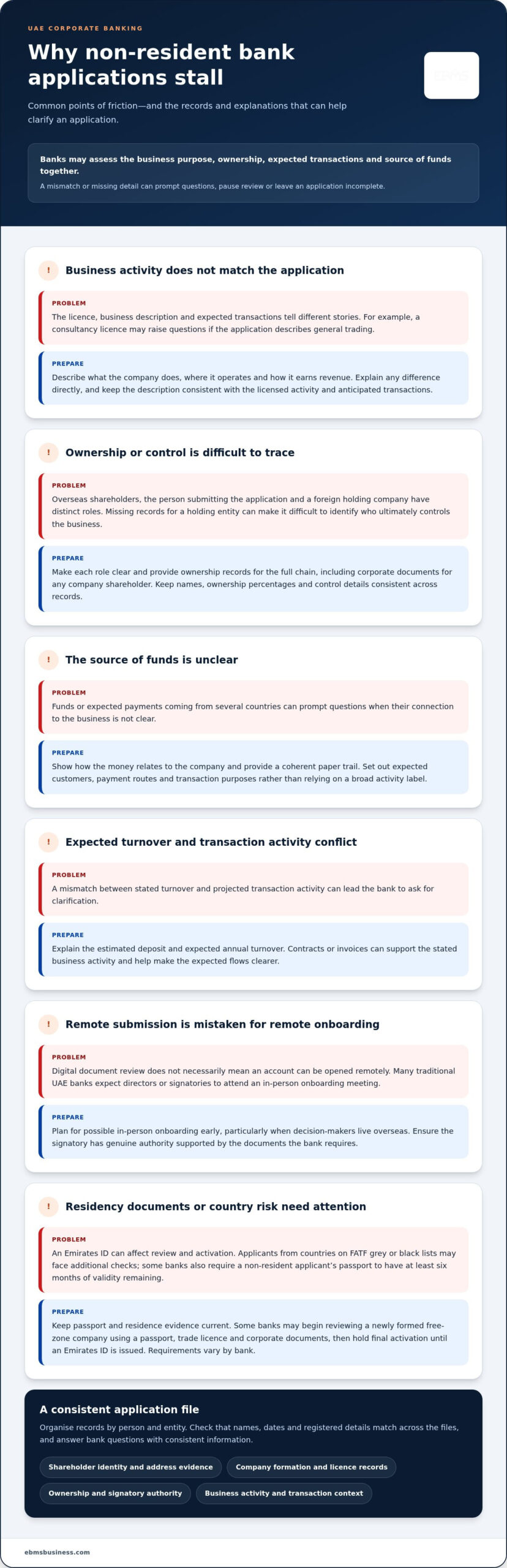
Organise the application file by person and entity before submitting it. Keep each shareholder’s passport, address evidence and bank statements together. Store the UAE company’s formation and licence documents separately from those of any parent entity. Check that names, dates and registered details match across all files. This makes it easier to answer bank questions with consistent records rather than conflicting versions.
Common application rejection reasons
A UAE bank may decline or pause an application if the company’s purpose, ownership or money flows are unclear. The review may reveal mismatches between the licence, business description, expected transactions and supporting records. For example, a consultancy licence may prompt questions if the application describes general trading. Explain any difference directly and ensure the application reflects how the business will operate.
Overseas shareholders, the person submitting an application and a foreign company play distinct roles in the review. A shareholder owns part of the business; an applicant handles the submission; a foreign holding company may sit above the UAE entity. Banks need to understand each role and the full ownership chain. Missing records for a holding entity can make it difficult for the bank to identify who ultimately controls the business.
Unclear evidence of the source of funds is another common obstacle. If company capital or expected payments come from several countries, show how the money relates to the business and provide a coherent paper trail. A mismatch between stated turnover and projected transaction activity can also prompt questions. Clearly set out expected customers, payment routes and transaction purposes rather than relying on a broad activity label.
Online submission does not necessarily mean that an account can be opened remotely. Some banks review documents digitally, but many traditional UAE banks expect directors or signatories to attend an in-person onboarding meeting. Plan for this early, especially if company decision-makers live overseas. A missed appointment or a signatory without documented authority can delay the review or leave the application incomplete.
An Emirates ID can affect the review, but not having one does not always prevent an initial assessment. Some banks may begin reviewing a newly formed free-zone company using a passport, trade licence and corporate documents, then hold final activation until an Emirates ID is issued. Without one, banks may examine ownership, activity and source of funds more closely. Prepare clear explanations for each point.
Country risk can also lead to additional scrutiny. Applicants from countries on FATF grey or black lists may face extra checks. Some banks require a non-resident applicant’s passport to have at least six months of validity remaining. Banks may also request evidence of residence in the applicant’s home country or a UAE company address. Before submitting, ensure these records are current, consistent and legible.
Before applying, compare every statement in the application with the licence and company records. Correct discrepancies, explain unusual transaction patterns and prepare the authorised signatory to answer questions about the company’s operations. These steps address common review concerns, although the bank decides based on its assessment of the complete application.
Bank-specific residency and ownership conditions
Which UAE free zones or company structures do local banks accept? Banks assess applications from free-zone, mainland and other UAE companies according to their own policies and the ownership structure. DMCC and IFZA are examples of free zones banks may find easier to assess, but neither guarantees acceptance.
Residency can affect who may sign for and activate a corporate bank account. UAE banks usually require at least one UAE-resident authorised signatory with a valid Emirates ID. A business without a resident visa for a shareholder, general manager or director may find local corporate banking very challenging. Some banks may review a newly formed free-zone company before an Emirates ID is issued, then hold final activation.
Ownership matters as well as residency. Banks examine who owns the company and who is authorised to give instructions or approve transactions. If a foreign corporate entity holds shares, the bank may need documents showing the ownership chain and identifying the ultimate beneficial owners. Ensure the proposed signatory’s authority matches the company records, so the bank can see who may operate the account.
Minimum balances and charges vary by bank and account type. Banks typically require average monthly balances between AED 20,000 and AED 150,000. Compare these terms with expected cash flow before choosing.
Digital onboarding may suit companies seeking online access, while traditional banks may offer different account features and service arrangements. Digital UAE business accounts may take one to three working days to open. Traditional banks commonly expect directors or authorised signatories to attend an in-person meeting. Plan for travel and ensure the attendee can explain the company’s formation, ownership and anticipated transactions.
Service limitations also matter. Traditional UAE banks typically make cheque books available only to residents, and non-residents may face limits on cards or branch services. Some non-resident account holders rely mainly on internet banking for online transfers. Before choosing an account, map the company’s needs, including receiving customer payments, paying suppliers and handling routine transactions.
A practical comparison should consider the account’s minimum balance, monthly charges, signatory rules, onboarding format and available services. For example, a company with overseas owners and no resident signatory should first examine the bank’s residency requirements. A business that needs cheque transactions should check whether residency restrictions suit its operations. These distinctions help align the company structure with its banking needs.
Business activity, expected transactions and source of funds
A UAE bank assesses whether the expected use of an account fits the company’s licensed activity. Describe what the business sells, who pays it and where transactions originate. For example, a consultancy should explain its services, customer types and payment routes. A licence alone may not show how the company will operate or why it needs a UAE account.
Prepare a business plan or activity description that connects the licence to actual operations. Include the company’s operating model, target markets, expected suppliers and anticipated customer payments. Banks may also ask for an estimated deposit and expected annual turnover. Keep these estimates consistent with projected transaction volumes, contracts and the company’s formation documents.
Economic substance means showing a credible connection between the company’s stated purpose and its UAE operations. Explain why the business banks in the Emirates, how it serves customers and what activity takes place locally. A free-zone licence without another UAE footprint may contribute to delay or rejection. Describe any office, staff, supplier, customer or operational links that support the business case.
Evidence of the source of funds should explain where the opening capital comes from and how the company earns revenue. Trace funds through relevant personal or corporate accounts, particularly when payments originate in multiple jurisdictions. For example, if a shareholder funds the company from an overseas account, identify the transfer and its business purpose. Unclear or inconsistent records can delay the review, so align explanations with bank statements and transaction documents.
Describe expected account use clearly enough for the bank to compare planned activity with actual transactions. State the expected types of incoming and outgoing payments, the countries involved and the reasons for regular transfers. A trading company should distinguish supplier payments from customer receipts; a service company should explain invoice payments and operating expenses. Explain unusual or high-value flows in the business plan rather than leaving them unexplained.
Passport details, company records and signatory information should support the same account-use narrative. During onboarding, authorised signatories may need to explain the company’s activity and how it will handle funds. Prepare them to describe expected customers, payment channels and the source of initial capital. Clear answers help the bank understand the proposed account and reduce avoidable follow-up before approval.
A zero minimum deposit does not, by itself, mean an account has no ongoing balance conditions or charges. Compare the account terms with the company’s projected cash flow and transaction needs. The practical choice depends on whether the business needs digital access, specific payment functions or traditional banking arrangements.
UAE banks offering non-resident accounts
For corporate applications involving non-resident companies, Emirates NBD, ADCB and RAKBANK are commonly used UAE banks. They are reasonable options to consider, but that does not mean every applicant will qualify. Each bank assesses the company, its owners, business activity and country connections against its own requirements.
Distinguish a corporate account application from a personal account application. UAE banks generally offer non-residents savings accounts rather than current accounts, but this does not determine corporate account eligibility. Business owners should clarify whether the applicant is a UAE company with overseas shareholders or a foreign company seeking an account. The legal structure affects which company records and ownership details the bank needs.
Start by comparing the three banks against the company’s practical requirements. Consider its legal form, shareholder locations, signatory arrangements, expected transactions and need for in-person onboarding. A bank that considers one structure with non-resident owners may assess another differently. Focus the comparison on the actual applicant and account purpose rather than assuming a bank’s policy for personal non-resident accounts also applies to companies.
Balance requirements also matter. Treat that as a planning indicator, not a universal minimum for Emirates NBD, ADCB or RAKBANK. Account type and bank terms determine the applicable amount, so compare the balance conditions with the company’s available working capital before choosing.
Prepare an application file for each bank rather than sending identical paperwork without context. Make the company structure clear, identify every shareholder and controlling entity, and explain the business purpose. Include a concise account-use summary covering expected receipts, payments and the countries involved. If a parent company holds shares, organise its records alongside the UAE entity’s documents so the ownership structure is easy to follow.
Non-resident business owners should plan for onboarding logistics as well. Traditional UAE banks commonly expect directors or authorised signatories to attend an in-person meeting. Confirm who can represent the company and ensure that person can explain its activity and expected account use. A prepared signatory can answer questions consistently with the company documents and application.
The practical takeaway is to shortlist Emirates NBD, ADCB and RAKBANK as possible corporate banking options, then compare each with the company’s ownership, structure, balance capacity and onboarding needs. A foreign company and a UAE-registered company with overseas owners are different applicants. Recognising this distinction helps focus preparation on the records and banking arrangements relevant to the case.
EBMS Business Services LLC: Free Zone Company Setup
EBMS Business Services LLC can help when your banking plans depend on establishing a UAE company. Its Free Zone Company Setup service helps you consider the formation route and establish a business foundation aligned with your intended activity. Because banks review company structure and licensed activity, consider them alongside your operating model and ownership plans.
If your circumstances point to a different structure, EBMS Business Services LLC also offers Mainland Company Setup and Offshore Company Setup. These options suit different formation needs, so the right route depends on how you plan to operate and where your business will be based. Company formation supports your setup plans, but it does not determine a bank’s account decision.
Contact EBMS Business Services LLC to discuss your plans and get guidance on a suitable UAE company setup route.
Set a clear direction for your UAE business
As you prepare to launch, include banking readiness in your operating plan rather than leaving it until the company is active. Decide who will oversee financial records, maintain ownership information and keep business explanations consistent as operations develop. These responsibilities help keep the company organised beyond the application stage.
Corporate account opening in the UAE for non-residents is one part of establishing a functioning business. Consider how account access, record-keeping and internal decision-making fit into your wider plans, so your practical arrangements support the way you intend to operate.
A clear plan for these responsibilities provides a useful foundation for managing the company’s next phase. It also helps you understand which company information needs to stay current as you make business decisions.
If you’re planning a UAE business and would like tailored guidance on your next steps, contact EBMS Business Services LLC. You can move forward with a clearer plan and a stronger operational foundation.
Frequently Asked Questions
Can I open a UAE corporate account remotely?
Sometimes, but submitting an application remotely is not necessarily the same as opening an account entirely remotely. Before applying, ask the bank which stages can be completed from abroad and whether any require physical attendance. This distinction matters when directors or signatories live in different countries, as coordinating documents and appointments can affect the process.
Do I need to meet the banker in person?
Some banks, particularly traditional banks, require an in-person meeting. Treat it as an opportunity to explain the company’s commercial purpose and anticipated account use, not simply as a paperwork handover. Before the meeting, ensure the representative can describe the business consistently with the application and supporting records. The bank’s onboarding process determines whether a meeting is required.
Do I need to visit the UAE in person?
There is no single visit rule that applies to every bank. Whether you need to travel depends on the selected bank’s onboarding process and whether it requires an in-person meeting. If travel is difficult, consider this requirement when shortlisting banks, before preparing an application. That helps you avoid choosing an option whose onboarding arrangements do not fit your availability.
How long does it take?
A straightforward non-resident application may take two to four weeks after the documents are complete. Treat this as a planning estimate, not a fixed appointment date. Document preparation, bank questions and arrangements for any required meeting can affect the overall schedule. Keep the application moving by responding promptly to requests and providing consistent, legible records.
Which UAE banks accept non-residents?
Emirates NBD, ADCB and RAKBANK are commonly used for corporate accounts involving non-resident companies. Their suitability depends on the applicant and account purpose, not just the bank name. When comparing them, distinguish a UAE-incorporated company with overseas owners from a foreign-registered company. These are different applicant profiles and may receive different assessments.
Which documents are most critical for approval?
Prioritise records that help the bank connect the company’s ownership, authority and business purpose. Organise the file by entity and person, then check that names and company details match across documents. If a shareholder is a corporate entity, include its records in the ownership file so the bank can follow the applicant’s full structure.
Why was my application rejected?
A rejection may reflect the bank’s assessment of the complete application, not just a missing document. Review any feedback against the information submitted, then identify whether the concern involves the business profile, ownership, expected transactions or supporting evidence. Address the specific gap before applying again, and keep the explanation consistent throughout the revised file.
Will my account information be reported to my home country?
Account information may be exchanged with participating jurisdictions under the Common Reporting Standard. For a UAE corporate account held by a non-resident, the bank identifies the tax residency of controlling persons and reports account details to the UAE tax authority. Information is exchanged with participating jurisdictions annually. Keep the company’s records and each controlling person’s tax-residency information accurate and distinct.