

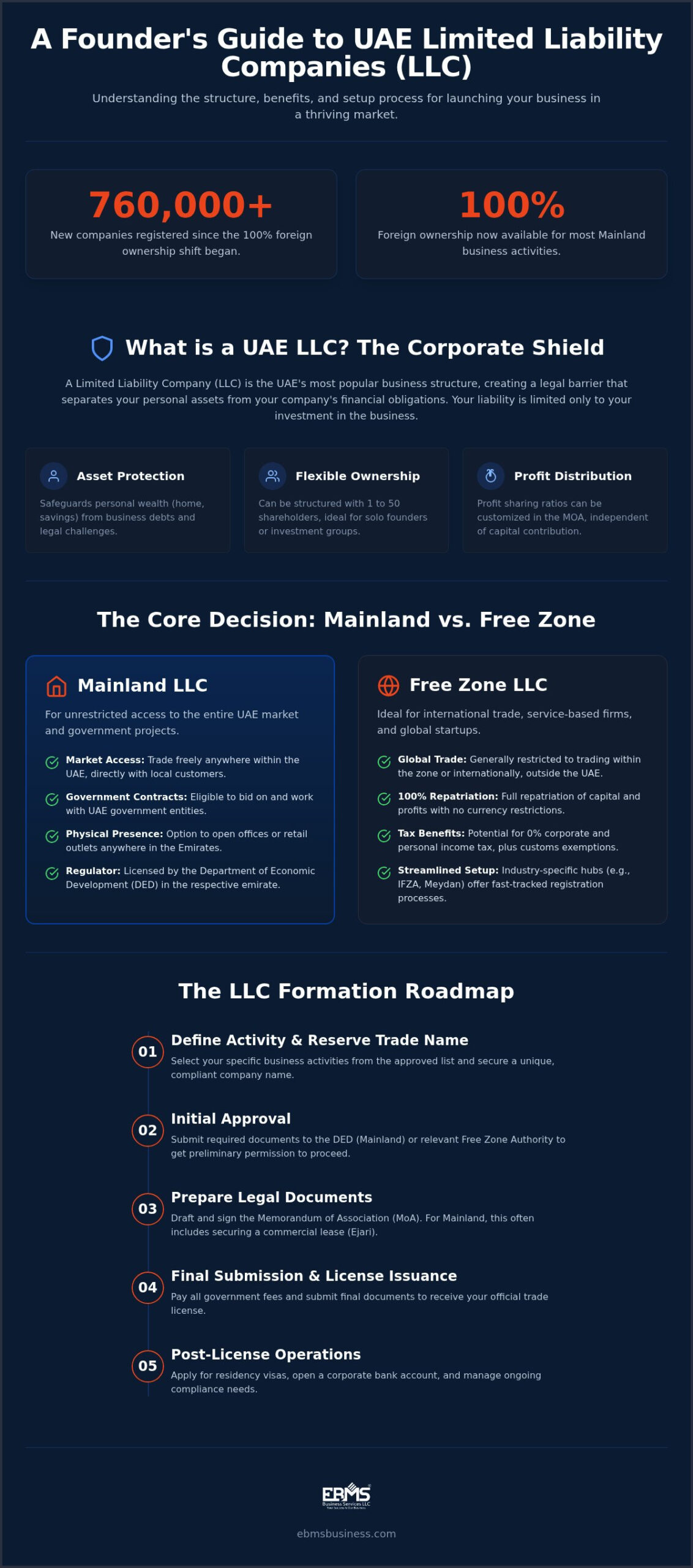
Did you know that nearly 760,000 new companies have registered in the UAE since the shift to 100% foreign ownership began? In 2025 alone, 250,000 entrepreneurs chose this region to launch their ventures, proving that the landscape for a UAE llc has never been more rewarding. Whether you’re a seasoned investor or a first-time founder, the current momentum of the non-oil economy offers a stable foundation for long-term growth.
We understand that the path to incorporation often feels clouded by confusion over Mainland versus Free Zone jurisdictions and the fear of hidden administrative costs. It’s common to feel a sense of anxiety regarding corporate bank account hurdles or the latest 2026 tax compliance standards. You want a clear direction that protects your personal assets while giving you full control over your business future.
This guide provides the exact steps, requirements, and benefits of forming a Limited Liability Company to ensure your venture is built on solid ground. We’ll explore the roadmap for setup, from initial approvals to residency visas, so you can move from inquiry to readiness without the stress. By the end of this guide, you’ll have the clarity needed to scale your business with confidence in a globally compliant market.
Key Takeaways
- Understand how a Limited Liability Company creates a robust legal barrier between your personal wealth and your business obligations.
- Compare the strategic advantages of Mainland and Free Zone setups to determine which jurisdiction aligns with your growth targets.
- Master the step-by-step roadmap for trade name reservation and activity selection to avoid common administrative delays.
- Learn how to leverage current regulations to maintain 100% foreign ownership of your UAE llc while trading across the Emirates.
- Gain insights into managing “Day 2” operations, including digital infrastructure and ongoing compliance, to ensure long-term stability.
What is an LLC? Understanding Limited Liability in the UAE
Have you ever wondered how to protect your personal savings while launching a bold new venture? In the Emirates, a Limited Liability Company, or llc, serves as the most reliable vehicle for this purpose. It creates a robust corporate shield that separates your personal assets, such as your home or private bank accounts, from the liabilities of the business. If the company encounters debt or legal challenges, your personal liability is strictly limited to your share in the company capital. This separation is why the structure remains the top choice for startups and SMEs looking to establish a secure presence.
The Legal Foundation of a UAE LLC
The strength of this structure comes from a clear UAE Corporate Law Overview, which establishes the company as a separate legal person. This means the entity can enter contracts, own property, and sue or be sued in its own name. To formalize this, shareholders sign a Memorandum of Association (MoA). This document is vital. It outlines the rights of each partner, the distribution of capital, and the management powers within the firm. It’s the primary document UAE courts look at when resolving internal disputes or verifying ownership.
Benefits of Choosing an LLC Structure
One of the biggest draws for investors is the flexibility this model offers. You can have anywhere from one to 50 shareholders, making it ideal for both solo founders and larger investment groups. Unlike many international versions of the structure found in the US or UK, the UAE allows for unique profit-sharing arrangements. Partners can agree to distribute profits in ratios that don’t necessarily match their capital contributions. This makes Dubai mainland company formation particularly attractive for ventures where one partner provides the capital and another provides technical expertise.
Transferring shares is also a structured and transparent process. If you decide to exit or bring in new investors, the law provides a clear path for share transfers through the relevant licensing authorities. This scalability ensures that your business can evolve as the market changes. While the core concept of limited liability is global, the UAE llc is specifically tuned to support the region’s rapid economic growth and diverse investor needs. It balances legal protection with the operational freedom required to scale a business effectively.
UAE LLC Structures: Mainland vs. Free Zone Explained
Choosing the right jurisdiction is the most critical decision you’ll make when forming your UAE venture. While both structures offer limited liability, their geographic reach and operational rules differ significantly. Since the landmark changes in 2021, the landscape has shifted, making the mainland a direct competitor to free zones for many international investors. It’s no longer a simple choice between ownership and market access, as both paths now offer compelling advantages for global entrepreneurs.
Mainland LLC: Trading Without Limits
A mainland llc is registered with the Department of Economic Development (DED) and allows you to trade anywhere in the UAE, including with government entities. This structure is essential if your business model involves local retail, distribution, or bidding on public contracts. Following the update to Foreign Investment Regulations, most commercial and industrial activities now allow for 100% foreign ownership. This removes the previous requirement for a local Emirati partner to hold 51% of the shares. If you’re looking for Dubai mainland company formation, you’ll benefit from the ability to open physical offices and warehouses anywhere in the country. The DED acts as the primary regulator, ensuring that all businesses meet the necessary safety and operational standards before granting a license.
Free Zone LLC: The Expat Entrepreneur’s Choice
Free zones are dedicated economic hubs designed for specific industries. Setting up a Free Zone business is often the preferred route for startups and service-based firms that primarily trade internationally. Hubs like IFZA, Meydan, or RAKEZ offer streamlined registration and the repatriation of 100% of capital and profits. While these entities are generally restricted to trading within their specific zone or outside the UAE, they offer a 0% corporate tax rate on qualifying income. This makes them highly tax-efficient for global consultants, tech firms, and creative agencies. Each zone has its own independent authority, which often means faster processing times and industry-specific support services tailored to your niche.
Understanding these nuances ensures you don’t face unexpected restrictions later. Whether you need the broad reach of the mainland or the specialized ecosystem of a free zone, the right choice depends on your specific business activities. If you aren’t sure which path fits your 2026 goals, you can always reach out to our team for a personalized consultation to explore your options. We focus on providing clarity so you can focus on growth.
Key Requirements for LLC Formation in 2026
Setting up a UAE llc requires precision during the planning stage to ensure your business aligns with the latest regulatory standards. While the process is streamlined, missing a single documentation step can lead to delays in your trade license issuance. Success starts with a clear understanding of your operational needs and the specific legal mandates for 2026.
Defining Your Business and Identity
Your first task is matching your intended operations to the official list of business activities. Each activity carries specific licensing requirements, and choosing the wrong one can limit your ability to trade or open a bank account later. Once your activities are set, you must reserve a trade name. The UAE has strict naming rules: you cannot use religious references, names of existing brands, or offensive language. If you’re using your own name, it must be your full name without abbreviations.
Shareholder and Management Roles
A standard company structure typically involves between 2 and 50 shareholders. You’ll need to appoint a Manager whose name appears on the license. This individual is responsible for the daily operations and legal standing of the firm. It’s vital to draft a robust Memorandum of Association (MoA) that clearly defines these roles. This document must be attested by a notary public to be legally binding in UAE courts. The MoA serves as the foundation for your corporate governance and shareholder rights.
Premises and Documentation Checklist
Having a physical presence is a mandatory requirement for most jurisdictions. Whether you choose a physical office with an Ejari (lease contract) or a virtual office package in a free zone, you must have a registered address. To begin the application, you’ll need a specific set of documents:
- Clear passport copies of all shareholders and managers.
- Copies of entry stamps or current UAE residency visas.
- A signed initial approval from the relevant licensing authority.
- The trade name reservation certificate.
Regulatory Compliance and 2026 Tax Rules
The regulatory environment has shifted toward greater transparency and compliance. All new entities are now required to register for Corporate Tax with the Federal Tax Authority, even if they anticipate income below the AED 375,000 threshold. While a 0% rate applies to taxable income up to that amount, registration is not optional. Additionally, some industries require external approvals from bodies like the Ministry of Economy or the Central Bank before the final license is granted. Staying ahead of these requirements ensures your incorporation remains stress-free and fully compliant with the latest laws, and firms like Bin Hamad Mathew Joseph and Associates Chartered Accountants can provide the expert guidance needed to navigate these auditing and tax obligations.
How to Set Up Your LLC: A Step-by-Step Process
Ready to turn your business vision into a reality? The formation of a UAE llc follows a logical sequence designed to verify your operational readiness and legal standing. While the steps are structured, the speed of execution often depends on having your documentation prepared in advance. It’s a journey that moves from conceptual planning to physical presence.
Step 1: Define Activities and Jurisdiction. Your journey begins by selecting the specific activities for your new llc and deciding between a Mainland or Free Zone setup. This choice is vital because it dictates the regulator you’ll work with and the geographic scope of your trade.
Step 2: Reserve Your Trade Name. Once your path is chosen, you’ll apply for trade name reservation and initial approval. This step confirms that the authorities have no objection to you starting your business under your chosen name. It’s the first official nod from the government.
Step 3: Draft the Memorandum of Association. You’ll then draft the MoA, which outlines ownership and management. For mainland companies, this must be signed in front of a notary public or via an electronic signature system. This document is the legal heart of your company.
Step 4: Secure Business Premises. Every entity needs a registered address. For mainland firms, you’ll finalize a lease agreement and obtain an Ejari. Free zone companies will secure a lease through their respective zone authority. This physical link is mandatory for license issuance.
Step 5: Final Submission. After paying the required license fees and submitting the collected documents, you’ll receive your Trade License. This is the moment your company becomes a legal entity capable of trading in the market.
Navigating the Visa and Emirates ID Process
Obtaining your license is just the beginning of your residency journey. You’ll then transition into the visa phase, which involves applying for investor or employment visas for yourself and your team. This process includes a medical fitness test and biometrics for your Emirates ID. For high-net-worth investors and specific professionals, exploring Golden Visa options can provide long-term stability without the need for frequent renewals.
PRO Services: Simplifying Government Liaison
The administrative work of business setup can be complex and time-consuming. PRO services act as your direct link to government departments, managing the opening of labor and immigration files once your license is issued. They ensure that your company remains compliant by handling timely license renewals and document attestations throughout the year. Using an expert facilitator removes the friction of dealing with multiple ministries. If you’re ready to start your journey without the administrative stress, contact our team today to begin the process.
Beyond Incorporation: Managing Your LLC with EBMS
Opening a business account is often cited as the most difficult hurdle in the Emirates. Banks follow rigorous Know Your Customer (KYC) protocols to ensure global compliance, which can be overwhelming for new investors. We provide dedicated assistance with bank account opening in UAE, helping you prepare the necessary corporate profiles and financial projections that banks require. Once your account is active, you must integrate accounting software that supports the 5% VAT rate and the 9% corporate tax framework. Since all businesses must now register with the Federal Tax Authority, having these systems in place from day one prevents costly errors during tax filing periods. It’s about building a foundation of financial honesty and precision.
Digital and IT Support for New LLCs
Establishing a professional online presence is no longer optional. It’s the first thing potential clients and partners look for when verifying your brand. Through our specialized IT services, we help you secure your domain, set up secure corporate emails, and implement CRM systems tailored to the local market. Your digital infrastructure should be as stable as your legal one. We focus on removing the technical obstacles that often distract founders from their core mission. Whether you’re setting up internal communication tools or launching a customer-facing website, we ensure your tech stack is ready for 2026 standards.
Building Your Future in the UAE Market
Navigating the complexities of business setup in a foreign market can feel overwhelming, but the rewards of establishing a UAE llc are significant. As we’ve explored, the journey begins with a strategic choice between Mainland and Free Zone jurisdictions. This decision dictates your trading freedom and tax obligations for years to come. By ensuring your documentation is precise and your “Day 2” operations are ready for 2026 compliance standards, you protect your assets while positioning your venture for rapid growth.
Success in this region depends on having a partner who understands the local landscape’s nuances. Since our establishment in 2015, we’ve acted as a trusted navigator for international investors across both Mainland and Free Zone environments. Our multilingual team provides the clarity needed to remove administrative obstacles, allowing you to focus on your core business objectives. Whether you’re a solo entrepreneur or a scaling SME, we’re here to ensure your transition into the UAE market is stress-free and transparent.
Ready to take the next step? Get Expert Assistance with Your UAE LLC Formation and secure your company’s foundation today. The Emirates offer a world-class platform for innovation; it’s time to make your mark.
Frequently Asked Questions
What is the minimum capital required for an LLC in the UAE?
There is no fixed minimum share capital for a mainland llc in the UAE, provided the capital is sufficient to achieve the company’s objectives. However, certain activities or specific free zones may mandate a specific amount. You’ll need to declare the capital in your Memorandum of Association. While you don’t always have to deposit this in a bank immediately, it’s vital to consult a professional to ensure your structure meets the requirements of your chosen jurisdiction.
Can an expat own 100% of a Mainland LLC in 2026?
Yes, expats can legally hold 100% ownership of a mainland company for the vast majority of commercial and industrial activities. This major shift in the Commercial Companies Law has transformed the region into a more competitive global hub. While some strategic sectors still require local participation, most entrepreneurs now enjoy full control over their ventures. It’s always best to verify your specific activity against the latest list of approved categories to confirm your eligibility for full ownership.
How long does it take to form an LLC in the UAE?
The timeline for formation typically ranges from a few days to three weeks. If you choose a free zone with pre-approved packages, you might receive your license in under a week. Mainland setups often take slightly longer because they require approvals from the Department of Economic Development and potentially other ministries. Factors like trade name availability and how quickly you secure an office lease will also impact the speed. We recommend preparing your documents early to avoid delays.
Do I need a local sponsor for my LLC setup?
For most business types, you no longer need a local Emirati sponsor to hold a majority stake in your company. The requirement for a local service agent may still apply to certain professional licenses, but they don’t own shares in your business. This transparency allows you to retain full operational and financial control. Since regulations can vary between emirates, we suggest checking the specific requirements for your activity to see if any local involvement is still mandatory.
Is an LLC in a Free Zone exempt from UAE Corporate Tax?
What are the annual renewal requirements for a UAE LLC?
Your company must renew its trade license annually to remain legally operational. This process involves renewing your office lease agreement and updating your registration with the relevant licensing authority. As of January 2026, authorities have increased scrutiny on renewals, often requiring corporate bank statements or proof of an active office. Staying on top of these dates is critical because late renewals can result in fines or the suspension of your company’s immigration and labor files.
Can an LLC have only one shareholder?
Yes, a UAE limited liability company can be formed with a single shareholder. This structure, often called a Single Member LLC, allows an individual or a single corporate entity to own 100% of the shares. It provides the same limited liability protection as a multi-partner firm. This is an excellent option for solo entrepreneurs who want to protect their personal assets while maintaining total authority over their business decisions and profit distribution without the need for partners.
What is the difference between a Trade License and an LLC?
An llc refers to the legal structure and ownership framework of your business, while a Trade License is the actual permit that allows you to conduct specific activities. Think of the company as the legal person and the license as its permission to work. You cannot have a trade license without a registered legal entity. Your license will list your approved activities and the jurisdiction where you’re allowed to operate, while your corporate documents define your shareholders and managers.