

A UAE mainland company is licensed by the Department of Economic Development (DED), and foreign nationals can own 100% of a company in most business sectors. When working with EBMS Business Services LLC, the core benefits of a mainland company setup include the ability to serve customers across the UAE, while the business activity and legal structure shape its licensing and office requirements. Strategic-impact sectors can have UAE national participation requirements.
Before choosing a structure, weigh the benefits of mainland company setup against the practical requirements. This guide covers the setup process, office and capital considerations, and costs that depend on your activity and company form. It also compares mainland, free zone and offshore options so you can assess which best fits your target market, operations and plans to trade in the UAE.
Key Takeaways
- Match your licence category and business activity to the work you plan to do, and account for any additional government approvals the activity may require.
- Plan office space around your operating needs and visa sponsorship capacity; the office size can affect how many visas the company can sponsor.
- Separate the capital rules for an LLC from those for other legal forms before setting your budget. A Dubai mainland LLC has no mandatory minimum capital.
- Consider mainland eligibility for government contracts when comparing structures, alongside where you intend to trade and whether you need UAE residence visas.
- Use the mainland, free zone and offshore comparison to identify which structure best fits your target market and planned activities.
1. How to Setup a Mainland Company in Dubai?
Start by choosing the business activity, legal form and ownership structure. Dubai mainland companies obtain licences through the Department of Economic Development (DED). Your activity determines the licence category and may require approvals from other government authorities. Next, reserve a trade name, prepare the application documents and complete the licensing steps. For example, a tourism operator should ensure the proposed activities match the licence before applying.
Ownership conditions can vary by business activity and legal structure, so foreign founders should check the requirements before applying. This gives overseas founders direct ownership and access to customers across the UAE mainland. A local sponsor is not mandatory for every company, so the old 51% local ownership arrangement is no longer a blanket rule. However, ownership conditions depend on the activity and legal form, not simply the founder’s nationality.
Strategic-impact sectors are an important exception. Cabinet Decision No. 55 of 2021 identifies sectors where UAE national participation remains required. If an activity falls within a strategic-impact sector, the company’s ownership or governance arrangements must reflect that requirement. Check the activity classification before finalising shareholder terms, signing documents or opening a bank account. This sequence helps prevent a mismatch between the proposed ownership and licence application.
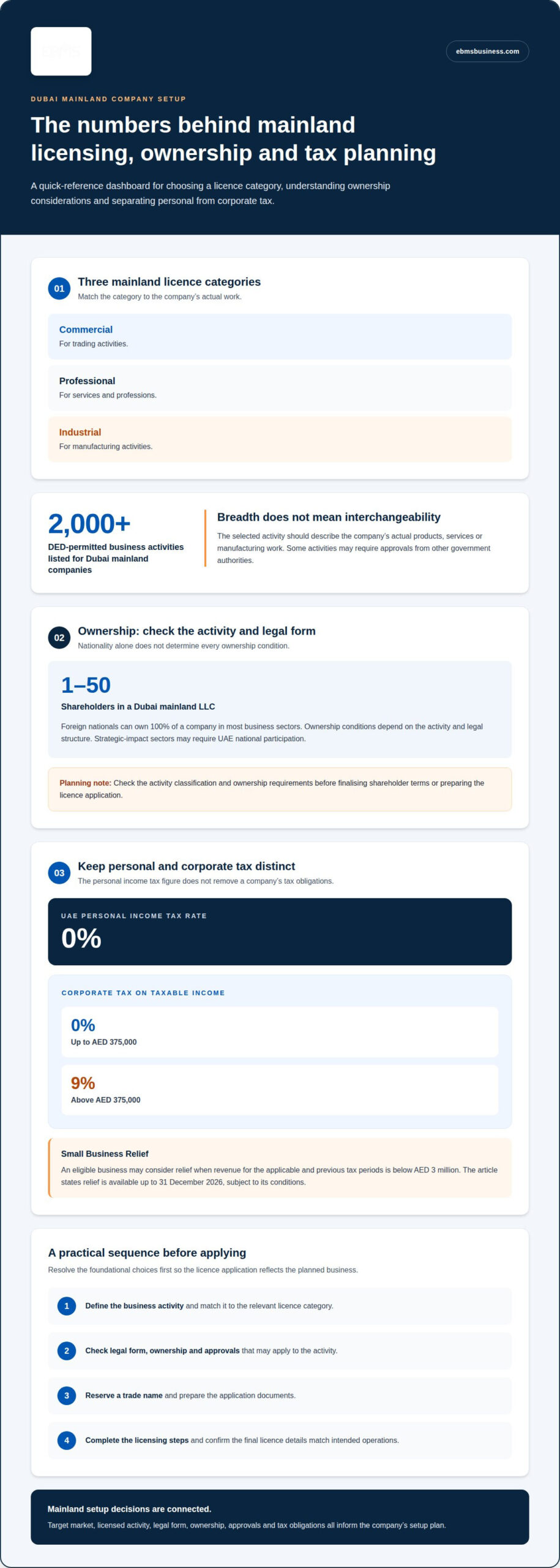
Tax treatment also matters to foreign owners. The UAE has a 0% personal income tax rate, but that does not remove a company’s corporate tax obligations. Corporate tax is 0% on taxable income up to AED 375,000 and 9% above that threshold. An eligible business may also consider Small Business Relief when revenue for the applicable and previous tax periods is below AED 3 million. Relief is available up to 31st December 2026, subject to its conditions.
What ongoing renewal, accounting and compliance requirements apply to Dubai mainland companies? Companies must keep their trade licences current and maintain accounting records for financial reporting and tax obligations. They must also meet the activity-specific approval and filing requirements that apply to their structure and operations.
What are common risks or disadvantages of setting up a Dubai mainland company? Office requirements, external approvals and activity-specific ownership conditions can add costs or administrative work. Applications may also be delayed if the licence activity, shareholder documents and actual business plans do not align.
For a practical formation sequence, settle the activity and ownership questions first, then prepare the application and supporting documents. Check that the final licence details match your intended operations before arranging premises or applying for a bank account. This helps clarify where mainland access supports the business and where regulations require careful planning.
2. Choosing a structure based on target market and business activity
Choose a jurisdiction by mapping where your customers are and what the company will do. A mainland structure can suit businesses planning to trade within the UAE or seeking to operate outside a free zone. For example, an investor targeting customers across Dubai and other emirates can compare mainland licensing with the planned sales and services. This links market access to the licence, rather than treating legal form as a standalone choice.
Dubai mainland licences fall into three categories: commercial for trading, professional for services and professions, and industrial for manufacturing. Describe the company’s actual work in plain language, then match each activity to the relevant category. If the business will trade goods and provide a separate service, check whether the proposed licence covers both. Some activities also require approvals from other government authorities, which can affect the application sequence.
Activity availability is broad, with more than 2,000 DED-permitted business activities listed for Dubai mainland companies. That range helps investors assess options across the emirate’s economy, but it does not make every activity interchangeable. The selected licence should reflect the actual services, products or manufacturing work. Compare the activity description with the company’s operating plan before settling the legal structure or preparing corporate documents.
Legal form shapes how ownership and governance are recorded. A Dubai mainland LLC may have between 1 and 50 shareholders. This can suit a single founder or a group of investors, provided the proposed business activity and ownership arrangements align. By contrast, choosing a licence category identifies the type of work, while choosing the legal form establishes how the company is constituted. Treat these as connected decisions, not substitutes.
Recent amendments to the UAE Commercial Companies Law provide a route for a free zone company to move to the mainland without liquidation. This may suit a business whose target market or operating needs have changed. Before planning a transfer, compare the existing licensed activities with mainland requirements, then review the new legal structure and approval steps. A change in jurisdiction should address a clear business need, such as serving mainland customers directly.
Make the choice practical: define your target market, list each revenue-generating activity, select the matching licence category, then assess the legal form and required approvals. If most customers are in the UAE mainland, consider whether a mainland licence fits your sales model. If operations are designed around a free zone, compare that structure’s conditions before committing. This approach connects ownership, activity and market access to the company’s actual plans.
3. Office space and minimum capital requirements
A Dubai mainland company needs physical office space, so include premises in the formation plan from the outset. The office may support daily operations, client meetings or specialist work, depending on the licensed activity. Compare location, lease terms and practical access before committing. A retail business, for instance, may prioritise customer access, while a back-office operation may have different workspace needs.
Office size can affect visa sponsorship capacity. A typical guideline is one visa per 80-100 square feet of office space. Treat this as a planning reference, not a guarantee of visa allocation. The company’s activity, premises and applicable requirements also matter. Estimate the space needed for staff and operations first, then consider how the expected visa needs fit that footprint.
For a Dubai lease, align the premises documents with the company’s registered details and application requirements. Ejari is associated with tenancy registration in Dubai, so account for it alongside the lease when preparing office documents. Make sure the address, tenant details and business arrangement are consistent across the lease and company records. A mismatch can complicate administrative steps or delay use of the premises.
Capital depends on the legal form. A Dubai mainland LLC has no mandatory minimum capital. By contrast, private joint stock companies require minimum capital of AED 5 million under Federal Decree Law No. (32) of 2021. These are different legal structures, so don’t treat the joint stock company threshold as an LLC requirement. Choose the form based on ownership, governance and business needs.
Keep share capital separate from operating funds. Even where an LLC has no mandatory minimum, budget for rent, fit-out, equipment, staff and working capital. The lease can also affect flexibility: a larger space may support more visa capacity, while a smaller office may suit lean operations. Activity or property-related restrictions can influence the final choice.
Formation costs depend on the licence activity, legal structure, office lease, external approvals and visa requirements. Build your budget around these components rather than treating the licence as the only expense. For example, a manufacturing business may need different premises from a professional consultancy. This keeps your Dubai setup grounded in the actual operating model.
Before signing, match the proposed office to the activity, expected staffing and required documentation. Then review the lease and capital structure alongside the licence application. Entrepreneurs planning mainland company formation can use the Dubai mainland company formation process as a reference point while organising these decisions.
4. Access to government and semi-government tenders
A Dubai mainland company is eligible to bid for government contracts. This can matter when a business serves public entities, departments or government-linked organisations. Eligibility to bid does not mean a contract is guaranteed: the opportunity must match the company’s licensed activities and capabilities. For example, a supplier should ensure its licence covers the goods or services specified in a tender before preparing a proposal.
Mainland market access can also support companies serving customers across the UAE. A Dubai-based business can plan sales and service delivery for customers in other emirates, while its licensed activities determine what it may do. This may suit a company pursuing both public contracts and private-sector work. Serving customers in different locations still requires practical planning, including how staff, equipment and customer support will reach each project.
For each tender, begin with the published scope and participation terms. Compare the requested work with the company’s licence, then identify deliverables, submission deadlines and evaluation criteria in the tender documents. A facilities supplier, for example, should distinguish a request for equipment from one that also requires installation or ongoing service. This helps assess whether the licensed activities and operating capacity match the contract.
Government and semi-government procurement processes can vary by issuing entity and contract. Read each tender’s documents closely instead of assuming one department’s process applies elsewhere. Record the submission format, required declarations, response date and named contact point. These details shape a complete bid and help the company decide whether to pursue the opportunity or focus on a contract that better matches its scope.
Company formation decisions can support tender readiness. Keep the trade licence, corporate details and ownership records consistent across business documents and bid materials. Assign responsibility for tracking tender notices, coordinating technical responses and reviewing commercial terms. For a company pursuing public and private work, this process connects its Dubai licence to a clear account of what it can deliver across the emirates.
Before committing resources to a proposal, compare the contract’s location, delivery schedule and operational demands with current capacity. A tender covering several emirates may require a different staffing plan from a Dubai-only project. Also consider whether the contract aligns with the company’s licensed activities and existing commitments. This makes pursuing a tender a deliberate business decision, not simply an extension of market access.
Mainland trading rights and eligibility to bid for government tenders can support a broader sales strategy, but each opportunity has its own terms. Review the licence scope first, then assess the tender’s requirements and delivery expectations. This sequence helps investors connect company formation with a realistic plan to serve UAE customers and respond to public-sector opportunities.
5. Comparing mainland, free zone, and offshore structures
The right structure depends on where the company will trade and whom it needs to serve. A mainland business can suit operations targeting customers across the UAE, while a free zone may fit a business organised around a specific zone. Offshore companies serve a different purpose and cannot trade commercially inside the UAE. Compare customer access, operating location and visa needs before deciding.
Dubai mainland and free zone companies can both sponsor visas, while offshore companies cannot. Mainland companies need physical office space in Dubai, and office size can affect visa sponsorship capacity. Premises and licence arrangements for a free zone company depend on the chosen zone. For example, a business that needs staff based in Dubai should weigh its premises and visa needs alongside its sales plan.
Foreign ownership is available at 100% in Dubai free zones. Foreign nationals can also own 100% of mainland companies in most business sectors, with strategic-impact sectors subject to UAE national participation requirements. Both structures allow 100% repatriation of capital and profits. These points matter to investors, but ownership alone doesn’t determine which jurisdiction best supports contracts, customers or day-to-day operations.
Trading access is a key distinction. A mainland company can serve the UAE market directly, while a free zone company cannot trade directly with the UAE mainland without a local distributor. An offshore company cannot conduct commercial trade inside the UAE. A consultancy targeting mainland clients should consider these limits before choosing a free zone or offshore structure.
Tax treatment also differs. Qualifying income of a UAE free zone company is taxed at 0%, subject to UAE free zone person rules. Mainland companies follow UAE corporate tax rules, including the applicable taxable-income threshold and rate. Offshore status doesn’t by itself establish that a company qualifies for a particular tax treatment. Compare the company’s actual income and activities with the relevant rules.
Dubai mainland vs free zone company: benefits, costs, and restrictions? Mainland offers direct UAE market access, while free zones provide 100% foreign ownership and a 0% rate on qualifying income subject to the applicable rules. Setup costs depend on the activity, jurisdiction, office arrangements, approvals and visa needs; pricing is provided after a quote request.
Choose offshore only when the planned work fits its role, rather than expecting UAE commercial trading rights or residence visas. If your business needs UAE customers and visa sponsorship, compare mainland and free zone conditions first. Then match the licence, premises and target market to your operating plan. This helps identify the structure that supports the company’s actual contracts and growth plans.
EBMS Business Services: Free Zone Company Setup
EBMS Business Services LLC can help you assess Free Zone Company Setup, Mainland Company Setup or Offshore Company Setup against your planned activities and target market. If you’re weighing mainland access against free zone operations, clarify where you expect to trade, whether you need physical premises and how each structure fits your business model. Then discuss the most relevant formation route with EBMS Business Services LLC. Entrepreneurs and investors considering UAE Golden Visa Processing can also explore it as part of their broader plans. Contact EBMS Business Services LLC to discuss which setup route fits your priorities.
Choose a setup path that supports your next stage
Your company structure should support the business you intend to build, not just the paperwork needed to launch it. Use your expected customers, operating model and growth plans to decide which route deserves closer attention. The benefits of mainland company setup in Dubai matter most when the structure fits your commercial plans; a different approach may suit another operating model better.
Before moving forward, turn your priorities into a clear plan for activities, ownership and operations. EBMS Business Services LLC can help you assess the setup route against those priorities, so you can make your next decision with greater clarity.
Contact EBMS Business Services LLC to discuss your business setup plans and take the next step with a clearer direction.
Frequently Asked Questions
How to Setup a Mainland Company in Dubai?
Register the company with Dubai’s Department of Economic Development after identifying its licensed activity and legal form. The Ministry of Economy gives an official company registration time of four days with the Department of Economic Development. This covers registration, not every operational task. Keep shareholder names, activity descriptions and company records consistent, particularly if you use contracts prepared before the licence is issued.
Mainland Company vs Free Zone: Which is Right for You?
A mainland structure is generally a better fit when planned operations require direct trading with UAE mainland customers; a free zone may suit a business organised around a zone. Before deciding, map a typical sale: identify the contracting entity, customer location and where services or goods will be delivered. This can reveal practical restrictions that a comparison based only on licence labels or ownership may miss.
Can I sponsor employees and dependents?
A mainland company can sponsor employees, but a company licence alone does not establish that every employee or dependent qualifies for residence sponsorship. Treat employee and family applications as separate immigration matters, with eligibility depending on the applicable criteria for each person. For workforce planning, distinguish the company’s role as an employer from an individual’s eligibility to sponsor family members. These questions are related, but not interchangeable.
Can a mainland company apply for government projects?
Yes, a Dubai mainland company is eligible to bid for government contracts. Prepare a tender file that keeps the current licence, corporate details and bid documents consistent. Assign someone to track deadlines and maintain a record of submissions and clarifications. This helps the company respond accurately and assess each opportunity against its delivery capacity, rather than treating eligibility as a reason to bid for every project.
How long does it take to set up?
The Ministry of Economy gives an official company registration time of four days with the Department of Economic Development. Registration is one milestone, not a complete measure of readiness to trade. Document preparation, activity-related approvals and operational arrangements can affect the overall schedule. Plan around the outstanding tasks for your activity, and distinguish the company’s registration date from the point when it can begin its intended operations.
What 6 factors should I consider to get maximum advantage of mainland business?
Consider six practical factors: customer demand, sales channels, delivery capacity, partner responsibilities, cash-flow planning and the ability to adapt operations as demand changes. For example, a business expecting large contracts should compare staffing and supplier capacity with likely delivery commitments. These factors help test whether a mainland structure supports the operating plan, beyond simply asking whether the company can obtain a licence.
What are the tax benefits?
The UAE’s tax framework can provide a 0% rate on taxable income up to AED 375,000, with a 9% rate above that threshold. Tax planning should also distinguish revenue from taxable income and assess whether Small Business Relief applies to the company’s circumstances. Treat the relief as a tax eligibility question, not as a blanket exemption for every company or tax period.
What are the benefits of setting up a mainland company in Dubai?
A mainland structure can support businesses that need to contract directly with UAE mainland customers or pursue government opportunities. It can also suit companies whose operating model depends on serving customers across the country. To assess whether these advantages matter to your business, examine where customers are located, how contracts are awarded and whether the planned activities fit your revenue model.