

If you could build a legal fortress around your international assets while streamlining global trade, would you still settle for a traditional domestic structure? Many investors find the prospect of an offshore company setup intimidating, especially when faced with the UAE’s evolving tax landscape and strict compliance standards. It’s natural to feel concerned about the technicalities of opening corporate bank accounts or the nuances of economic substance regulations. You likely want the benefits of global reach without the administrative headache of potential non-compliance.
We understand that the shift from a “tax-free” to a “tax-compliant” environment in 2026 requires a more strategic approach than in years past. This guide provides the clarity you need to navigate these complexities, ensuring your entity is both secure and fully aligned with federal laws. Whether you’re looking to protect intellectual property or hold international real estate, we’ll help demystify the requirements for you. Our goal is to make the prospect of starting your venture feel achievable rather than overwhelming.
In the following sections, we’ll explore the strategic differences between jurisdictions like RAKICC and JAFZA, the mandatory role of a licensed registered agent, and the practical steps to optimizing your tax efficiency. You’ll discover how to build a foundation that supports long-term stability and growth while removing the obstacles to your global success.
Key Takeaways
- Learn why the UAE remains a premier hub for offshore company setup by offering a balance of 100% foreign ownership and access to global markets.
- Understand the critical differences between RAKICC and JAFZA, including which jurisdiction uniquely allows your entity to hold freehold property in Dubai.
- Discover how to optimize your tax efficiency and safeguard your personal wealth within the 2026 UAE Corporate Tax framework.
- Identify the essential documents and procedural steps required to incorporate your entity smoothly while meeting all modern regulatory standards.
- Gain clarity on maintaining long-term operational stability through Economic Substance Regulations and the mandatory use of a licensed registered agent.
Understanding Offshore Company Setup in the UAE Context
What exactly is a UAE offshore company? In simple terms, it’s a non-resident entity incorporated in a jurisdiction that allows it to conduct business outside its borders. For investors looking for a secure foundation, Understanding Offshore Companies is the first step toward effective asset protection. The UAE has solidified its position as a premier global hub for an offshore company setup in 2026, offering a stable legal environment and world-class infrastructure. This jurisdiction is particularly favored because it bridges the gap between Eastern and Western markets. Most investors use these entities for international consulting, holding intellectual property, or managing global investments while keeping their corporate liabilities separate from personal assets. It’s a strategic architectural layer that provides a robust shield for your wealth.
Offshore vs. Free Zone: Which is Right for You?
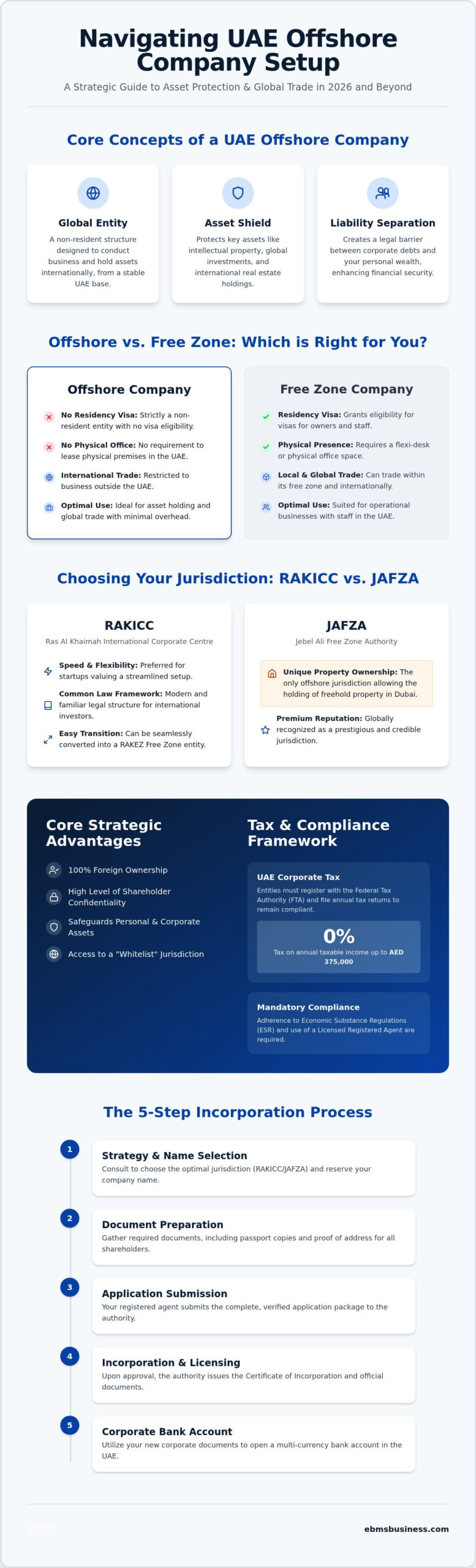
It’s common for entrepreneurs to confuse these two structures, yet they serve very different purposes. A Free Zone company is a resident entity that requires a physical office or a flexi-desk and grants eligibility for UAE residency visas. In contrast, an offshore company is strictly non-resident. You won’t get a visa with this setup, and you aren’t required to rent physical office space. While a Free Zone entity can trade within the UAE under specific conditions, an offshore entity is restricted to international markets. If your goal is simply to hold assets or manage global trade with minimal administrative overhead, the offshore route is usually the more efficient choice. It allows you to maintain a presence in a reputable jurisdiction without the costs associated with physical premises or staff visas.
Key Characteristics of a UAE Offshore Entity
One of the most attractive features of this structure is the allowance for 100% foreign ownership. You don’t need a local partner or sponsor to maintain full control of your business. Additionally, these entities offer a high level of confidentiality. While you must disclose the Ultimate Beneficial Owner (UBO) to the authorities, this information isn’t available to the general public. Regarding taxes, all offshore companies must now register with the Federal Tax Authority under the 2026 regulations. You’ll likely benefit from a 0% rate on taxable income up to AED 375,000, but you must still file an annual return. This ensures your offshore company setup remains fully compliant with international transparency standards and avoids the pitfalls of being labeled a “tax haven” by global regulators. By choosing the UAE, you’re opting for a jurisdiction that balances privacy with modern financial integrity.
Primary Jurisdictions for Offshore Formation: RAKICC and JAFZA
Choosing the right jurisdiction is the most critical decision in your offshore company setup. While investors often compare the UAE to traditional hubs like the BVI or Seychelles, the UAE has become a more attractive alternative in 2026. This shift is driven by its “whitelist” status and commitment to international transparency. Unlike many other global jurisdictions, both RAKICC and JAFZA require you to appoint a licensed Registered Agent. This agent isn’t just a formality; they act as your essential navigator, handling all communications with the authorities and ensuring your entity remains in good standing. By choosing the UAE, you’re placing your assets in a stable, reputable environment that avoids the stigma often associated with older tax havens.
RAKICC: Versatility and Efficiency
RAK International Corporate Centre (RAKICC) is the preferred choice for startups and entrepreneurs who value speed and flexibility. It operates under a modern legal framework that incorporates common law features, making it easy for international investors to understand. One of its standout features is the ability to easily transition into other structures. If your business grows and you require a physical presence, you can explore RAKEZ support to expand your operations seamlessly. RAKICC requires only one director and offers a streamlined incorporation process that focuses on ease of use without compromising on legal protections.
JAFZA Offshore: Prestige and Real Estate
If your investment strategy focuses on Dubai real estate, Jebel Ali Free Zone (JAFZA) is the premium choice. It’s the only offshore jurisdiction currently permitted to directly own freehold property in designated areas of Dubai. This makes it an indispensable tool for high-net-worth individuals looking to consolidate property portfolios under a single corporate umbrella. JAFZA maintains rigorous regulatory standards, which provides a high level of international prestige. While the administrative requirements are more detailed, such as the mandate for at least two directors, the long-term benefits for asset protection are significant. It’s a structure designed for those who prioritize reputation and specific property rights over pure setup speed.
Maintaining operational stability requires staying ahead of regulatory expectations. Just as the U.S. government conducts Offshore Incident Investigations to ensure safety and compliance in their maritime sectors, UAE authorities monitor offshore entities to uphold financial integrity. Ensuring your company meets every local mandate is vital for long-term success. If you’re struggling to decide which path fits your goals, we can help you evaluate your options to ensure a secure and compliant foundation.
Strategic Benefits of an Offshore Structure in 2026
Why do seasoned investors prioritize this specific corporate architecture? An offshore company setup offers more than just operational ease; it provides a legal framework for multi-jurisdictional growth and risk mitigation. In the 2026 regulatory environment, the focus has shifted toward tax-compliant efficiency. While the UAE now implements a federal corporate tax, the threshold of AED 375,000 for a 0% rate remains a significant advantage for holding companies and international consultants. It’s a strategic way to manage global income while ensuring your business remains fully aligned with modern financial standards.
Asset Protection and Wealth Management
Protecting your hard-earned wealth is a priority for any serious investor. By placing international assets, such as intellectual property or global stock portfolios, under an offshore entity, you create a vital legal separation. If your primary business faces litigation or personal liabilities arise, these specific assets remain shielded within the corporate fortress. This structure is particularly effective for those managing investments across different continents. For those looking to further cement their ties to the region, combining this corporate strategy with a UAE Golden Visa for long-term investors can provide both personal and professional stability. It’s a dual approach that secures your business interests and your family’s future simultaneously.
Privacy in the Age of Transparency
Privacy is often misunderstood in the modern financial world. While the UAE complies with international standards, it still offers a high degree of confidentiality for legitimate business owners. You must disclose the Ultimate Beneficial Owner (UBO) to the registry, but this data isn’t available for public browsing. This balance is crucial. History shows that poor due diligence or using non-compliant jurisdictions can lead to issues, as documented in the ICIJ Offshore Leaks Database. By choosing a reputable jurisdiction like the UAE, you benefit from a system that values your privacy while maintaining the transparency required by global banks. It’s about being “clean” and “private” at the same time.
Succession planning is another vital benefit that often goes overlooked. Transferring shares in an offshore company is typically much simpler than dealing with the probate laws of multiple countries. You can define exactly how your assets are distributed, ensuring a smooth transition for the next generation. This ease of share transfer makes the UAE a strategic choice for families looking to manage wealth across borders without the typical administrative friction. It ensures your legacy remains intact and your assets continue to grow without interruption.
The Step-by-Step Process of Offshore Incorporation
How do you move from a strategic investment plan to a legally recognized entity? The process of an offshore company setup follows a logical, highly structured progression that ensures every legal requirement is met with precision. It begins with selecting the jurisdiction that aligns with your goals, whether that’s RAKICC for flexibility or JAFZA for property holding. Once you’ve defined your business activities, the next phase involves name reservation and the preparation of core documents like your passport copy and proof of address. These initial steps set the foundation for your entity’s legal standing in the UAE.
A critical requirement that many investors overlook is the mandatory appointment of a Registered Agent. Under UAE law, you cannot interact directly with offshore registrars; you must work through a licensed intermediary. EBMS Business Services acts as your essential navigator in this role, bridging the gap between your vision and the regulatory authorities. We handle the technical filing and ensure your application meets the registrar’s standards. Once the submission is reviewed, the registrar issues your Certificate of Incorporation, Memorandum of Association, and Articles of Association, officially bringing your entity to life.
Critical Documentation and Attestation
The documentation phase is where many applications face delays. For individual shareholders, a valid passport and a recent utility bill are standard. However, if a corporate entity is the shareholder, you’ll need its Certificate of Incorporation and Memorandum of Association, all of which must be attested by the UAE Embassy in the country of origin and the Ministry of Foreign Affairs in the UAE. Navigating this “paper trail” is complex, and missing a single stamp can halt the entire process. To ensure you stay on track, it’s helpful to review common Dubai company formation mistakes before you begin your submission.
Corporate Bank Account Opening Assistance
Securing a corporate bank account is often the most significant hurdle in an offshore company setup. Banks in the UAE maintain rigorous Know Your Customer (KYC) standards and will scrutinize your business profile, source of wealth, and expected transaction volumes. While no provider can guarantee an account opening, we focus on preparing a robust business profile that addresses these compliance needs head-on. We help you organize your documentation to present a transparent and professional image to financial institutions. If you need support with this vital phase, you can explore our corporate bank account assistance in the UAE to better understand the current banking landscape.
Our team is dedicated to removing the administrative friction from your journey, allowing you to focus on your global investment strategy. If you’re ready to begin your incorporation with a partner who understands the nuances of 2026 regulations, we invite you to contact our consultants for personalized guidance.
Maintaining Compliance and Operational Stability
Annual renewals are another critical pillar of stability. You must renew your license and maintain your Registered Agent every year. For a RAKICC offshore company, the government renewal fee is AED 3,950, while a JAFZA offshore company requires AED 2,500. These fees are separate from your agent’s professional service fees. Failing to renew on time can lead to significant penalties or even the striking off of your company from the register. This would effectively freeze your corporate bank accounts and halt your global trade operations. We help you track these deadlines to ensure your foundations remain secure.
Does your business perform activities like holding intellectual property or distribution? If so, you must demonstrate sufficient economic substance. While separate ESR filings ended in 2023, you now confirm your compliance within your annual Corporate Tax return framework. For those looking to benefit from the UAE’s extensive tax treaty network, obtaining a Tax Residency Certificate (TRC) is a strategic move. This document proves your entity is managed and controlled from within the UAE, helping you avoid double taxation in other jurisdictions. To ensure you meet all fiscal obligations, we provide specialized VAT registration and compliance services tailored to international structures.
The EBMS Advantage: Your End-to-End Partner
We believe a successful venture needs more than a one-time registration. As your Registered Agent, EBMS provides the continuity required to navigate changing regulations without stress. We don’t just file your paperwork; we act as a proactive partner invested in your future stability. This includes helping you scale your digital presence through website and IT support for global ventures. By choosing a long-term partnership, you ensure that administrative burdens never distract you from your core investment goals. We provide the clarity and precision needed to keep your global operations running smoothly and transparently.
Securing Your Global Business Foundation
Building a successful international structure requires more than just a registration document. It demands a clear understanding of how jurisdictions like RAKICC and JAFZA align with your specific goals, whether you’re prioritizing flexibility or Dubai property ownership. As we’ve explored, maintaining a compliant offshore company setup is the only way to ensure long-term asset protection and operational ease in 2026. By staying ahead of corporate tax filings and economic substance requirements, you protect your venture from unnecessary administrative friction and legal risks.
Since 2015, EBMS Business Services has served as a trusted UAE consultancy, providing the expert guidance needed to demystify complex legal frameworks. We specialize in end-to-end support, from the initial selection of your jurisdiction to facilitating corporate banking and ongoing PRO services. You don’t have to face these regulatory hurdles alone. Our team is ready to help you build a stable, transparent foundation that supports your global trade aspirations with precision and clarity.
If you’re ready to take the next step toward a secure corporate future, contact EBMS Business Services today for a personalized offshore setup consultation. We look forward to helping your business thrive in the UAE’s world-class environment.
Frequently Asked Questions
Can an offshore company in the UAE obtain a residency visa for its owners?
No, an offshore company doesn’t grant eligibility for UAE residency visas. Because these are non-resident entities designed for international operations, they don’t require physical office space or local staff. If your goal includes obtaining a residency visa, you should consider a Free Zone or Mainland structure instead. We can guide you through the specific requirements if your business needs evolve from a simple holding structure to an active local presence.
What is the main difference between an offshore company and a free zone company?
The primary distinction lies in residency and trade permissions. A Free Zone entity is a resident company that requires a physical office and allows for UAE residency visas. An offshore company setup is strictly non-resident, meaning it can’t trade within the UAE or rent local premises. While Free Zone firms can conduct business locally under certain conditions, offshore companies are restricted to managing international assets and global trade from outside the country.
Is it possible for a UAE offshore company to own local real estate?
Yes, but this privilege is currently restricted to Jebel Ali Free Zone (JAFZA) offshore companies. These specific entities are the only offshore structures permitted to directly own freehold property in designated areas of Dubai. Other jurisdictions, such as RAKICC, are excellent for holding international assets or intellectual property but don’t possess the legal standing to hold UAE real estate. It’s a critical factor to consider when choosing your jurisdiction.
How long does the offshore company setup process typically take in 2026?
The incorporation phase typically takes between three to seven working days once all attested documents are submitted to the registrar. However, you should account for additional time for document attestation in your home country. While the legal formation is relatively fast, opening a corporate bank account is a separate process that can take several weeks or months, depending on your business profile and the bank’s internal compliance review.
Do I need to be physically present in the UAE to set up an offshore company?
No, physical presence isn’t a requirement for the incorporation phase. You can complete the entire offshore company setup remotely through a licensed Registered Agent like EBMS. We handle the submission of your attested documents and coordinate with the relevant authorities on your behalf. You’ll only need to consider travel if it’s required by your chosen bank during the final stages of opening your corporate account, though some banks offer digital alternatives.
What are the annual renewal requirements for a RAKICC offshore entity?
To keep your RAKICC entity active, you must pay an annual government renewal fee of AED 3,950 and maintain a licensed Registered Agent. You’re also required to submit an annual corporate tax return to the Federal Tax Authority, even if your income qualifies for the 0% rate. Keeping your bookkeeping records updated is vital for this process. We help you track these deadlines to ensure your company remains in good standing without penalties.
Can a UAE offshore company open a multi-currency corporate bank account?
Yes, offshore entities can apply for multi-currency corporate bank accounts to facilitate international trade. These accounts typically support major currencies like USD, EUR, and GBP alongside the local AED. You’ll need to provide a comprehensive business profile and proof of the source of wealth to meet strict KYC standards. While we provide extensive assistance with the application process, the final approval always rests with the bank’s compliance department.
Are offshore companies exempt from the UAE’s 9% corporate tax?
Offshore companies aren’t exempt; they fall within the scope of the UAE Federal Decree-Law No. 47 on Corporate Tax. While a 0% tax rate applies to taxable income up to AED 375,000, any profit exceeding this threshold is subject to the standard 9% rate. All entities must register with the Federal Tax Authority and file annual returns. This ensures the UAE maintains its reputation as a transparent and compliant international financial center.