

What if the most challenging part of launching your venture isn’t the licensing or the office space, but simply getting a bank to say “yes”? For many entrepreneurs, opening a business bank account in uae feels like solving a puzzle where the pieces keep changing. You’re likely prepared for the paperwork, but the reality of strict KYC procedures and high minimum balance requirements can be a significant drain on your momentum. It’s frustrating to wait weeks for a response only to face a generic rejection letter.
We understand that you need a reliable financial partner to start trading, not a series of administrative roadblocks. This guide provides a clear roadmap to master the complexities of UAE corporate banking in 2026. We’ll show you how to satisfy compliance officers, choose between traditional and digital-first banks, and organize your documentation to avoid common pitfalls. By the end of this article, you’ll have a structured checklist and the professional strategies needed to secure your account with confidence. Whether you’re setting up in a Free Zone or on the Mainland, the path to a successful application starts with the right preparation.
Key Takeaways
- Understand the 2026 regulatory landscape and how the Central Bank of the UAE’s compliance standards influence your application.
- Identify the core legal documents required for opening a business bank account in uae, tailored to both Mainland and Free Zone entities.
- Compare traditional banking models against agile digital platforms to find the right balance between service levels and transaction fees.
- Master the two-phase application timeline to ensure your documents are vetted correctly before meeting with bank representatives.
- Recognize common compliance red flags and learn how professional pre-screening can help you avoid frequent document rejections.
The Landscape of Corporate Banking in the UAE (2026)
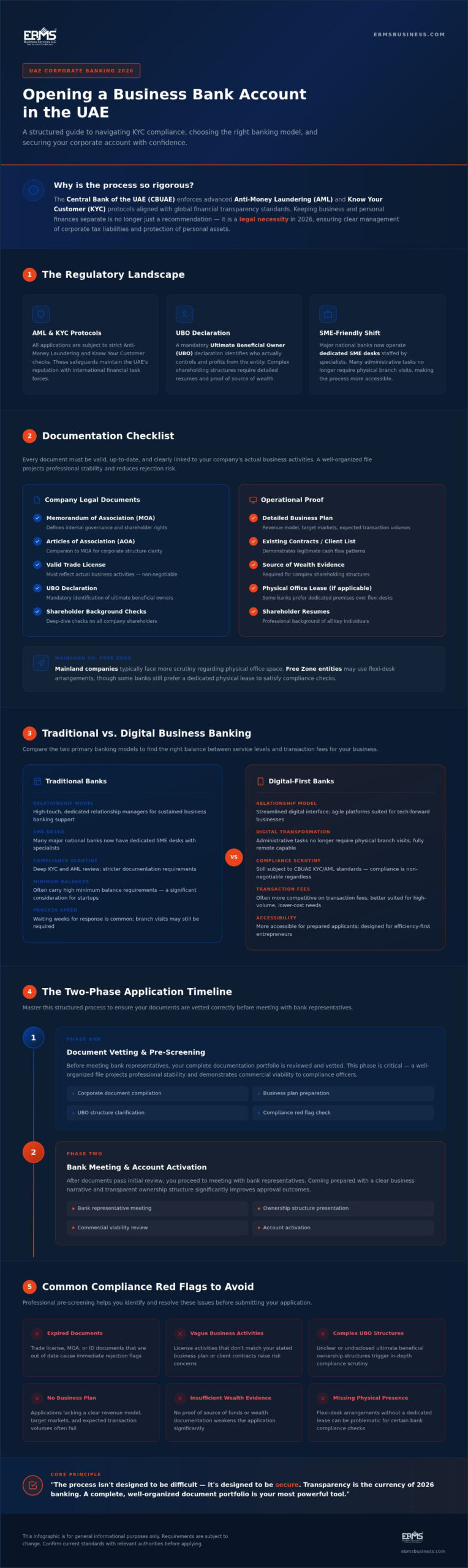
The UAE has established itself as a premier global financial hub. This reputation rests on a foundation of rigorous stability and strict adherence to international compliance standards. If you’re looking at opening a business bank account in uae, it’s helpful to understand that the process isn’t designed to be difficult; it’s designed to be secure. The banking sector in the United Arab Emirates operates under the watchful eye of the Central Bank of the UAE (CBUAE), which has implemented advanced standards for 2026 to align with global financial transparency.
Why are the rules so strict? The CBUAE prioritizes Anti-Money Laundering (AML) and Know Your Customer (KYC) protocols to protect the economy from illicit activities. These aren’t just bureaucratic hurdles. They’re essential safeguards that maintain the country’s reputation with international financial task forces. For entrepreneurs, keeping business and personal finances separate is no longer just a recommendation; it’s a legal necessity. It ensures clear boundaries for managing corporate tax liabilities and protects your personal assets from business risks.
Regulatory Standards and Compliance
Banks now perform deep-dive background checks on all company shareholders. This includes a mandatory Ultimate Beneficial Owner (UBO) declaration, which identifies who actually controls and profits from the entity. Transparency is the currency of 2026 banking. If your shareholding structure is complex, expect the bank to request detailed resumes and proof of the source of wealth. This level of scrutiny ensures that every business operating in the Emirates contributes to a stable and trustworthy marketplace.
The Shift Toward SME-Friendly Banking
Despite the heavy focus on compliance, there’s a clear move toward supporting small and medium enterprises. Many major national banks have launched dedicated SME desks staffed by specialists who understand the unique cash flow patterns of startups. Digital transformation has also changed the game. You’ll find that many administrative tasks no longer require physical branch visits. Whether you prefer a high-touch relationship or a streamlined digital interface, opening a business bank account in uae has become more accessible for those who come prepared with the right documentation. This evolution reflects the UAE’s commitment to fostering an environment where new businesses can thrive while maintaining world-class security.
Essential Requirements and Documentation for Business Accounts
Preparation is the absolute foundation of success when opening a business bank account in uae. While the regulatory environment is robust, having a complete and transparent document portfolio significantly reduces the risk of rejection. Banks operate under strict Central Bank of the UAE regulations; this means every piece of paper must be valid, up-to-date, and clearly linked to your company’s activities. It’s helpful to view these requirements as a way to build trust with your future financial partner from the very first interaction. A well-organized file doesn’t just save time; it projects professional stability.
Company Legal Documents
Every bank requires a core set of corporate documents to verify your legal standing and ownership structure. You’ll need your Memorandum of Association (MOA) and Articles of Association (AOA), which define your company’s internal governance and shareholder rights. A valid Trade License is non-negotiable. Whether you are pursuing Mainland company formation or looking into UAE Free Zone company formation, your license must reflect your actual business activities. Mainland companies typically face more scrutiny regarding physical office space, whereas Free Zone entities might use flexi-desk options, though some banks still prefer a dedicated physical lease to satisfy compliance checks.
Operational Proof and Business Profile
Banks aren’t just looking at your legal status; they’re evaluating your commercial viability and risk profile. The process of opening a business bank account in uae often hinges on the quality of your business plan. This document should outline your revenue model, target markets, and expected transaction volumes. Providing proof of existing contracts or a list of potential clients helps the bank understand your cash flow patterns. This transparency demonstrates that your business is a legitimate, functioning entity rather than a shell company. If you have a professional website or marketing materials, include them to show your brand’s presence in the market.
Shareholder and Director Information
The bank must verify the identity and professional background of everyone involved in the business. This includes passport copies, Emirates IDs, and residence visas for all shareholders and directors. If you hold a UAE Golden Visa, ensure your documentation reflects this status because it often signals long-term commitment to the region. You’ll also need to provide personal bank statements for the last three to six months to prove your financial standing. If the paperwork feels overwhelming, you can consult with our specialists to ensure your file is bank-ready before submission.
Choosing Between Traditional and Digital Business Banking
Which banking model aligns best with your long-term operational goals? As you move forward with opening a business bank account in uae, you’ll find the market is broadly divided between established national banks and agile digital platforms. Each path offers distinct advantages depending on your company’s size, industry, and transaction frequency. Much like choosing the right business bank account in any global market, the decision in the Emirates requires a careful balance of cost versus capability.
Analyzing fee structures is a vital first step. Traditional banks often rely on monthly maintenance fees or require a high average balance to waive them. In contrast, digital platforms might offer transaction-based pricing, which can be more predictable for businesses with lower volumes. It’s also important to consider your need for credit. While digital platforms excel at daily payments, traditional banks still hold the advantage when it comes to securing corporate loans or complex trade finance facilities.
The Case for Traditional National Banks
Traditional banks remain the bedrock of the local economy. They provide a level of personal touch that digital systems can’t always replicate, such as having a dedicated relationship manager. This person acts as your advocate within the bank, which is vital for complex international trades or when you need bespoke credit facilities. If your business involves heavy cash handling or requires complex trade finance options like Letters of Credit, a traditional institution is likely your best fit. However, be prepared for higher minimum balance requirements. These often range from 25,000 د.إ to over 200,000 د.إ depending on the account tier you select.
The Rise of UAE Digital Business Platforms
Digital business platforms have surged in popularity by addressing the pain points of startups and SMEs. They typically offer much faster onboarding and lower entry barriers. Many of these platforms don’t require the steep monthly minimum balances that traditional banks demand, making them ideal for freelancers, consultants, or new e-commerce ventures. They also tend to integrate seamlessly with modern accounting software and digital tools. While they may lack physical branches, their efficiency in handling daily digital transactions is unmatched. For those prioritizing speed and simplicity, opening a business bank account in uae through a digital provider can be a strategic move to get your operations running without delay.
The Step-by-Step Application Process and Timeline
How long should you expect to wait before your corporate account is fully operational? Even with the rise of digital-first platforms mentioned previously, the process of opening a business bank account in uae remains a methodical journey that requires patience and precision. In 2026, the timeline is dictated by the depth of the bank’s compliance review and the clarity of your initial submission. Understanding this sequence allows you to plan your first transactions and vendor payments with greater accuracy, ensuring your business launch remains on schedule.
Phase 1 & 2: Preparation and Submission
The first stage involves a final vetting of your documents against the specific requirements of your chosen bank. If your corporate papers were issued outside the Emirates, they must be attested by the UAE Ministry of Foreign Affairs before submission. This is a non-negotiable step that often causes delays if overlooked. Once the paperwork is verified, you’ll move to the submission phase, which typically involves a meeting with a bank representative, either in person or via a secure digital portal. During this interaction, you’ll sign the formal application and provide the bank with a clear overview of your expected business activities. To navigate this stage without friction, our corporate bank account assistance ensures your application is polished and compliance-ready before it reaches the bank’s desk.
Phase 3 & 4: Compliance and Finalization
After submission, the bank’s internal compliance team begins a deep-dive review. In the current 2026 landscape, this phase typically lasts between two and four weeks. During this period, the bank may issue “queries” or requests for additional information regarding your shareholders or business model. Responding to these promptly is essential. If a query remains unanswered for several days, the bank may archive your application, forcing you to start the process again. Being aware of common UAE company formation mistakes can help you anticipate these questions and avoid unnecessary setbacks. Once approval is granted, you’ll receive your IBAN and instructions for activating your digital banking credentials. If you want to ensure your timeline remains as short as possible, contact our team today for expert guidance through every phase.
Overcoming Common Challenges with Professional Assistance
What if you have secured your trade license and office space, but still face a rejection letter from the bank? It is a common frustration for many entrepreneurs. The process of opening a business bank account in uae is often the final, most complex piece of the setup puzzle. Banks operate with high levels of autonomy, meaning they can decline applications even if your business is fully legal. Understanding why these rejections happen is the first step toward securing a successful approval. Most obstacles stem from perceived risks that can be mitigated with the right presentation and transparent documentation.
Once your account is active, the work doesn’t stop there. Maintaining your corporate account requires ongoing diligence. You must ensure your trade license is renewed annually and that the bank receives updated copies of your shareholders’ visas and Emirates IDs. If these documents expire, banks may freeze your account, which can halt your operations overnight. Professional support ensures that these administrative foundations remain solid so you can focus entirely on your company’s growth.
Mitigating Rejection Risks
Why do banks flag certain applications? Red flags often include “high-risk” business activities, such as gold trading, crypto-assets, or certain industrial sectors. Nationalities that are under increased international scrutiny can also face more intensive vetting. However, a “high-risk” label doesn’t mean an automatic “no.” It simply means the bank requires a more detailed business profile and a cleaner professional history for all shareholders. When you present a well-prepared profile that clearly explains your revenue streams and target markets, you change the bank’s perception from a risk to a viable commercial partner. A strong business plan acts as your advocate when you aren’t in the room with the compliance officer.
How EBMS Supports Your Banking Journey
EBMS Business Services LLC has been acting as a “Trusted Navigator” for international investors since 2015. We understand the internal dialogue of compliance departments and use this insight to bridge the gap between your business and the bank. Our team handles the administrative heavy lifting, from vetting your shareholder resumes to ensuring your MOA meets specific banking standards. We leverage our established relationships with major UAE banking institutions to ensure your file reaches the right desk. We don’t just hand you a list of requirements; we walk you through the entire process to ensure a stress-free experience. If you are ready to remove the uncertainty from your application, you can contact EBMS for personalized assistance. Let us help you build a stable financial foundation for your venture in the Emirates.
Establishing Your Financial Foundation in the Emirates
Success in the Emirates depends on a solid financial foundation. We have explored the strict regulatory landscape and the essential documents required to build trust with local institutions. Whether you opt for a traditional national bank with a dedicated relationship manager or an agile digital platform, your preparation determines your speed to market. It’s clear that opening a business bank account in uae is a process of precision, not just paperwork. By organizing your documentation early and understanding the compliance “why,” you remove the most significant hurdle to your company’s growth.
Since 2015, EBMS Business Services LLC has provided the expert guidance needed to simplify these complexities. We offer transparent documentary support and end-to-end business setup solutions to ensure your application meets every compliance standard from the start. You don’t have to face the banking puzzle alone. You can secure your UAE corporate bank account with professional assistance from EBMS and focus on what you do best: scaling your venture. The path to a successful business is ready for you, and with the right partner, your financial setup will be efficient and stress-free.
Frequently Asked Questions
Can I open a business bank account in the UAE without a residence visa?
Generally, yes, but it’s significantly harder. Most banks require at least one shareholder to have a UAE residence visa to satisfy KYC and AML protocols. Non-resident accounts often face higher minimum balance requirements and more intensive scrutiny regarding the source of funds. Having a residency visa demonstrates a long-term commitment to the local economy, which banks prefer for risk assessment. It’s often the deciding factor in whether an application moves forward.
What is the average minimum balance required for a UAE corporate account in 2026?
Minimum balance requirements vary greatly depending on the bank and the account tier. For SME accounts, you’ll typically find requirements ranging from 25,000 د.إ to 50,000 د.إ for basic digital or startup accounts. Larger traditional banks may require 200,000 د.إ or more for premium corporate services. Falling below these thresholds usually results in a monthly maintenance fee, so it’s vital to choose a tier that matches your cash flow and operational needs.
How long does it typically take to open a business bank account?
The timeline for opening a business bank account in uae usually spans two to four weeks. Digital platforms can sometimes activate accounts within a few business days if the documentation is straightforward. However, traditional banks involve a more comprehensive compliance review that includes background checks and document verification. If your corporate structure is complex or involves foreign shareholders, the process might extend to six weeks or more to satisfy all regulatory queries from compliance.
Do I need a physical office to open a business bank account in the UAE?
Yes, having a verifiable physical presence is a core requirement for most UAE banks. While some digital banks and specific Free Zone packages allow for flexi-desk arrangements, traditional institutions often require a physical office lease, such as an Ejari or a Free Zone lease agreement. This provides the bank with a physical point of contact and serves as proof that your company is a legitimate, functioning entity within the national marketplace.
Are digital banks in the UAE as safe as traditional banks?
Digital banks in the UAE are highly secure and operate under licenses granted by the Central Bank of the UAE. They must adhere to the same rigorous AML and KYC standards as traditional institutions. Many digital platforms are actually backed by major national banks, providing a blend of modern efficiency and established financial stability. Your deposits are protected by the same regulatory frameworks that govern the entire national banking sector, ensuring your funds are safe.
Can a Free Zone company open a bank account in the UAE Mainland?
Absolutely, Free Zone companies are eligible to open accounts with any Mainland or international bank operating in the UAE. There are no legal restrictions preventing a Free Zone entity from using Mainland banking services. However, the bank will still perform its own due diligence on your license and activities. Some banks may have specific departments or account types tailored specifically for Free Zone businesses to streamline the onboarding and documentation process for investors.
What happens if my business bank account application is rejected?
If your application for opening a business bank account in uae is rejected, the bank isn’t legally required to provide a specific reason. You should review your documentation for any inconsistencies or red flags, such as “high-risk” activities or incomplete business plans. It’s often possible to apply to a different bank if you address the potential issues in your profile. Seeking professional vetting before your next submission can significantly improve your chances of a successful outcome.
Is it possible to open a multi-currency business account in the UAE?
Yes, most corporate accounts in the UAE are multi-currency by default or allow you to add sub-accounts easily. The primary currency is the UAE Dirham (د.إ), but you can typically hold and trade in major global currencies like the Euro or British Pound. This is particularly beneficial for companies involved in international trade or those receiving payments from overseas clients, as it helps manage exchange rate risks effectively while facilitating global business growth.