

A move to the UAE doesn’t automatically mean closing your UK company. When relocating a UK business to the UAE post-Brexit, you can consider preserving the existing company through corporate migration, establishing a new UAE entity, or using a UAE branch to maintain one legal identity. The right route depends on your business activities, UK obligations and plans for operating in the region.
It’s understandable to want a clear answer before committing to a move. Company structure affects more than where your business is registered: it can shape licensing, tax considerations, banking arrangements and how you manage your UK presence. Brexit alone doesn’t determine which setup is right for your business.
This guide explains how to compare migration with forming a new company, and when a free zone or mainland setup may fit. It also outlines licensing, banking and relocation costs to consider, helping you approach the move with a clearer view of the decisions involved.
Key Takeaways
- Choose between moving the existing UK company, forming a new UAE entity, or keeping both structures based on your operational and legal priorities.
- Match a free zone or mainland setup to your licensed activities, customer base and plans for doing business in the UAE.
- Plan licensing, residency and corporate banking as connected parts of the move, with requirements shaped by your business and circumstances.
- Build a relocation budget around setup choices and practical needs such as documents, office arrangements and visas.
- Consider how Brexit, UK obligations and your longer-term regional plans affect whether relocation makes sense.
Do I need a free zone or a mainland company?
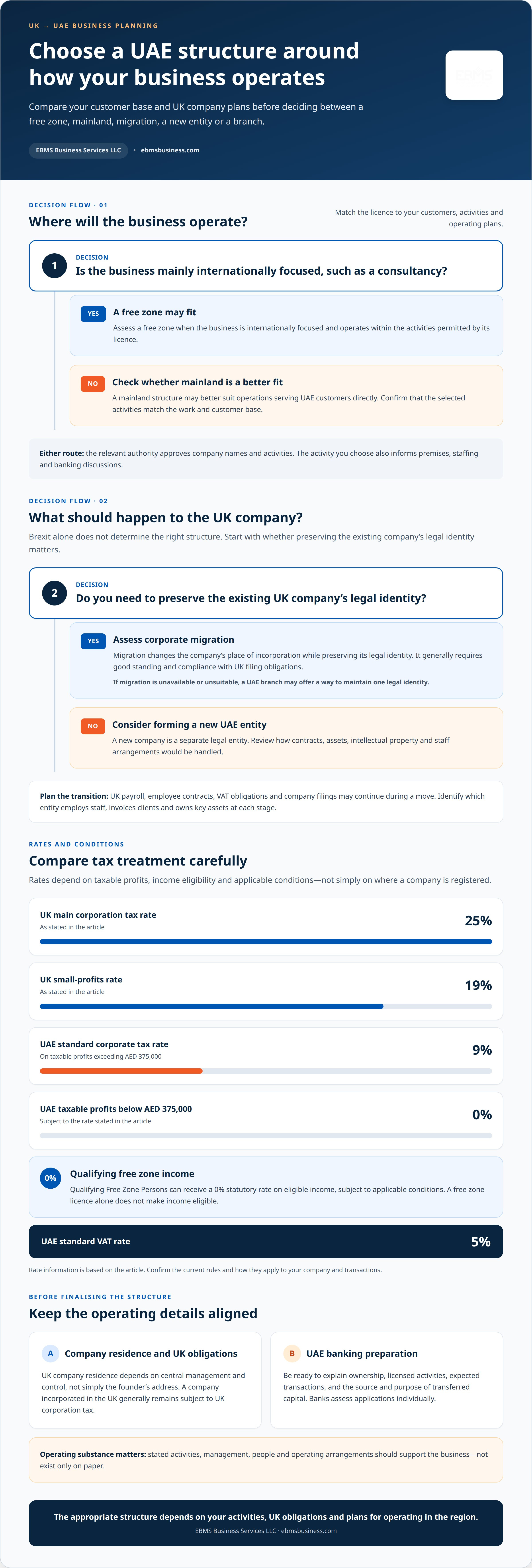
Choose a free zone or mainland company by matching the licence to your customers, activities and operating plans. A free zone may suit an internationally focused consultancy, while a mainland structure may better fit operations serving UAE customers directly. The relevant authority approves activities and company names, so align the proposed name with the business and its licensed work. A free zone company setup is one route to assess.
Compare corporate tax carefully rather than assuming relocation removes UK obligations. In the UK, the main corporation tax rate is 25%, while the small-profits rate is 19%. In the UAE, the standard rate is 9% on taxable profits exceeding AED 375,000, and taxable profits below that threshold are subject to 0%. Qualifying free zone persons can receive a 0% statutory rate on eligible income, according to the Federal Tax Authority. Eligibility depends on meeting the applicable conditions; a free zone licence alone does not establish that income qualifies. The UAE standard VAT rate is 5%, according to the Federal Tax Authority.
Corporate migration changes a company’s place of incorporation while preserving its legal identity. It differs from forming a new UAE company, which creates a separate legal entity and may require reviewing contracts, assets, intellectual property and staff arrangements. Migration generally requires good standing and compliance with UK filing obligations. If that route is unavailable or unsuitable, a new entity or UAE branch may offer a more practical structure.
After Brexit, the UK-UAE Double Taxation Convention remains relevant to eligible cross-border income. The treaty may provide a 0% withholding tax rate on dividends between treaty-resident companies, subject to applicable conditions, including the recipient’s status and circumstances. Confirm the current treaty position for the specific payment.
For UAE banking, prepare a clear account of ownership, licensed activities, expected transactions, and the source and purpose of transferred capital. Banks assess applications individually. The company’s operations should also match its stated activity: real management, people and operating arrangements should support the business rather than exist only on paper.
UK company residence depends on central management and control, not simply the founder’s address. A company incorporated in the UK generally remains subject to UK corporation tax; strategic decisions made from the UAE may also affect its tax position. Under the UK Statutory Residence Test, spending 183 days or more in the UK in a tax year makes a person automatically UK resident under the stated automatic UK test, according to HM Revenue & Customs.
Plan for legal, employment and operational risks before changing structures. UK payroll, employee contracts, VAT obligations and company filings may continue during the transition; closing a UK company doesn’t automatically settle them. Review UAE licensing, staffing, banking continuity and UK contracts involving employees or customers. A documented transition plan helps identify which entity employs staff, invoices clients and owns key assets at each stage.
UAE trade licence, residency visa, and corporate banking
A UAE trade licence defines the activities a company can legally conduct. Choose activities that match the work, customer base and operating model: a consultancy and a trading business need different activity selections. A free zone licence may suit a company operating within its permitted activities, while a mainland licence may fit businesses serving customers across the UAE. The chosen activity also informs premises, staffing and banking discussions.
Corporate tax treatment depends on taxable profit and income eligibility, not simply the company’s location. The UAE corporate tax framework is established under Federal Decree-Law No. 47 of 2022, according to UAE Legislation. The standard rate is 9% on taxable profits exceeding AED 375,000, while taxable profits below AED 375,000 are subject to 0%. Qualifying UAE Free Zone Persons can receive a 0% statutory corporate tax rate on eligible income, according to the Federal Tax Authority. That treatment depends on qualifying conditions and income type; a free zone licence alone does not secure it. Consider the company’s activities, customers and transaction flows when selecting its tax structure.
Corporate tax registration and filing are separate from licence issuance. Registration deadlines depend on the taxable person and, for certain juridical persons, the date of incorporation or establishment. Companies should check the applicable deadline under current Federal Tax Authority guidance rather than assume it falls 90 days after the financial year end. Eligible businesses may also consider Small Business Relief, which requires an election and applies to companies with revenue at or below AED 3 million. VAT is another separate obligation: mandatory registration begins at AED 375,000 of taxable supplies and imports over the past 12 months, or expected within the next 30 days. Voluntary registration is available from AED 187,500.
Residency planning depends on the founder’s role and chosen company structure. A founder can own a UAE free zone company under a zero-visa licence without UAE residency. An investor or partner visa is typically linked to company ownership, while an employment visa may apply when the UAE entity sponsors the person as an employee or executive. Visa processing times and travel requirements vary by route and circumstances. Confirm the current requirements and expected timeline with the relevant authority or service provider before making plans.
Corporate banking needs its own preparation. Banks assess company ownership, licensed activity, expected transactions and source of funds. A coherent business profile, supporting contracts and clear explanations of transactions help show how the account will support the UAE operation. Approval is a bank decision, not an automatic result of incorporation.
For a free zone licence and related setup planning, discuss your UAE requirements with a business setup professional.
Move my UK company to the UAE or start a new one?
A professional can map your UK company’s operations against your intended UAE activities, then compare migration with establishing a separate entity. This review connects registration choices with contracts, ownership, employees and your plans for operating in the Middle East.
Relocation and Entity Structures
Relocating a business means shifting some or all of its operations, ownership structure or legal registration from the UK to the UAE. Corporate migration specifically changes a company’s place of incorporation while preserving its legal identity. It therefore differs from creating a new UAE company and transferring selected operations.
A free zone or mainland company can conduct licensed operations under approved activities. An offshore entity may suit a holding or ownership purpose rather than day-to-day UAE trading. The structure matters because it determines which entity contracts with customers, conducts licensed activities and supports the company’s international position. Registration should reflect the actual business model, not only the owner’s preferred jurisdiction.
Choosing a Relocation Model
A full relocation moves the main operating position to the UAE. It may fit when management, staff, customers and commercial decisions will increasingly be based there. Any UK company migration or closure remains a separate legal and tax matter, so consider how contracts, assets and existing obligations will be handled before changing registration.
A dual structure keeps the UK company active while establishing a UAE entity for regional operations. For example, the UK company could retain UK-facing contracts while the UAE entity serves Middle East clients under its own licence. A holding structure separates ownership from operations, with one entity holding shares or assets while another conducts licensed business. Each model assigns different responsibilities for control, compliance and contracting.
Relocation Steps
A professional starts by mapping the UK entity’s shareholders, directors, activities, contracts and intended UAE operations. This helps compare migration, a dual structure and a holding arrangement against the company’s commercial plan. Good standing and compliance with UK statutory filings are generally relevant to corporate migration, making the existing company’s records important.
For UAE registration planning, a professional matches proposed activities to a suitable structure and licence. You may need to provide incorporation and constitutional documents, shareholder and director details, ownership records, financial information and key contracts. These materials help identify which assets, employees and agreements remain with the UK company or move to a UAE entity.
A professional can coordinate UAE formation and licensing, then align operational arrangements with the selected structure. Banking preparations and owner or staff residency needs can be considered alongside registration. UK tax, payroll and closure obligations remain separate workstreams, so the transition plan should identify which entity employs each person and invoices each customer.
Relocation costs and business setup pricing
Budget for a UK-to-UAE move in separate categories: UAE company formation, operational requirements, personal relocation and UK transition obligations. The chosen structure affects which costs apply. Free zone, mainland and offshore companies have different licensing and operating needs, while a dual structure may require maintaining UK and UAE entities at the same time.
UAE setup costs depend on the licence, approved activities, visa allocation, premises and other operational requirements. A company with several activities or employees may need a different setup from a founder-led business with a narrow activity scope. Treat these as planning factors, since they can affect the licence package, office arrangements and ongoing renewals.
Costs vary according to the specific case. Key cost factors include the jurisdiction, business activities, visa requirements, office arrangements and whether the move involves a new entity or multiple entities. Confirm the costs for your proposed setup before making financial commitments.
Timelines also vary according to the scope and requirements of the case. The figures of 5 to 15 working days for formation and three to six months for a complete UK-to-UAE business transition should not be treated as confirmed estimates. Formation concerns establishing the UAE company, whereas a transition can also involve UK contracts, staff, assets, banking and changes to day-to-day operations. Confirm expected timelines for your specific circumstances.
Include document preparation and relocation planning in your wider forecast. UK documents submitted for UAE formation may require apostille processing, and each document can add preparation time. Personal relocation may involve residency arrangements and Emirates ID procedures. The number of founders or employees moving, and the timing of their transition, shape the plan and its associated expenses.
Build a working budget around these categories:
- Formation: licence and registration requirements based on the UAE jurisdiction and activity.
- Operations: premises, staffing, banking and other needs tied to the business model.
- Transition: UK company obligations, contract changes, document preparation and asset transfers.
- Personal relocation: residency-related arrangements for owners and staff moving to the Emirates.
Include tax planning in the forecast too. UAE corporate tax applies to taxable profits under the federal framework, and qualifying free zone income is subject to specific conditions. A holding structure may also involve separate entities and accounting records. Map where income arises, which company earns it and which expenses it bears before estimating the cash available for operations.
For a more reliable forecast, have the proposed structure and activity list assessed before committing to premises or staffing. Compare the costs of operating one UAE entity with maintaining both UK and UAE companies, then account for the obligations attached to each. This makes the first-year budget more useful than considering a licence figure alone.
Post-Brexit reasons UK businesses may consider relocating to the UAE
Brexit changed the UK’s trading relationship with the European Union, but it doesn’t automatically require a business to relocate. Relocating a UK business to the UAE post-Brexit also doesn’t remove obligations connected to UK-EU customers, suppliers or contracts. Assess each market and contracting entity separately before deciding whether a UAE presence supports your plans.
The UAE may make commercial sense when a company wants a base closer to Middle Eastern customers, suppliers or partners. More than 5,000 British companies operate in the UAE, reflecting established commercial links between the two markets. A UAE entity can provide a local operating position, but its activities, customers and management arrangements should support that purpose.
Tax can influence the decision, but it isn’t a standalone reason to move. UAE corporate tax applies to taxable profits under the federal framework, and qualifying free zone income depends on specific conditions. The UAE doesn’t levy personal income tax, but a founder’s UK residency and the location of company decision-making can still affect UK tax obligations. Model both the entity’s position and the owner’s circumstances.
Market access is another consideration. A UK consultancy serving clients across the Gulf may benefit from a UAE-based team and contracts issued by a locally licensed entity. A business whose customers and staff remain in Britain may gain less from moving its operations. Identify where revenue comes from, who delivers the work and which entity will sign each contract before planning a transition.
Operational readiness matters as much as the headline tax position. A UAE company needs a licence that fits its actual activity, and its business profile must make sense to prospective banks. For example, a technology firm should be ready to explain its services, customer base, expected transactions and source of funds when applying for a corporate bank account. Incorporation alone doesn’t ensure banking approval or a ready-to-trade operation.
Brexit may prompt a review of supply chains, customer access and contract responsibilities, but the right response varies by business. A UK company could retain an EU-facing operation while establishing a UAE entity for regional growth. A dual structure can separate markets, but it also means managing records, contracts and compliance across both entities. Evaluate relocating a UK business to the UAE post-Brexit against the commercial purpose of the transition.
The practical takeaway is to compare the cost and purpose of each structure against your business plan for the next five to ten years. List target markets, staff locations, customer contracts, banking needs and management responsibilities. Then assess whether a full move, a UAE branch or a separate UAE company supports those plans without disrupting established UK or EU operations.
For guidance on assessing a UAE setup against your business plans, discuss your relocation options with a business setup professional.
EBMS Business Services LLC
EBMS Business Services LLC can help you assess the UAE company structure that fits your planned activities and operating model. Its Free Zone Company Setup, Mainland Company Setup and Offshore Company Setup services support different formation routes, whether you’re establishing an operating business or considering an offshore structure.
If residency planning is part of your move, EBMS also provides UAE Golden Visa Processing for eligible applicants. Company formation and residency are separate decisions, so consider each in light of your circumstances. For guidance on your UAE business setup plans, contact EBMS Business Services LLC.
Shape your next move with a clear plan
Relocating a UK business to the UAE post-Brexit is ultimately a decision about where you want the company to operate, serve customers and grow. Before changing the structure, define the role the UAE entity should play and how it will fit alongside your existing business. That clarity can keep commercial priorities at the centre of decisions about ownership, activities and transition.
There’s no single structure that suits every UK business. The right way forward depends on your goals, current commitments and plans for the UAE market. A considered plan gives you a stronger basis for moving from research to setup while keeping the implications for your business in view.
When you’re ready to discuss the setup options for your circumstances, speak with EBMS Business Services. A clear next step can make your UAE plans feel more manageable.
Frequently Asked Questions
Can I stop being UK tax resident by moving to the UAE?
Moving to the UAE alone doesn’t end UK tax residence; your circumstances under the UK Statutory Residence Test matter. Spending 183 days or more in the UK during a tax year makes a person automatically UK resident under the stated automatic UK test, according to HM Revenue & Customs. Your UK days, home, work and other UK connections can affect the assessment. Plan personal residency separately from your company’s registration.
Do I have to live in the UAE full-time?
No, not simply to own a UAE free zone company under a zero-visa licence. Company ownership and personal residency are separate considerations, so you may establish a company without moving to the UAE. If you want UAE residency, the suitable route depends on your circumstances and company role. Consider where you will actually live and work, since your UK presence can still affect your personal tax position.
First: can you actually leave the UK tax net?
Potentially, but moving your company or yourself doesn’t automatically end UK tax obligations. A UK-incorporated company generally remains subject to UK corporation tax, wherever its shareholders or directors live. Personal tax residence is assessed separately under the Statutory Residence Test. For example, a founder who continues living in the UK can remain liable to UK tax on salary and dividends from a UAE company.
How long does the whole move take?
The timing of a UK-to-UAE business transition depends on the structure, the relevant authorities and the circumstances of the business. Company formation is only one part of relocating an established operation. Banking arrangements and decisions about which entity will invoice customers can also affect the schedule. Confirm a case-specific estimate based on your plans and circumstances.
Second: will a UAE bank take on your profile?
A UAE bank assesses each application, so incorporation doesn’t guarantee an account. The bank may consider ownership, licensed activities, expected transaction patterns and source of funds. A UK consultancy with clear client contracts and a consistent explanation of incoming payments can present a clearer profile than an entity whose stated activity differs from its actual business. Prepare relevant corporate records and transaction details as part of the application.
What happens to my UK limited company when I move?
Your UK limited company doesn’t automatically close when you move to the UAE or establish a UAE entity. It may remain active, contract with UK customers and retain its existing filing and tax responsibilities. If you intend to stop using it, closure is a separate process from forming a UAE company. Before changing operations, identify which entity owns business assets, employs staff, invoices customers and fulfils existing contracts.
Can a UK company transfer its legal domicile or must it set up a UAE entity?
Corporate migration may allow a company to change its place of incorporation while preserving its legal identity, but it differs from establishing a new UAE entity. Migration generally requires the company to demonstrate good standing and compliance with filing requirements in its home jurisdiction. If migration doesn’t suit the company, it can establish a separate UAE entity and retain the UK company for existing activities or customer relationships.
What UAE business structures and free zones suit UK companies?
The right structure depends on the company’s licensed activities, customers and intended role in the UAE. A free zone or mainland company can conduct licensed operations under its approved activities. An offshore entity may suit a holding or ownership purpose rather than day-to-day UAE trading. For example, a UK firm expanding into the UAE could establish an operating entity while retaining its UK company for existing customers and contracts.