

With nearly 250,000 new companies established in the UAE in 2025 alone, the race for a foothold in the Middle East’s premier hub has reached an unprecedented pace. You likely understand that a successful business expansion in the UAE is no longer just about showing up; it’s about navigating a sophisticated landscape where the rules of the game are constantly evolving. Whether you’re weighing the merits of the mainland against one of the 40 plus free zones or managing the transition to mandatory electronic invoicing starting in July 2026, the technical complexity can feel daunting.
We believe that entering a new market should be a source of growth, not a source of stress. This roadmap provides a clear, professional guide to the 2026 regulatory environment, offering the clarity you need to make informed decisions about licensing and operational compliance. We’ll walk you through the strategic selection of jurisdictions, the nuances of securing a Golden Visa for long term stability, and the practical steps to achieve banking readiness. By the end of this guide, you’ll have a risk mitigated path to establishing a robust and compliant presence in the United Arab Emirates.
Key Takeaways
- Understand how to align your business expansion in Dubai with the D33 Economic Agenda to leverage the region’s long term growth and stability.
- Evaluate the strategic advantages of mainland versus free zone jurisdictions based on your specific operational needs and target market reach.
- Navigate the 2026 regulatory landscape with clarity on corporate tax registration, VAT compliance, and the new mandatory electronic invoicing standards.
- Identify the requirements for securing residency through the Golden Visa and the documentation necessary for opening a corporate bank account in the UAE.
- Follow a structured, phased roadmap to manage licensing and legal documentation, ensuring a risk mitigated entry into the UAE market.
The 2026 Landscape for Business Expansion in Dubai
Key Economic Drivers for the Current Year
Strategic Advantages of a UAE Presence
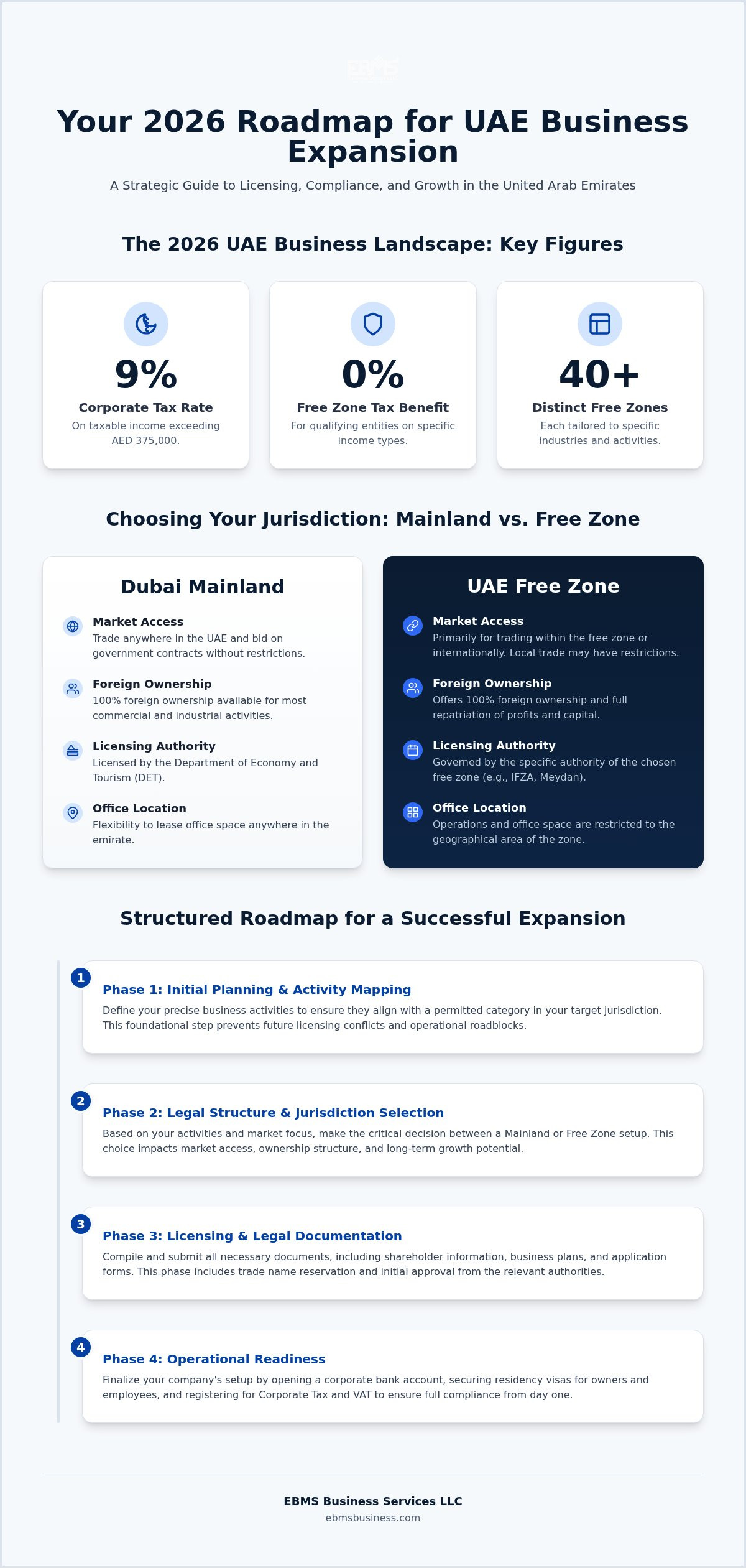
Positioning your brand in the Emirates offers more than just a prestigious address. It provides a gateway to emerging markets across Africa, Asia, and the Middle East. A deep dive into Dubai’s economic landscape reveals a system designed to reward innovation through tax-friendly policies. While the standard corporate tax rate is 9% on income exceeding AED 375,000, qualifying free zone entities may still benefit from a 0% rate on specific income types. Beyond financial incentives, the region’s greatest asset is its people. You’ll have access to a multilingual, diverse talent pool that understands how to operate in a globalized economy, making it easier to build a team that reflects your international ambitions.
Mainland vs. Free Zone: Choosing Your Corporate Structure
One of the most critical decisions during a business expansion in Dubai is selecting the right jurisdiction. This choice dictates where you can trade, who your clients can be, and how your company will grow. While the UAE offers a variety of paths, they generally fall into two categories: mainland and free zone. Your choice isn’t just about initial setup costs; it’s about aligning your legal structure with your long term operational goals and target audience. Choosing the wrong framework early on can lead to restrictive growth or costly restructuring down the line.
Dubai Mainland Company Formation
A Dubai mainland company formation provides the most flexibility for those targeting the local UAE market. Licensed by the Department of Economy and Tourism (DET), mainland entities can trade anywhere in the UAE and bid for lucrative government contracts. Since the landmark 2021 reforms, investors can enjoy 100% foreign ownership for most commercial and industrial activities without needing a local partner. This structure is ideal if you plan to open retail outlets or provide services directly to the local population. It removes geographic restrictions on where you can lease office space, allowing you to position your team where it makes the most sense for your operations.
UAE Free Zone Opportunities
If your focus is primarily international or sector-specific, a freezone business might be the more efficient route. The UAE hosts over 40 distinct free zones, each tailored to specific industries. For example, Meydan Freezone is highly regarded for its digital and e-commerce focus, while IFZA offers a streamlined approach for consultants and service providers. For those seeking cost-effective entry points without sacrificing quality, RAKEZ in Ras Al Khaimah provides excellent industrial and commercial facilities for a broad range of activities.
Free zones offer 100% foreign ownership and often provide simplified recruitment and customs procedures. However, they are generally restricted to trading within the zone or internationally. Choosing between these options requires a careful analysis of your business activity and where your primary revenue will be generated. If you’re unsure which jurisdiction fits your 2026 roadmap, it’s helpful to speak with a strategic consultant to weigh the pros and cons of each specific zone before committing to a license.
Step-by-Step Roadmap for a Successful Expansion
Establishing a new venture requires more than just paperwork; it’s a series of strategic milestones that must be completed in a specific order. If you’re planning a business expansion in Dubai, you’ll need to move through four distinct phases to ensure your company is legally sound and operationally ready. This sequential approach prevents common pitfalls, such as choosing an activity that isn’t permitted in your chosen jurisdiction or facing delays during bank account opening. By treating the setup as a structured journey, you can mitigate risks and focus on your market entry strategy.
Initial Planning and Activity Mapping
The first phase involves identifying your specific business activities. The Department of Economy and Tourism (DET) and various free zones have extensive lists, and choosing the right one is vital. For instance, if you select a professional activity but your long term goal requires trading physical goods, you’ll face delays and extra fees later. Once the activity is set, you’ll apply for initial approval from the relevant authorities. This stage also includes trade name reservation. UAE naming conventions are strict; names shouldn’t be blasphemous, shouldn’t reference political groups, and must be available for use. It’s often helpful to have three options ready in case your first choice is already taken.
Documentation and Legal Formalities
After receiving initial approval, you’ll move to the legal documentation phase. This involves drafting the Memorandum of Association (MOA) or a Local Service Agent agreement, depending on your company structure. For international firms, this is often where the most administrative friction occurs. Any documents originating outside the UAE must be attested by the UAE Embassy in the country of origin and then by the Ministry of Foreign Affairs (MOFA) within the Emirates. Managing this bureaucracy is where professional support becomes invaluable. A trusted navigator acts as the liaison between your business and government bodies, ensuring every stamp and signature meets current standards.
The final phases involve securing your office space and finalizing the license. For mainland companies, a registered tenancy contract, known as Ejari, is usually a prerequisite for license issuance. Once the license is in hand, you’ll transition to post-licensing tasks. This includes registering for corporate tax within three months of starting your financial year and managing visa applications for your team. As of January 2026, renewal requirements for investor visas have become more stringent, often requiring proof of an active company lease and maintained bank balances. Taking these steps seriously ensures your business expansion in Dubai starts on a stable and compliant foundation.
Operational Essentials: Compliance, Banking, and Residency
Securing a trade license is a significant milestone, but it’s only the beginning of your operational journey. For a sustainable business expansion in Dubai, you must transition your focus toward long term compliance and financial stability. Many investors find that the technicalities of the post-setup phase, particularly banking and tax, are where the most professional guidance is needed. These foundations ensure your business isn’t just legally registered but is also capable of transacting and growing within the UAE’s maturing regulatory framework.
Opening a corporate bank account is often cited as a primary hurdle for new entrants. UAE banks maintain rigorous Know Your Customer (KYC) standards to comply with international anti-money laundering regulations. You’ll need to provide comprehensive documentation, including proof of address, detailed business plans, and sometimes personal bank statements from your home country. Because rejection rates can be high for incomplete or poorly presented applications, seeking assistance with corporate bank account opening in the UAE is often the difference between a quick start and months of administrative delay.
The UAE Golden Visa for Investors
Stability is a key concern for any international business owner. The Golden Visa framework provides a 10 year residency option that decouples your legal status from a specific employer or sponsor. This is available to investors who commit at least AED 2 million in qualifying commercial activities or public sector projects. It’s a powerful tool for business continuity. It allows you to sponsor your family and maintain a long term base in the country regardless of your company’s immediate employment needs or changes in the local labor market.
Accounting and Financial Compliance
The UAE’s fiscal environment has matured significantly over the last few years. With the standard corporate tax rate of 9% on taxable income exceeding AED 375,000, maintaining accurate financial records is no longer optional. You must also prepare for the mandatory electronic invoicing system starting in July 2026, which requires all B2B transactions to be processed through FTA-approved national systems. Utilizing professional VAT registration services ensures you don’t miss registration deadlines or face the AED 10,000 penalty for late corporate tax registration.
Proper bookkeeping and regular audits are the foundations of a healthy UAE entity. Implementing modern accounting software early allows for real-time financial oversight and simplifies your annual filings. If you’re ready to secure your operational foundation and ensure full compliance with 2026 regulations, you can consult with our compliance team to ensure every detail is handled with precision.
Partnering for Growth: How EBMS Facilitates Your Expansion
Beyond Incorporation: Post-Setup Support
Incorporation is merely the first step in your journey. Once your entity is active, the focus shifts to maintaining its legal standing and building a market presence. EBMS manages the critical cycle of company renewals and ongoing PRO requirements to ensure you never face penalties for expired documents or missed compliance deadlines. We also recognize that a modern business needs a digital foundation. Our team assists with website development and digital branding, integrating IT services into your initial setup phase. This comprehensive approach means you don’t have to manage multiple vendors for your administrative and digital needs. Our multilingual support team ensures that communication remains clear and supportive, regardless of where your global headquarters are located.
Taking the Next Step in Your UAE Journey
Choosing a corporate structure is a decision that impacts your tax liabilities, recruitment capabilities, and market reach. It’s not something that should be decided through a generic online form. Experience matters in this landscape. Since 2015, EBMS has been a proactive partner for entrepreneurs and SMEs, providing the local knowledge necessary for long term stability. We prioritize a personalized consultation for every client, ensuring that the path we build together is tailored to your specific industry and goals. This track record of efficiency and precision is what allows us to remove the uncertainty from your business expansion in Dubai. We invite you to consult with our team of experts to secure a strategic and stress-free entry into the UAE market.
Securing Your Strategic Foothold in the UAE
EBMS Business Services has been a dedicated partner for investors since 2015, providing over a decade of local expertise to demystify the complexities of the market. We offer transparent, end-to-end support across all UAE jurisdictions, covering everything from VAT compliance to IT infrastructure setup. If you’re ready to turn your vision for business expansion in Dubai into a reality, we’re here to ensure your journey is efficient and precise.
Contact EBMS Business Services today for a personalized expansion consultation and take the first step toward a stress-free entry. Your future in the UAE’s thriving economy is within reach.
Frequently Asked Questions
What is the most cost-effective way to expand a business to Dubai in 2026?
Selecting an entry level free zone with a flexi desk is generally the most economical route for business expansion in Dubai. Packages in specific zones can start as low as AED 5,750, while others typically range between AED 10,000 and AED 15,000. These options are ideal for startups or consultants who don’t require immediate physical warehouse space or a large local team to begin their operations.
Can I own 100% of my company when expanding to the UAE?
You can enjoy 100% foreign ownership in both mainland and free zone jurisdictions for most commercial and industrial activities. This represents a significant shift from older regulations that required a local partner for mainland entities. Today, international investors maintain full control over their operations and profits, making the UAE one of the most investor friendly environments in the global market.
How long does the typical business setup process take in Dubai?
The timeline varies based on your chosen jurisdiction and business activity. While some trade licenses can be issued within 24 hours through simplified digital portals, a complete setup for business expansion in Dubai usually takes longer. You should account for several weeks to finalize legal documentation, secure your residency visa, and complete the mandatory corporate tax registration required by federal law.
Is a physical office mandatory for business expansion in the UAE?
A physical office isn’t always mandatory depending on your license type. Many free zones offer virtual office or flexi desk packages that satisfy legal requirements without the need for a traditional lease. However, mainland companies usually require a registered tenancy contract, known as Ejari, to finalize their trade license. Your specific business activity often dictates whether a physical premises is necessary for operational approval.
What are the key differences between a Free Zone and a Mainland license?
A mainland license allows you to trade directly with the local UAE market and bid for government contracts without geographic restrictions. In contrast, free zone entities are designed for international trade or specific sector activities within their designated zones. While free zones offer streamlined customs and 0% tax on qualifying income, mainland structures provide broader operational flexibility for those targeting the domestic population.
How do I qualify for a UAE Golden Visa as a business owner?
Business owners can qualify for a 10 year Golden Visa by making a minimum investment of AED 2 million. This investment can be in a local company, a qualifying commercial activity, or a fixed deposit in a UAE bank. This long term residency option provides stability for your family and ensures business continuity without the need for frequent visa renewals or a local employer sponsor.
What are the corporate tax implications for new businesses in the UAE?
New businesses are subject to a standard corporate tax rate of 9% on taxable income exceeding AED 375,000. Income below this threshold is taxed at 0% to support small enterprises. It’s important to remember that qualifying free zone persons may benefit from a 0% rate on specific income types, provided they maintain adequate substance and meet all regulatory compliance requirements set by the authorities.
Can EBMS assist with opening a corporate bank account for my new entity?
EBMS provides specialized assistance with corporate bank account opening by managing the rigorous documentation and KYC requirements. We help you prepare your business plan and financial profiles to meet the strict standards of UAE financial institutions. While no consultant can guarantee an approval, our experience with various banks helps you navigate the process with greater clarity and a reduced risk of rejection.