

Establishing a presence in the UAE capital is no longer just about tax savings; it’s about embedding your business into a specialized ecosystem that dictates your future growth trajectory. With over 1,500 companies already operating in Masdar City and ADGM hosting more than 110 asset managers as of 2026, the stakes for your abu dhabi free zone company setup have never been higher. It’s natural to feel a sense of anxiety regarding which jurisdiction aligns with your specific industry or whether hidden regulatory costs will surface during the application process.
We understand that the variety of options, from the industrial scale of KEZAD to the common law framework of ADGM, can feel overwhelming. This guide simplifies the journey by providing a transparent, step-by-step framework to move you from confusion to a successful launch. You’ll gain a clear understanding of the latest 2026 incentives, a tailored shortlist of zones for your sector, and a practical roadmap for the entire licensing sequence. Whether you’re a tech startup or a global logistics firm, we’ve designed this resource to ensure your foundation in Abu Dhabi is both secure and compliant.
Key Takeaways
- Learn the fundamental differences between Abu Dhabi’s free zones and mainland setups to choose the most advantageous legal structure for your specific business goals.
- Identify the ideal strategic hub for your sector, comparing the international financial framework of ADGM with the sustainability-focused ecosystem of Masdar City.
- Master the step-by-step framework for abu dhabi free zone company setup, moving from activity selection to trade name reservation with clarity and confidence.
- Navigate the 2026 compliance landscape by understanding how Economic Substance Regulations and mandatory corporate tax registration apply to your new entity.
- Prepare for post-setup success with a practical roadmap for managing residency visas and meeting the requirements for opening a UAE corporate bank account.
Understanding Abu Dhabi Free Zone Company Setup
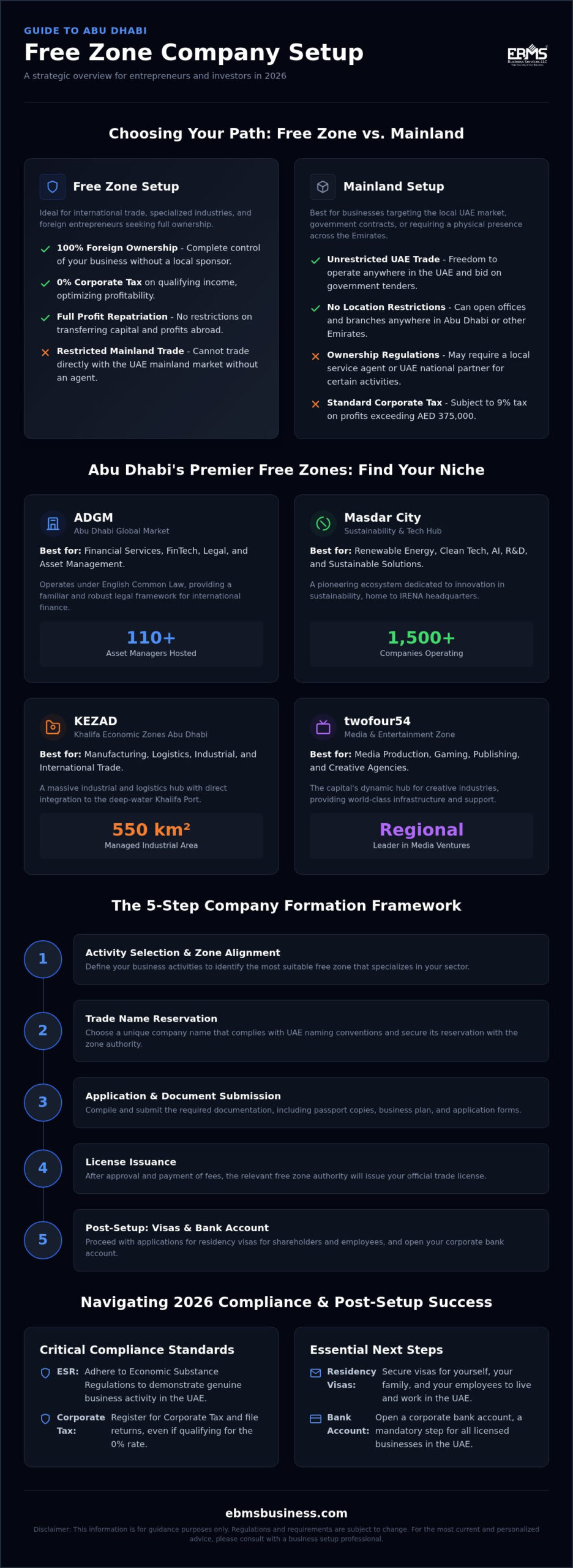
Have you wondered why global giants and ambitious startups are increasingly choosing the UAE capital for their regional headquarters? An abu dhabi free zone company setup offers a specialized environment where businesses operate under a regulatory framework distinct from the mainland. These zones are designed to attract foreign investment by providing a “business-friendly” bubble. Within these jurisdictions, you can enjoy 100% foreign ownership, full repatriation of profits, and exemption from personal income taxes. While the UAE introduced a 9% corporate tax on income exceeding AED 375,000, free zone entities can still access a 0% rate on qualifying income, provided they meet specific substance requirements.
Choosing the right legal structure is your first major decision. Most entrepreneurs opt for a Free Zone Limited Liability Company (FZ-LLC), which acts as a separate legal entity. Alternatively, established international firms often prefer a Branch of a Foreign Company. This allows the parent organization to maintain full control without creating a new corporate person. In 2026, Abu Dhabi stands out because of its strategic pivot toward innovation and capital-intensive industries. It’s not just about registration; it’s about joining an ecosystem backed by immense sovereign wealth and long-term economic vision.
Free Zone vs. Mainland: Choosing the Right Path
Is a free zone always the best choice? It depends on your target market. A free zone license generally restricts your physical trade to within that specific zone or international markets. You can’t directly trade with the Abu Dhabi mainland without a distributor or an additional mainland license. If your business model requires bidding on government contracts directly or opening multiple retail outlets across the city, you might consider Dubai Mainland company formation or an Abu Dhabi mainland setup instead. The Abu Dhabi Department of Economic Development (ADDED) oversees mainland activities, while free zone authorities manage their own internal regulations and licensing processes.
Key Advantages of the Abu Dhabi Jurisdiction
Stability is the hallmark of the capital. When you commit to an abu dhabi free zone company setup, you gain proximity to some of the world’s most influential sovereign wealth funds and government-backed innovation programs. The infrastructure is world-class. Proximity to Khalifa Port and the expanded Abu Dhabi International Airport ensures that logistics and travel remain seamless. For a broader perspective on the regional landscape, you can review the various UAE Free Trade Zones to understand how Abu Dhabi’s specialized hubs fit into the national economy. This jurisdiction is optimized for investors who prioritize a secure, predictable, and highly sophisticated regulatory environment for their long-term growth.
Top Free Zones in Abu Dhabi: Finding Your Strategic Hub
Which jurisdiction truly serves your long-term objectives? Selecting the right location for your abu dhabi free zone company setup isn’t just about administrative convenience; it’s about positioning your brand within a specialized cluster of peers and partners. Abu Dhabi Global Market (ADGM) stands as the premier choice for financial services. It operates under its own legal system based on English Common Law, providing a familiar framework for international institutions. As of late 2026, it hosts over 110 asset managers, reflecting its status as a global financial powerhouse. Note that ADGM fees are structured in US Dollars, which differentiates it from other regional zones.
If your focus is on sustainability or technology, Masdar City offers a dedicated ecosystem that currently supports more than 1,500 companies. This zone is a hub for renewable energy and clean tech, hosting major entities like the International Renewable Energy Agency (IRENA). For those involved in heavy industry or logistics, KEZAD (Khalifa Economic Zones Abu Dhabi) manages a massive 550 square kilometers of industrial area. It’s the gateway for manufacturing and trade, offering integrated infrastructure that connects directly to Khalifa Port. Creative professionals, meanwhile, find their home in Twofour54, the region’s leader for media and entertainment ventures.
Industry-Specific Ecosystems
Matching your business activity to the right zone is vital for operational success. You should explore the Innovation City freezone activities list to see how tech-driven licenses are categorized. Being ‘clustered’ with similar businesses provides more than just networking; it creates a shared pool of talent and specialized suppliers. This proximity often leads to collaborative growth that isolated mainland companies might miss. If you’re unsure which hub fits your specific niche, our team can help you evaluate the best jurisdiction for your unique business model.
Comparing Setup Packages and Facilities
Setup costs vary significantly based on your physical space requirements. Most zones offer flexi-desk options for startups, but permanent office requirements often apply as you scale or increase your visa quota. For instance, Masdar City offers startup packages starting at AED 7,000 with no visa, while KEZAD provides one-year business packages for approximately AED 9,450. While Abu Dhabi’s zones offer immense prestige and specific industrial advantages, some entrepreneurs find that Meydan Freezone or RAKEZ serve as effective alternatives for purely administrative or trading operations that don’t require a physical presence in the capital. Cost-conscious investors may also want to explore business setup in Ras Al Khaimah, which offers comparable tax advantages and global reach at significantly lower entry costs for startups and SMEs.
The Step-by-Step Abu Dhabi Free Zone Formation Process
How do you move from a corporate concept to an operational entity without getting lost in administrative paperwork? The journey toward a successful abu dhabi free zone company setup is defined by a structured five-step framework. While each jurisdiction has its own digital portal, the underlying logic remains consistent across the capital’s hubs. Precision at each stage is vital for avoiding delays and ensuring your business foundation is compliant from day one.
- Step 1: Activity Selection. You must choose your business activity from a comprehensive list of over 1,000 approved options. This choice dictates your license category.
- Step 2: Legal Structure and Naming. Decide between a Free Zone Limited Liability Company (FZ-LLC) or a Branch. You’ll also need to reserve a trade name that complies with UAE naming conventions.
- Step 3: Initial Application. Submit your proposal through the specific free zone’s e-services portal, such as ADGM’s ACCESSADGM or Masdar’s investor portal.
- Step 4: Document Submission. Upload your required documentation for regulatory and security approvals. This is where the authorities vet the shareholders and the business model.
- Step 5: Finalization. Sign your Lease Agreement and legal documents. Once the fees are settled, the authority issues your Free Zone license.
Selecting Approved Business Activities
Your choice of activity directly influences your license type, whether it’s commercial, service, or industrial. It’s not just a formality; it determines your future ability to expand or pivot. Many entrepreneurs seek professional guidance to ensure their chosen activity matches the freezone business regulations perfectly. Misalignment here can lead to complications during bank account opening or when applying for specific industrial permits later. It’s better to be precise now than to face a license amendment later.
Documentation and Regulatory Approvals
The documentation phase is often where investors feel the most pressure. Standard requirements include passport copies, a detailed business plan, and proof of address for all shareholders. However, if you’re entering a regulated sector like healthcare or finance, you’ll need additional NOCs (No Objection Certificates) from relevant UAE ministries. Managing these government liaisons is a core function of professional PRO services. They act as your navigator, handling document attestation and ensuring that security clearances don’t become a bottleneck for your abu dhabi free zone company setup. This proactive approach turns a complex regulatory hurdle into a manageable, transparent process.
Critical Requirements and Compliance Standards for 2026
Once your license is in hand, how do you ensure your business remains in good standing with UAE authorities? If your abu dhabi free zone company setup is to thrive long-term, you must look beyond the initial certificate. The regulatory landscape in 2026 is defined by a shift from a “tax-free” environment to a “compliance-first” jurisdiction. Every entity, regardless of its size, now operates under the watchful eye of the Federal Tax Authority (FTA) and must adhere to strict Economic Substance Regulations (ESR).
The introduction of the UAE federal corporate tax has changed the operational math for many. While a 0% rate applies to taxable income up to AED 375,000, any profit above this threshold is taxed at 9%. Free zone entities can still qualify for a 0% rate on “Qualifying Income,” but this requires meeting rigorous substance tests, including having adequate staff and expenditure within the zone. Failing to meet these criteria doesn’t just result in a higher tax bill; it can lead to significant penalties and the loss of your “Qualifying” status for five years.
VAT and Financial Compliance
Does your business model involve local trade or services? If your annual taxable turnover exceeds AED 375,000, registration for Value Added Tax (VAT) is mandatory. Many investors find it efficient to integrate VAT registration services in Dubai and Abu Dhabi into their initial launch phase. Maintaining accurate books of account is no longer a “best practice”; it’s a legal necessity. You’ll need to implement robust accounting software from day one to ensure your records are audit-ready. Annual audits are a standard requirement for most Abu Dhabi free zones, serving as a transparent check on your financial health and operational integrity.
Office Space and Residency Obligations
Your physical footprint in the zone is directly linked to your operational capacity and visa eligibility. Most authorities require a minimum office space—often 10 square meters per visa—to justify your residency quotas. While “flexi-desk” solutions are popular for startups, highly regulated sectors like finance or healthcare often require permanent, partitioned offices to meet security and privacy standards. Virtual office solutions are increasingly restricted in these zones to prevent “shell” companies from exploiting the system. It’s essential to align your lease with your long-term hiring plans to avoid the stress of constant office upgrades. If you’re feeling overwhelmed by these evolving standards, you can consult our compliance experts to ensure your abu dhabi free zone company setup remains foolproof.
Post-Setup Success: Visas, Banking, and Infrastructure
Receiving your trade license is a significant milestone, but it doesn’t mean your business is ready to trade immediately. To achieve full operational readiness after your abu dhabi free zone company setup, you must secure residency for your team and establish a robust financial foundation. This phase requires a shift from legal formation to practical administration. It’s the point where your corporate entity becomes a functioning workplace with the staff and tools necessary to generate revenue.
Residency and the UAE Golden Visa
Residency is the bridge that allows you and your employees to live and work in the UAE legally. For many high-net-worth individuals and successful entrepreneurs, evaluating eligibility for the Golden Visa is a priority. This 10-year renewable residency is available for investors who make a public investment of at least AED 2 million, which can include real estate assets of the same value. It provides long-term stability and the flexibility to stay outside the UAE for extended periods without losing residency status.
For standard free zone setups, the process involves obtaining entry permits, undergoing medical fitness tests, and applying for Emirates IDs. These visas are typically valid for two years. While EBMS Business Services LLC assists with the coordination and PRO services to streamline the workflow, it’s vital to remember that all residency approvals are subject to government authority. Managing dependents’ visas follows a similar path, ensuring your family can join you in the capital once your own residency is stamped.
Corporate Banking and Digital Infrastructure
Opening a bank account is often cited by entrepreneurs as the most challenging post-setup hurdle. The difficulty of bank account opening in UAE stems from strict Anti-Money Laundering (AML) and “Know Your Customer” (KYC) protocols. Banks require detailed business plans, proof of shareholder address, and sometimes evidence of existing business relationships or contracts. Success in this area depends on presenting a transparent and well-documented financial profile to the bank’s compliance department.
Simultaneously, you need to build your digital presence. This includes securing a domain, setting up professional business emails, and establishing reliable IT services for your office. EBMS Business Services LLC acts as your navigator during this transition. We don’t just hand over a license; we provide the ongoing administrative support needed for license renewals and operational stability. By handling these technical layers, we allow you to focus on your core business growth while we manage the background complexities of your abu dhabi free zone company setup.
Building Your Future in the UAE Capital
Your journey toward a successful abu dhabi free zone company setup requires more than just a trade license; it demands a strategic alignment with the capital’s specialized economic hubs. We’ve explored how matching your activity to specialized jurisdictions provides a competitive edge through industry clustering. Success in 2026 also hinges on maintaining rigorous compliance with evolving tax and substance regulations from day one. By prioritizing operational foundations, such as corporate banking and residency visas, you ensure your business is built for long-term stability rather than just a quick launch.
Since 2015, EBMS Business Services LLC has acted as a trusted navigator for international investors. We offer transparent, multilingual advisory that covers every detail from initial licensing to complex digital infrastructure. Whether you’re a tech innovator or a global logistics provider, our team is here to demystify the process and remove the administrative hurdles that often stall growth. Contact EBMS Business Services LLC today for a personalized consultation and take the first step toward establishing your presence in Abu Dhabi with confidence. Your vision for a UAE-based venture is within reach, and we’re ready to help you achieve it.
Frequently Asked Questions
How long does it take to set up a company in an Abu Dhabi free zone?
The timeline for an abu dhabi free zone company setup typically ranges from one to three weeks. This duration depends on your specific jurisdiction and whether you require additional regulatory approvals for specialized activities. Digital portals like ADGM’s ACCESSADGM have streamlined the process, allowing for faster document submission. We recommend initiating the process early to account for name reservations and security clearances which are essential stages in the formation journey.
Can I own 100% of my business in an Abu Dhabi free zone?
You can absolutely maintain 100% foreign ownership of your business when operating within a free zone. Unlike certain mainland setups that previously required a local partner, free zones are designed to give international investors full control over their enterprise. This ownership structure is a primary advantage for those seeking an abu dhabi free zone company setup, as it also facilitates the full repatriation of profits and capital back to your home country.
What is the minimum capital requirement for Abu Dhabi free zone setup?
Minimum share capital requirements vary significantly across different jurisdictions. For instance, setting up a Free Zone Limited Liability Company in Masdar City typically requires a minimum share capital of AED 50,000. Other zones might have lower thresholds or even no upfront capital deposit requirements for certain license types. It’s essential to verify the specific financial obligations of your chosen hub, as these requirements can change based on your business activity and legal structure.
Do I need a local sponsor for a free zone company in Abu Dhabi?
No, a local sponsor is not required for companies registered in a free zone. You have the right to 100% ownership without a UAE national holding equity in your business. This is one of the key differences between free zone and mainland setups. While you don’t need a sponsor for ownership, many businesses utilize PRO services to manage government liaisons, document attestations, and visa processing to ensure all administrative tasks are handled efficiently.
Is it mandatory to have a physical office in an Abu Dhabi free zone?
Yes, having a physical presence is a mandatory requirement for maintaining a valid license. Most free zones offer flexible options such as “flexi-desks” or “smart offices” for startups and SMEs that don’t require large premises. However, your office space often dictates your visa quota, with a standard requirement of approximately 10 square meters per visa. Highly regulated sectors may require permanent, partitioned office spaces to comply with specific security and operational standards.
Can a free zone company do business in the UAE mainland?
Free zone entities are generally restricted to trading within their specific zone or internationally. To do business directly with the UAE mainland, you typically need to work through a local distributor or obtain a “dual license” where available. Masdar City, for example, offers a dual license option that allows you to trade with the mainland market from your free zone base. Without these arrangements, direct mainland commercial activity is legally restricted for free zone companies.
What are the common costs involved in Abu Dhabi free zone formation?
The total investment includes several components such as registration fees, annual license fees, and office lease costs. You’ll also need to budget for establishment cards, visa processing, and medical fitness tests for your staff. In zones like ADGM, fees are charged in US Dollars, while others use UAE Dirhams. Costs vary based on your chosen package, such as Masdar’s Business One or KEZAD’s multi-year options. We recommend confirming the latest fee structures before proceeding. Entrepreneurs comparing costs across the UAE may also benefit from reviewing a comprehensive guide to business setup in Ras Al Khaimah, where fee structures are often more accessible for budget-conscious investors.
How do I apply for an investor visa after my company is registered?
Once your company is registered and you have received your establishment card, you can begin the residency process. This involves applying for an entry permit, completing a medical fitness test, and registering for an Emirates ID. The final step is the visa stamping or issuance of the residency permit. While the process is structured, approvals are always subject to government authority. Many investors also explore the 10-year Golden Visa if they meet specific investment thresholds.