

A Dubai blockchain business license isn’t a single, universal permit: the UAE has no single crypto licence, and the applicable regulator depends on the activity and jurisdiction. A trade licence establishes a company and its permitted activities, but it doesn’t by itself authorise regulated services such as operating an exchange or holding client assets. The right route starts with what your business will actually do.
That distinction can shape your choice of jurisdiction, eligibility requirements, and launch schedule. If you’re developing blockchain software, issuing tokens, or offering crypto services, understanding the difference between company formation and regulatory approval helps you plan clearly.
This guide explains what a crypto business licence covers, which activities may require approval, and how Dubai mainland, DIFC, and other UAE jurisdictions differ. It also outlines factors that affect eligibility and application timing, helping you distinguish company setup steps from regulatory review.
Key Takeaways
- The right regulator depends on your business activity and jurisdiction, so identify what the company will actually do before choosing a setup route.
- A trade licence establishes permitted business activities but does not, by itself, authorise regulated crypto services.
- Whether your model involves client assets, transactions or token issuance can affect regulatory approval, eligibility and the documents required.
- Application timing depends on the jurisdiction, activity and readiness of your business and compliance documents.
- According to the UAE Ministry of Finance, Qualifying Free Zone Persons may receive a 0% corporate tax rate on Qualifying Income, subject to applicable conditions.
Crypto and blockchain business licensing by jurisdiction
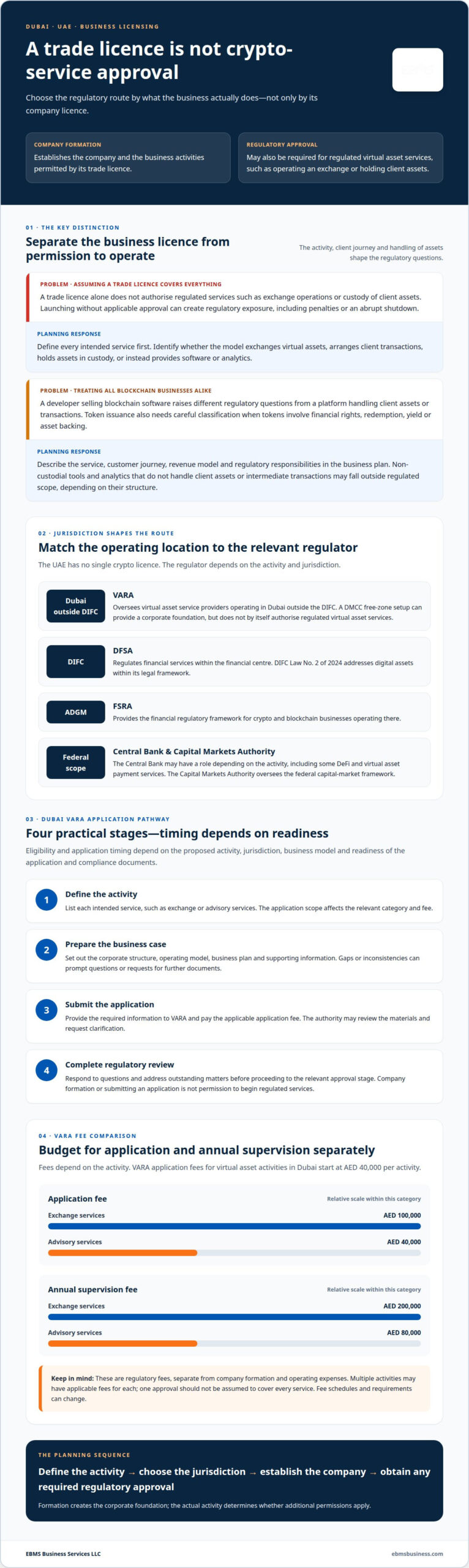
A blockchain business license in the UAE depends on the activity and where the company operates. Company formation and a trade licence establish the business and its permitted activities; regulated virtual asset services may also require approval from the relevant financial regulator. Authorities assess what a business actually does, not just the activity stated on its trade licence.
Which UAE regulators oversee blockchain, cryptocurrency, and virtual asset businesses? In Dubai outside the DIFC, VARA oversees virtual asset service providers. The DFSA regulates financial services in the DIFC, while ADGM’s FSRA oversees regulated financial activities there. The Central Bank and federal Capital Markets Authority may also have a role, depending on the activity.
Jurisdiction shapes the regulatory route:
- Dubai mainland: VARA oversees licensing and operational standards for virtual asset service providers operating in Dubai, outside the DIFC. VARA was established in 2022.
- DIFC: The DFSA regulates crypto operations within the financial centre. DIFC Law No. 2 of 2024 addresses digital assets within its legal framework.
- ADGM: The FSRA provides the financial regulatory framework for crypto and blockchain businesses operating there.
- Federal scope: Federal Decree-Law No. 6 of 2025 brought some DeFi and virtual asset payment services under Central Bank licensing. The Capital Markets Authority oversees the federal capital-market framework under Federal Decree-Laws No. 32 and 33 of 2025.
What risks and penalties can arise from operating without the required licence? Unlicensed crypto activity may lead to penalties or an abrupt shutdown. A trade licence alone does not authorise services such as exchange operations or custody of client assets, so launching such services without applicable approval creates regulatory exposure.
Approval depends on the business model. A platform that exchanges virtual assets, arranges client transactions, or holds assets in custody raises different regulatory questions from a developer selling blockchain software. Non-custodial tools and analytics platforms that don’t handle client assets or intermediate transactions may fall outside regulated scope, depending on their structure. Token issuance also needs careful classification, especially when tokens offer financial rights, redemption, yield, or asset backing.
DMCC offers a free-zone setting for crypto and blockchain businesses, including proprietary trading and distributed ledger technology activities. However, formation in DMCC does not by itself authorise regulated virtual asset services. A business planning exchange, brokerage, or custody must address the applicable regulatory approval separately. For companies weighing this route, free zone company formation provides the corporate foundation, while the activity determines whether additional permissions apply.
Tax treatment is a separate consideration from licensing: Qualifying Free Zone Persons in the UAE may receive a 0% corporate tax rate on Qualifying Income, subject to applicable conditions, according to the UAE Ministry of Finance. Eligibility depends on meeting the relevant conditions; it does not replace regulatory approval for crypto services.
Licence eligibility and application timelines
Eligibility and timing depend on the proposed activity, jurisdiction, business model, and application readiness. VARA assesses virtual asset activities separately, so an exchange application follows a different route from an advisory application. A clear business plan should explain the service, customer journey, revenue model, and how the company will manage its regulatory responsibilities.
For Dubai activities regulated by VARA, the application process generally moves through these practical stages:
- Define the activity. Identify each service the company intends to provide, such as exchange services or advisory services. The application scope affects the relevant category and fee.
- Prepare the business case. Set out the corporate structure, operating model, business plan, and supporting information. Gaps or inconsistencies can lead to questions or requests for further documents.
- Submit the application. Provide the required information to VARA and pay the applicable application fee. The authority may review the materials and request clarification.
- Complete regulatory review. Respond to questions and address any outstanding matters before proceeding to the relevant approval stage. The company should not treat formation or an application submission as permission to begin regulated services.
Fees vary by activity. VARA application fees for virtual asset activities in Dubai start at AED 40,000 per activity. Exchange services carry an application fee of AED 100,000 and an annual supervision fee of AED 200,000. Advisory services carry an application fee of AED 40,000 and an annual supervision fee of AED 80,000. These are regulatory fees, separate from company formation and operating expenses.
Budget for both the initial application and ongoing supervision. A company seeking approval for multiple activities should account for the applicable fee for each, rather than treating one approval as covering every service. The activity category and operational scale also affect annual supervision charges. Fee schedules and requirements can change, so consider figures in their stated regulatory context.
How long does approval take? The estimated timeline for obtaining a crypto licence in Dubai ranges from 2 to 12 months, depending on the business model and document readiness. A CASP application review is approximately 3 to 6 months. These periods concern regulatory review; they should not be treated as a combined timeline for company formation, premises, staffing, or operational readiness.
Prepare for a review that may involve follow-up questions. A business plan that clearly connects the proposed service to its operating controls helps define the application’s scope. For example, an exchange model should describe its exchange services separately from advisory work. Allow time to refine the application if VARA requests clarification, and plan launch steps around the required regulatory approval.
What is a Crypto Business License in Dubai?
A crypto business licence authorises specified virtual asset services, while a company trade licence records permitted business activities. Application materials should match the service the company plans to operate.
Personal and Business Documentation
For a VARA application, prepare shareholder passport copies, corporate information, and a business plan describing the proposed services. Passport copies should have at least 6 months before expiry. The application may also require further documents or interviews during review, so keep shareholder details and the company’s operating description consistent across submissions.
Build the file around the actual ownership and operating structure. Include shareholder and company formation documents, then explain each planned service, its customers, and how the business will operate. For example, a platform offering exchange services should describe that activity clearly rather than relying on a broad technology label.
Technology and Virtual Asset License Differences
A blockchain technology licence generally covers technology development, while a crypto or virtual asset licence concerns regulated services involving virtual assets. The key distinction is the platform’s function: software development differs from exchanging assets, arranging transactions, or holding client assets in custody.
Non-custodial tools and analytics platforms that don’t handle client assets or intermediate transactions may fall outside regulated scope, depending on their structure. Describe how the product works, whether it controls assets, and whether it facilitates transactions. VARA assesses the actual activity, not just the licence wording.
Compliance documents should explain how the company will manage financial crime and technology risks. Crypto businesses must address anti-money-laundering, know-your-customer, and cybersecurity requirements. Set out relevant policies and controls alongside the business plan, showing how they apply to the proposed customer journey and services.
Capital and application records also depend on the activity. The stated paid-up capital range for a Dubai cryptocurrency licence is AED 100,000-1,500,000+, while exchange services carry a stated range of AED 800,000-1,500,000. These figures differ by licence type and operational model, so the application should clearly identify its category.
Banking preparation matters because crypto businesses face additional banking scrutiny. The application process may require a dedicated corporate account for trading funds. Prepare a clear explanation of the source and movement of funds, the company’s investors, and how its platforms handle currency and virtual assets. Bank approval is not assured, so don’t treat account opening as automatic.
Organise documents by purpose: personal and shareholder records, corporate formation materials, operating plans, and compliance policies. This structure links the proposed activity to its controls and capital needs without confusing a technology product with a regulated financial service.
Activities that typically require regulatory approval
Regulatory approval depends on the service delivered, not simply the company’s technology label. VARA defines eight virtual asset activities for licensing in Dubai. A company licence establishes its legal business activities, but it does not replace VARA approval when the operating model provides regulated virtual asset services.
Review each customer-facing function separately. Activities involving asset handling or transaction facilitation need particular attention:
- Exchange: Operating a platform that exchanges digital assets for clients falls within virtual asset services.
- Custody: Holding or safeguarding client assets differs from providing software that lets clients retain control.
- Brokerage and transfer: Arranging transactions or transferring assets for clients can trigger regulatory requirements.
- Advisory: Recommendations concerning virtual assets are distinct from general blockchain technology development.
Token issuance also requires careful classification. Tokens that provide financial rights, such as profit participation, redemption, yield, or asset backing, typically require regulatory approval. Describe the rights attached to each digital asset and the issuer’s functions. A token’s technical format alone does not determine its regulatory treatment.
Some technical businesses operate differently. Pure blockchain software development, non-custodial tools, and analytics platforms may fall outside regulated scope when they neither handle client assets nor intermediate transactions. Their structure matters. For example, a tool that only analyses public blockchain data differs from a platform that routes a client’s asset trade.
VARA approval and company formation are separate requirements. An IFZA commercial licence, for example, does not itself authorise regulated virtual asset services. A business must obtain any required VARA licence before starting those services. Proprietary traders also face a specific threshold: registration with VARA is required when trading exceeds AED 1 billion in 30 days.
Capital requirements depend on the activity. The stated minimum for advisory services is AED 100,000, while custody services require AED 600,000. Lending and borrowing services have a stated capital requirement of AED 500,000. Exchange applicants face different thresholds: AED 800,000 when using a VARA-licensed custodian, or AED 1,500,000 without one. These are capital requirements, not the full cost of establishing and operating a business.
Office and staffing arrangements are also part of planning. A Dubai crypto business must appoint two UAE-resident Responsible Individuals. Premises and operational needs should match the chosen jurisdiction and activity. Before applying, map each service, its client touchpoints, asset flows, and responsible staff. This helps distinguish technology functions from regulated services and align the company licence with required approvals.
Company formation and trade licensing support
Eligibility starts with matching the company’s legal structure and trade activities to its intended operations. What are the eligibility requirements and documents for a blockchain business license? Applicants need a defined business model, shareholder and company records, and documents supporting the proposed activity; regulated services also require the relevant approval.
Eligibility and Company Setup
Choose the jurisdiction and company structure around where the business will operate, who it will serve, and which activities it will conduct. A mainland setup and a free zone setup follow different frameworks. Mainland companies may have 100% foreign ownership, depending on the activity. Offshore entities cannot conduct business within the UAE and mainly serve holding purposes.
Trade-name selection is part of setting up the company. The proposed name should suit the intended business and its licensed activities. Formation then establishes the legal entity and records its permitted activities. A trade licence does not, by itself, authorise regulated crypto services, so keep company setup and regulatory approval as distinct workstreams.
Eligibility Documents for Blockchain Licensing
Prepare shareholder identity records, company formation documents, and a business plan describing the proposed services. Passport copies for shareholders should have at least 6 months before expiry. The business plan should align with the selected activities and explain how the company will operate, including whether it handles digital assets or facilitates transactions.
For a regulated application, organise supporting materials around the ownership structure, operating model, and compliance controls. Anti-money-laundering, know-your-customer, and cybersecurity policies should correspond to the services described. If the application covers an exchange, its documents should distinguish that service from software development or advisory work.
Jurisdiction also shapes the setup decision. A free zone can provide a designated company framework, while a mainland structure may suit businesses planning broader UAE operations. DMCC offers company licensing for proprietary trading, distributed ledger technology, and virtual asset service providers. A DMCC company licence does not replace VARA approval for regulated virtual asset services.
Setup costs depend on the jurisdiction, licensed activities, office or workspace needs, and the company’s operating requirements. For a DMCC setup, consider company licence and formation requirements separately from any regulatory application, capital requirements, or compliance systems. These are distinct cost categories, not interchangeable parts of one licence package.
Before formation, map the proposed activities to the intended trade licence and regulatory framework. This helps prevent a mismatch between the company’s stated business and actual operations. It also clarifies whether a free zone or mainland structure better fits the company’s customers, operating plans, and approval pathway.
EBMS Business Services LLC: Business Setup in dubai
EBMS Business Services LLC helps entrepreneurs choose and establish a UAE company structure suited to their plans. Its Free Zone Company Setup and Mainland Company Setup options support different formation routes. Offshore Company Setup serves a different purpose and isn’t a route for conducting business within the UAE.
Company formation and regulatory approval are separate steps. EBMS Business Services LLC assists with company setup, while regulated virtual asset services require the relevant regulatory approval. The company also offers UAE Golden Visa Processing for entrepreneurs and investors considering this option.
For guidance on your UAE business setup, contact EBMS Business Services LLC.
Turn your business model into a clear setup plan
Before moving forward, write a concise description of your product, customers, and intended services. This connects your operating plan to the right company structure and gives founders and investors a practical basis for discussing priorities.
The next step is to align your plan with a suitable UAE formation route. EBMS Business Services LLC can help you consider company setup requirements and prepare for formation. Keep the commercial structure and any regulatory approvals in view as separate considerations.
For tailored guidance on your UAE business setup, contact EBMS Business Services LLC. A considered plan can help you move ahead with greater clarity and confidence.
Frequently Asked Questions
What Business Activities Can Be Conducted Under This Licence?
Depending on the licence scope, activities can include blockchain software development, analytics, virtual asset advisory, exchange services, or custody. To assess a proposed product, map each user action: what the customer can do, how the company responds, and whether the company controls assets or moves transactions. This functional map helps distinguish product features from the company’s commercial activities.
What is a blockchain business license?
The term describes authorisation for a business using blockchain, but it does not identify one standard UAE licence category. For practical planning, describe the business by its services rather than relying on this broad label. For example, specify whether the company develops software, offers analytics, advises customers, or provides a virtual asset service. Precise descriptions make the intended scope easier to assess.
Which countries or jurisdictions require a license for blockchain businesses?
Licensing depends on the laws and regulatory approach of each jurisdiction where a business operates or serves customers. Before expanding beyond the UAE, assess local rules for each service and market rather than assuming the UAE setup covers overseas activity. A useful comparison records intended customer locations, services offered, and whether the business handles client assets or facilitates transactions.
What licenses are required for a blockchain company in the UAE?
Required permissions depend on the company’s activity and chosen jurisdiction. For planning, distinguish the company’s commercial licence from any approval needed for regulated financial activity, then ensure each document describes the same business model. A software developer and a platform that handles customer assets may need different permissions. The chosen free zone or financial centre also affects the relevant route.
How do you apply for a blockchain business license in Dubai or Abu Dhabi?
Begin by deciding where the entity will be established and documenting its intended services, customer groups, and operating model. In Dubai, VARA may be relevant for regulated virtual asset activity; in ADGM, the FSRA framework applies. Prepare a consistent application file in which the proposed activities, company structure, and supporting documents describe the same operations. This helps avoid preventable ambiguity during review.
How long does it take to obtain a blockchain business license?
Timing varies with the jurisdiction, application scope, and clarity of the business’s operating model. Plan separate milestones for entity formation, regulatory review, and operational readiness. This helps founders identify dependencies, such as unresolved activity descriptions or regulator follow-up, without treating incorporation as the same milestone as permission to launch regulated services.
What compliance rules apply to licensed blockchain businesses, including AML and KYC?
AML, KYC, and cybersecurity controls should be reflected in practical procedures, not just policy titles. For example, document who handles customer checks, who reviews exceptions, how staff access sensitive information, and how security concerns are escalated. Match each procedure to the services the company actually provides, then keep records showing how the controls operate. The applicable regulator and activity determine the relevant compliance expectations.