

The simplest-looking setup may not be the right foundation for your business. Choosing a commercial license for commercial license dubai depends on more than the activity you want to register. Your customers, where you plan to trade, and how you will operate all help determine the suitable route. With mainland, free zone, and offshore options to compare, it can be difficult to know where to begin.
Start by matching the license and jurisdiction to your actual business plans, rather than relying on generic promises or headline costs. This guide explains the decisions that shape a commercial license, so you can compare options and prepare for the next steps.
You’ll learn how business activities relate to commercial and professional licensing, what distinguishes mainland, free zone, and offshore setups, and which operating plans each may suit. We’ll also cover what information to prepare, why approvals and ongoing obligations matter, and how EBMS Business Services LLC can support your setup. Requirements vary by activity and authority, so confirm current details before proceeding.
Key Takeaways
- Choose a commercial license dubai route by clarifying your approved activities, intended customers, and operating model.
- Compare mainland, free zone, and offshore structures according to where and how you plan to do business.
- Use the distinction between goods trading and service delivery as a planning guide, then verify how the relevant authority classifies your activities.
- Prepare a clear activity description and organize relevant documents before reviewing current authority requirements.
- Plan beyond incorporation by considering needs such as banking, visas, renewals, and ongoing compliance, as they apply to your case.
What Does a Commercial License Cover, and What Should You Decide First?
A commercial license is an authorization linked to the business activities a company is approved to carry out. Terminology, activity categories, and requirements can vary by jurisdiction and licensing authority, so treat this as a plain-English guide rather than a formal legal definition.
When planning a commercial license dubai, begin with how you intend to operate, not with a package or a broad business idea. The goods or services you provide, the customers you serve, and how you earn revenue help identify which activities to consider. They also give you a practical basis for comparing setup routes.
How does a business activity shape its license?
Describe what the business will actually do. For example, will it buy and resell physical goods, sell directly to businesses, or provide services under client agreements? Note how customers will place orders, receive products or services, and pay. These details create a more useful activity description than a general label such as “trading” or “consulting.”
Choose activities that reflect the intended operation, not just a business idea you may develop later. Authorities maintain their own activity lists, and some activities may involve additional review or approvals. Because lists and requirements can change, verify the relevant authority’s current guidance before settling on an activity or making commitments.
Which decisions should founders make before comparing routes?
Map out the business model first. Consider where you expect to operate, whether your customers will be in the UAE or elsewhere, and how you’ll deliver goods or services. Then consider ownership goals, staffing plans, premises, and likely expansion. A lean operation serving overseas clients may have different priorities from a business that plans to sell locally, hold stock, or build a larger team.
The UAE’s varied business environment supports activity across multiple sectors. The Economy of the United Arab Emirates offers useful background, but it does not determine which license or jurisdiction fits a particular venture. That depends on your plans and the current rules of the relevant authority.
Before comparing structures, write down your expected activities, customer types, delivery model, premises needs, and growth priorities. If a free zone route is under consideration, EBMS provides free zone company setup guidance. Then compare potential routes against your business needs and verify the details that apply to the chosen authority.
How Do Mainland, Free Zone, and Offshore License Routes Differ?
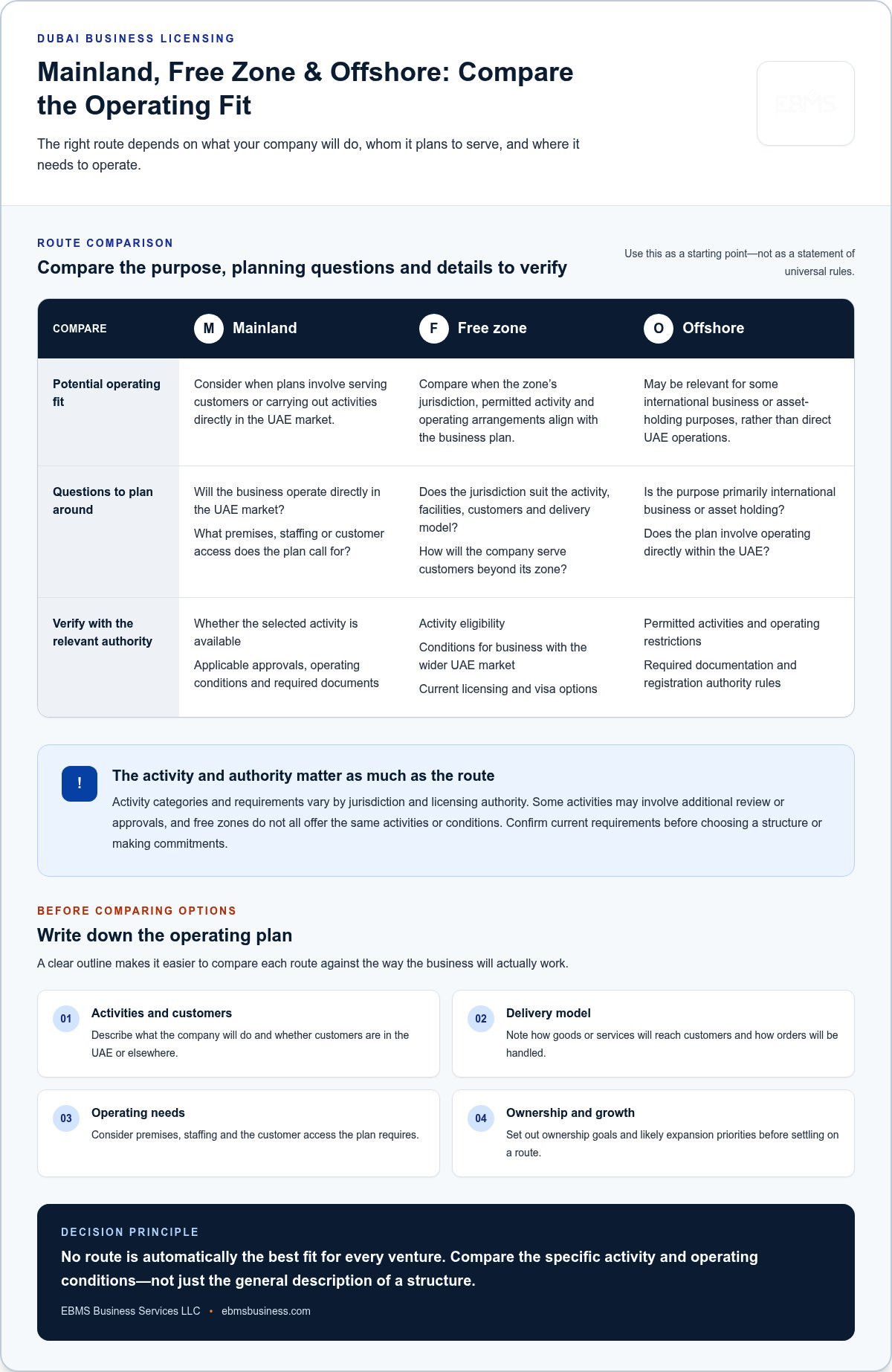
The right route depends on what the company will do, whom it plans to serve, and where it needs to operate. Mainland, free zone, and offshore structures serve different business purposes, and none is automatically the best fit for every venture. For a commercial license dubai, compare the operating conditions for the specific activity and jurisdiction, not just the route’s general description.
| Route | Typical planning questions | Details requiring authority verification |
|---|---|---|
| Mainland | Will the business need to operate directly in the UAE market? What premises, staffing, or customer access does the plan call for? | Whether the selected activity is available, what approvals or operating conditions apply, and which documents are required. |
| Free zone | Does the chosen jurisdiction suit the activity, facilities, customers, and delivery model? How will the company serve customers beyond its zone? | Activity eligibility, any limits or conditions on business with the wider UAE market, and current licensing and visa options. |
| Offshore | Is the purpose primarily international business or asset holding rather than operating directly within the UAE? | Permitted activities, operating restrictions, documentation, and the rules of the relevant registration authority. |
This comparison is a starting point, not a statement of universal rules. Conditions differ by activity and authority, so confirm current requirements before choosing a structure. The archived World Bank’s Doing Business report can provide historical context on business environment indicators, but it is not a current guide to licensing requirements.
When might a mainland setup merit consideration?
Consider a mainland structure if your planned operations involve serving customers or carrying out activities directly in the UAE market. Think about where work will take place, whether you need premises, and how you expect to reach customers. The activity, approval pathway, and operating conditions still need to be checked for your specific case. EBMS provides mainland company formation support as part of its setup services.
When might a free zone or offshore structure be relevant?
A free zone may be worth comparing when its jurisdiction, permitted activity, and operating arrangements align with your plan. Don’t assume every zone offers the same activities or conditions for serving customers outside it. An offshore structure may suit some international business or holding purposes, but it should not be treated as a default route for a trading company seeking to operate locally. Review the relevant authority’s current rules before deciding.
EBMS supports company formation across mainland, free zone, and offshore structures. If you’re weighing these routes, its business activity and jurisdiction guidance can help you compare them against your actual operating needs.
How Can You Match Your Business Plan to the Right Commercial License?
Start with the work the company will actually carry out, then compare that plan with the activity options and conditions of each licensing authority. A suitable commercial license dubai should reflect your planned operations, customer base, delivery model, premises needs, and growth priorities. A broad label alone may not capture the full scope of the business.
Use this framework to separate business-fit questions from details that require confirmation:
| Business-fit questions | Details to verify with the authority |
|---|---|
| Will you trade in goods, deliver services, or combine both? | Which listed activities match the planned work, and whether any require additional approvals. |
| Will customers be individuals, businesses, or organizations in different markets? | Whether the selected activity and jurisdiction permit the intended customer and sales model. |
| Will you sell through a shop, online channels, client sites, or a combination? | Any conditions related to premises, delivery, or the chosen operating arrangement. |
| Do you expect to hire, add activities, or enter new markets? | How changes to activities or operations are handled under the specific setup. |
What information helps identify the right activity?
Describe each product or service in practical terms. For goods, note what the company will buy or sell and whether it expects to import or export. For services, explain whether the business will advise, design, create, install, or deliver work for clients. These are planning examples, not legal classifications.
Record who will buy, how they’ll find you, and how you’ll complete each sale. Online sales, direct business sales, and work delivered at a client’s premises can involve different operating considerations. If your plan combines activities, such as selling equipment and providing related consulting, review each part separately. Check the authority’s current activity list and any approval requirements for the exact combination.
How should growth plans influence the license decision?
Look beyond launch. Consider whether you may hire staff, add activities, serve new markets, or change how you deliver the work. A structure that fits a small initial operation may need review as the business develops. Requirements for amendments and expansion depend on the chosen authority and setup, so don’t assume a future change will be automatic.
Before committing, note open questions about activity scope, customers, premises, staffing, and likely changes. EBMS can help founders assess business activities and jurisdiction options as part of company formation planning. This gives you a clearer basis for comparing routes and confirming current requirements for your case.
What Should You Prepare Before Applying for a Commercial License?
A clear preparation process can help you compare routes and identify questions before beginning an application. Describe the proposed activities, compare suitable structures, organize relevant information and documents, then review the chosen authority’s current requirements. This is preparation guidance, not a universal application checklist or a promise of approval.
Requirements vary according to the activity, jurisdiction, ownership arrangement, and applicant’s circumstances. Treat any document list as a starting point, then confirm what applies to your case with the relevant authority. EBMS can also support company formation, documentation, and PRO services.
What should founders organize for an initial review?
Bring together a short description of what the business will do, its proposed ownership plan, intended customer groups, and operating model. Note whether you expect to use premises, hire staff, combine activities, or serve customers through particular channels. These details help clarify the setup route before you assemble an application file.
Keep identity and company documents organized, but don’t assume every route requires the same paperwork or format. Confirm which documents apply to the chosen jurisdiction and whether the activity calls for additional approvals. It’s also useful to note questions about premises, staffing, and how future activity changes may be handled.
Use a simple preparation sequence:
- Describe the activities: Explain the products or services and how the business will deliver them.
- Compare structures: Consider which route aligns with your customers, operating plans, and growth priorities.
- Organize documents: Gather relevant personal and company information for an initial review.
- Check current requirements: Review the latest authority guidance for the selected activity and structure.
How can you plan for costs and timelines responsibly?
Costs and timelines depend on the selected jurisdiction, activity, and details of the individual case. The license may be only one part of the setup budget; other costs depend on the structure and operating plan. Avoid treating broad promotional estimates as a final figure or assumed processing schedule.
Instead, request current, case-specific information and clarify what it covers, which requirements remain outstanding, and what could affect the schedule. This supports realistic planning without treating an estimate as a guarantee. Requirements and fees may change, so verify the latest details before making commitments.
If you’re preparing to apply for a commercial license and would like support reviewing your setup requirements, discuss your business setup with EBMS.
What Happens After Licensing, and How Can EBMS Support the Setup Journey?
Receiving a license is an important step, but it doesn’t complete every part of getting a business ready to operate. Depending on the company’s plans and circumstances, founders may also need to consider banking, immigration support, renewals, and ongoing compliance. Each is a separate process with its own requirements.
A license doesn’t guarantee a bank account, visa, further approval, particular tax outcome, or business success. Banks and authorities make decisions under their own processes, while tax and compliance considerations depend on the company’s situation. Plan for these areas without assuming they follow automatically from incorporation.
Which operational needs may follow the license?
Consider what the business will need after setup. Banking assistance may be relevant as you prepare to manage company transactions. If the business plans to bring staff or owners into the UAE, immigration and visa assistance may also be part of the planning. Keep track of renewal dates and confirm the company’s ongoing requirements with the relevant authority.
Tax and record-keeping needs also deserve attention. VAT registration may be relevant depending on the company’s activities and circumstances, while accounting support may form part of its wider operational planning. Neither should be treated as a universal requirement based only on holding a license. Confirm which rules apply to your business and keep the necessary records and deadlines in view.
How does EBMS help founders move from planning to setup?
EBMS supports founders through company formation and licensing across mainland, free zone, and offshore structures. Its assistance can include activity and jurisdiction guidance, documentation, PRO services, visa assistance, banking support, and ongoing compliance. This connects initial setup decisions with practical needs that may arise after incorporation.
Clear communication matters throughout the process. EBMS emphasizes transparency around costs, timelines, and documentary requirements, as well as multilingual assistance. Requirements vary, so review current details for the specific activity, authority, and case. Support can guide the process, but it cannot guarantee a license, visa, bank account, approval, or business outcome.
If you’re planning a setup and would like guidance tailored to your circumstances, contact EBMS to discuss your business setup.
Build a Clear Path from License Choice to Launch
The right commercial license dubai setup begins with a clear description of your activities, customers, and operating plans. Compare mainland, free zone, and offshore routes against those needs, then verify current activity, documentation, and approval requirements with the relevant authority. This keeps decisions focused on your venture, rather than general claims about what a setup includes.
Licensing is one stage of the journey. Depending on your circumstances, you may also need to plan for documentation, banking, visa assistance, renewals, and ongoing compliance. EBMS supports company formation across mainland, free zone, and offshore structures, from consultation through incorporation and post-setup needs. Its approach emphasizes transparent communication about costs, timelines, and documentary requirements, without guaranteeing approvals or outcomes.
If you’re ready to review your plans and identify practical next steps, contact EBMS to discuss your business setup requirements. With the right information prepared, you can move forward with greater clarity and a stronger foundation for your venture.
Frequently Asked Questions
What is a commercial license in the UAE?
A commercial license is an authorization connected to the business activities a company is approved to carry out. It helps define the permitted scope of the business, while precise terminology and conditions depend on the relevant jurisdiction and licensing authority. For a commercial license dubai, begin by describing what the company will do, whom it will serve, and how it will operate, then check the current activity requirements.
What is the difference between a commercial license and a trade license?
The terms “commercial license” and “trade license” are sometimes used to describe business licensing, but their exact meaning can depend on the authority and context. Don’t assume they always refer to identical activity categories or requirements. Focus on the activities shown on the proposed license and confirm how the relevant authority names and defines them. This helps clarify what the company is authorized to do.
How do I choose the right business activity for a commercial license?
Describe your planned work in practical terms, then compare it with the current activity options provided by the licensing authority. Explain whether you’ll sell goods, provide services, advise clients, or combine different operations. Include your likely customer groups and sales channels. The activity should reflect what the company intends to do, and the authority can clarify any activity-specific conditions or approvals that may apply.
Can one commercial license cover more than one business activity?
It may be possible to include multiple activities, but this depends on the licensing authority, jurisdiction, and activities selected. Some combinations may require closer review or additional approvals, so don’t assume every activity can appear under one license. Prepare a clear list of the company’s planned operations and confirm with the relevant authority which activities can be included and what conditions apply.
What documents are needed to apply for a commercial license?
There isn’t one document list that applies to every applicant and setup route. Depending on the case, you may need to organize identity and ownership information, proposed business activities, and relevant company documents. These are preparation examples, not a universal checklist. The chosen authority’s current requirements determine the documents, format, and any additional approvals needed for the specific activity and ownership arrangement.
How long does it take to obtain a commercial license?
There is no single timeframe for every commercial license application. Timing can depend on the selected jurisdiction, activity, completeness of submitted documents, and whether additional reviews or approvals are needed. Ask for a current estimate based on your circumstances and clarify which steps it covers. Treat general timelines as guidance, not a guarantee, since requirements and application details can vary.
Does a commercial license guarantee a UAE business bank account?
No. A commercial license does not guarantee that a bank will open an account for the company. Banks make their own decisions and may request information about the business, its ownership, and its activities. EBMS assists with corporate bank account opening as part of the wider setup journey, but the bank retains control over its review and final decision.