

The quickest offshore setup isn’t automatically the best fit. Dubai offshore company formation timelines vary by jurisdiction: RAK ICC incorporation typically takes 3-7 days, while JAFZA Offshore incorporation typically takes 2-4 weeks. The choice of structure matters as much as the processing time.
It’s understandable to want a clear timeline and cost picture before committing to Dubai offshore company formation. The right option depends on what the company needs to do, where it will operate, and which licensing framework applies. A fast registration alone may not answer the bigger question.
This guide compares offshore, free zone, and mainland companies, explains how jurisdiction affects procedures and licensing, and outlines factors that shape formation costs. It also covers the documents involved and how to assess whether an offshore structure fits your business plans.
Key Takeaways
- Compare jurisdiction-specific processing timelines, and factor in document readiness when planning your launch.
- Choose offshore for international holding or structuring; consider free zone or mainland options for permitted UAE operations.
- Match the jurisdiction to your company’s purpose, ownership structure, and registered-agent requirements.
- Assess total setup and ongoing costs by looking at the jurisdiction, company structure, and any additional requirements.
- Map the formation steps, documents, and licensing needs to your intended business activities before proceeding.
How long will it take to register a UAE Offshore company?
UAE offshore companies aren’t automatically exempt from Corporate Tax: taxable income may be taxed at 0% up to AED 375,000 and 9% above, depending on income and structure. They must keep accounting records; JAFZA companies must appoint an auditor from its approved list. Economic substance notification and reporting requirements do not apply to financial years starting on or after 1 January 2023.
According to the Federal Tax Authority, UAE VAT registration is mandatory when taxable supplies and imports exceed AED 375,000, and voluntary registration is available above AED 187,500. These VAT thresholds concern taxable supplies, not the offshore company’s incorporation timeline.
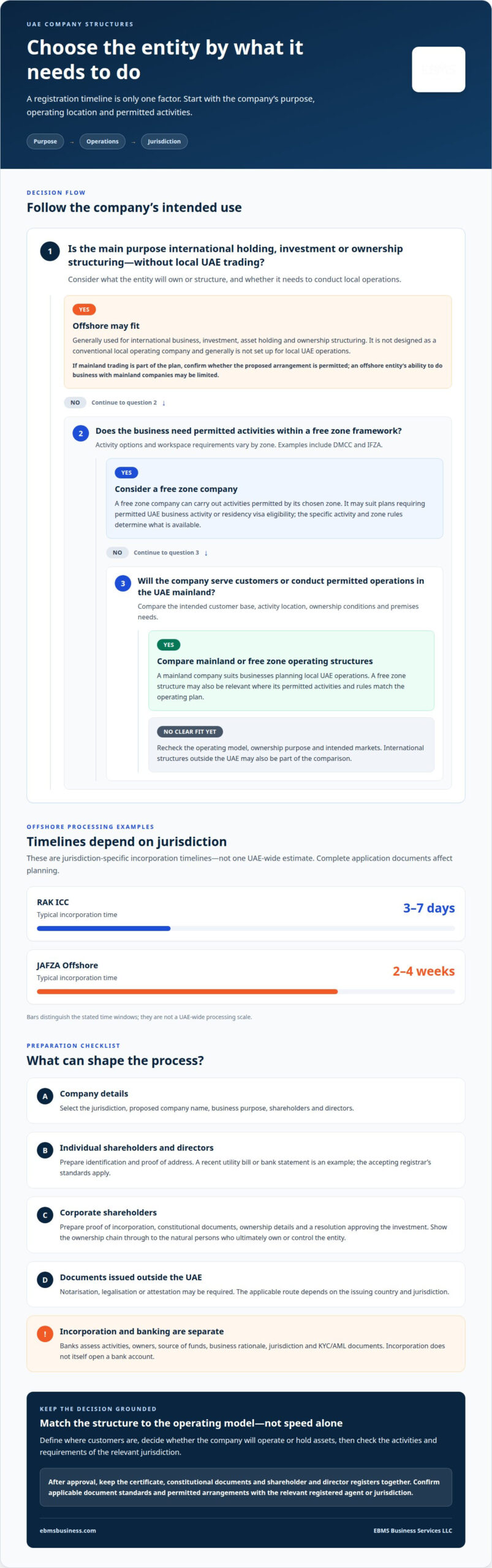
Processing time depends on the jurisdiction and complete application documents. RAK ICC incorporation typically takes 3-7 days, while JAFZA Offshore incorporation typically takes 2-4 weeks. Treat those as jurisdiction-specific timelines, not a single UAE-wide estimate.
Start by selecting the jurisdiction, proposed company name, business purpose, shareholders, and directors. The registrar or registered agent then reviews the application and due diligence documents. Once accepted, the application results in incorporation documents issued under that jurisdiction’s procedures.
Prepare identification and proof-of-address records for each individual shareholder and director. A recent utility bill or bank statement can serve as an example, subject to the accepting registrar’s document standards and requirements.
For a corporate shareholder, prepare proof of incorporation, constitutional documents, ownership details, and a resolution approving the investment. Show the ownership chain through to the natural persons who ultimately own or control the entity. Clear records help explain the proposed corporate structure.
Documents issued outside the UAE may need notarisation, legalisation, or attestation before submission. Requirements depend on the issuing country and jurisdiction. Ask the registered agent to identify the applicable document format and certification route before arranging translations or authentication.
Banking due diligence is separate from incorporation. Banks assess the company’s activities, owners, source of funds, business rationale, jurisdiction, and KYC/AML documents. Prepare corporate records, ownership evidence, and financial or trading information that explains expected income and account use. Incorporation does not itself open a bank account.
Keep incorporation records together after approval, including the certificate, constitutional documents, and shareholder and director registers. If your intended activity involves UAE mainland trading, compare the structure with Dubai mainland company formation before choosing. The operating model, rather than speed alone, should guide that decision.
Offshore vs free zone vs mainland: which do you need?
Choose the entity based on its intended work, not simply its place of registration. In the UAE, offshore, free zone, mainland, and international structures serve different operating and ownership purposes.
Entity Structure Comparisons
A UAE offshore entity generally supports international business, investment, asset holding, and ownership structuring outside the UAE. It isn’t designed as a conventional local operating company. A free zone company, by contrast, can conduct activities permitted by its chosen zone, while a mainland company suits businesses planning local UAE operations.
Foreign investors can own up to 100% of many mainland and free zone companies, subject to activity-specific requirements. For an international holding structure, consider whether the entity needs to own assets or investments without conducting local trading. For UAE customers or physical operations, compare permitted activities and operating requirements instead.
International structures may also involve companies registered outside the UAE. Compare how each entity supports ownership, operations, and the company’s intended markets. For example, a group holding overseas investments may consider an offshore structure, while a UAE-facing retailer may need an operating company with suitable activities.
Offshore and Free Zone Differences
Offshore and free zone companies aren’t interchangeable. An offshore company generally supports cross-border holding or investment, while a free zone company can carry out permitted activities within its framework. Free zone examples include DMCC, IFZA, and other UAE free zones. Activity options and workspace requirements vary by zone.
Consider practical requirements before choosing: a UAE offshore company generally isn’t set up for local UAE operations, and its ability to conduct business with mainland companies may be limited. The permitted arrangements depend on the relevant rules and circumstances, so confirm what is allowed before proceeding. A free zone company may suit plans requiring permitted UAE business activity or residency visa eligibility. The specific activity and zone rules determine the available setup.
Mainland structures are another option for businesses serving customers or conducting permitted operations in the UAE. Compare the intended customer base, activity location, ownership conditions, and premises needs. If your company must trade directly with mainland businesses, confirm whether an offshore entity can support the proposed arrangement; a mainland or free zone operating structure may be more suitable.
Use a simple decision sequence: define where your customers are, decide whether the company will operate or hold assets, then match its activities to a jurisdiction. An international investment vehicle and a UAE-based consultancy, for instance, have different structural needs, even if both have foreign owners.
Free zone flexibility depends on the zone’s permitted activities, so match the proposed work to its activity framework before selecting a jurisdiction. A company planning consulting, trading, or another activity should assess the relevant permissions rather than assume all zones offer the same scope. For tailored guidance on the structure, discuss your UAE setup requirements.
Dubai offshore jurisdictions and registered agents
The UAE has three offshore jurisdictions: JAFZA, Ajman Offshore, and RAK ICC. Each has its own regulations and registration authority, so the jurisdiction you select determines the rules governing the company. Compare those frameworks with the company’s intended purpose and ownership arrangements before beginning registration.
All UAE offshore registrations require a licensed registered agent. The agent acts as the registration intermediary, submitting company information and supporting documents through the relevant authority’s process. Keep the agent’s details and the company’s registry information aligned in the incorporation file.
A UAE offshore company can have at least one shareholder. RAK offshore companies require at least one director, while JAFZA Offshore companies require at least two. The company does not need a local UAE office and cannot lease office space in the UAE.
Each jurisdiction has a distinct regulatory framework. JAFZA offshore companies follow the JAFZA Offshore Companies Regulations, while RAK ICC companies follow the RAK ICC Business Companies Regulations. Ajman Offshore companies are governed by Ajman’s offshore regulations. Identify the correct authority for resolutions, application forms, and later registry correspondence.
Changing a registered agent is a formal registry matter, not simply a private update to contact details. The company’s current jurisdiction determines the applicable process and registry charge. RAK ICC lists an AED 1,250 fee for changing an offshore agent, while Ajman Offshore lists an AED 500 fee. These amounts are specific to the respective registry changes.
Agent service charges are separate from registry fees. Request an itemised breakdown that distinguishes the authority’s change fee from the agent’s service charge. This helps shareholders understand which payment goes to the registry and which covers handling the change.
Before changing agents, prepare the company’s current incorporation records and ownership information. Ensure the company name and registry details match across the change request and supporting documents. This makes the administrative handover easier to track and helps prevent discrepancies between the official record and the agent’s file.
For a company with corporate shareholders, keep ownership records consistent when registry or agent details change. The registered agent can submit the relevant paperwork to the authority under the chosen jurisdiction’s procedure. Retain updated correspondence and records with the company’s incorporation documents for future administration.
Formation timelines and operating costs
Formation time and total operating costs depend on the jurisdiction, application documents, and services the company needs. Compare incorporation, renewal, and banking as separate stages.
Formation Processing Times
Incorporation processing times can vary by jurisdiction and application. This is a jurisdiction-specific estimate, not a timeline for every UAE offshore registry. Document completeness and due diligence affect when an application can move through review.
Banking follows a separate process. Opening a UAE offshore company’s account typically takes 2-4 weeks at traditional banks, and approval isn’t automatic. Banks assess the company’s activities, ownership, source of funds, business rationale, jurisdiction, and KYC/AML documents.
Plan the company launch around both stages. Incorporation may finish before account opening, for example, so a business relying on banking for trading receipts should account for that sequence. Keep incorporation and banking documents ready together to support each review.
Setup Costs and Fees
Build a cost comparison by separating registry charges from registered-agent fees and any additional support. The total depends on the registrar, company structure, and whether banking support is included. A quote should clarify which items cover incorporation and which relate to ongoing administration.
Jurisdiction affects the fee structure, so compare like with like. A JAFZA Offshore setup and an Ajman Offshore setup, for example, may involve different registry procedures and charges. Shareholder structure and document preparation can also affect the work required.
Annual renewal is another budget item. UAE offshore companies need annual renewal, so include recurring registry and agent charges in projections rather than treating incorporation as the only expense. Renewal requirements and fees depend on the company’s chosen jurisdiction.
A bank account may involve separate costs if banking support is part of the setup. Treat it as distinct from registration because banks conduct their own due diligence and decide independently. The company’s expected transactions, income source, and supporting records shape that assessment.
For a useful comparison, request an itemised breakdown of registry charges, agent services, renewal, and any banking-related support. Confirm that the relevant jurisdiction and company structure appear in the breakdown. This clarifies which costs recur and which apply only during initial setup.
The lowest initial figure may not reflect the full operating picture. Compare annual renewal, planned activities, and account requirements alongside incorporation. A structure with different administrative needs can change the effort and cost over time.
Shareholders should also consider whether 100% foreign ownership and the intended use of company assets fit the chosen structure. These advantages matter only when the entity can support the company’s actual plans. Match the cost comparison to the operating model, not just the initial approval stage.
Company formation procedures and licensing
Offshore incorporation starts with a clear business purpose and the right jurisdiction. The key distinction is whether the entity will hold assets internationally or conduct permitted operations in the UAE.
UAE offshore companies are not formed under Federal Decree-Law No. 32 of 2021, the mainland Commercial Companies Law. JAFZA Offshore and RAK ICC companies instead follow their respective offshore regulations. The chosen jurisdiction determines the applicable incorporation framework and filing route.
- Define the company’s purpose. Specify whether it will hold assets, investments, or shares, or support international structuring. An offshore entity is generally intended for activity outside its registered jurisdiction, not conventional UAE operations.
- Select the jurisdiction. Compare JAFZA, RAK ICC, and Ajman Offshore based on the intended structure and relevant regulations. The selected authority determines which incorporation rules apply.
- Set the ownership and management structure. A UAE offshore company can be formed with a minimum of one shareholder. Identify each shareholder and director, and document corporate ownership clearly if another company will hold shares.
- Prepare and submit the application. Provide the proposed company details and shareholder, director, and due diligence documents through the required registration channel. Investors don’t need to be physically present in the UAE to register an offshore company.
- Complete review and receive incorporation records. The authority reviews the application and due diligence material before issuing the company’s incorporation documents. Keep those records available for ownership administration and later banking applications.
Licensing depends on what the entity is intended to do. Offshore registration does not mean the company can conduct every UAE trading activity. A business planning local operations should assess whether a mainland or free zone structure better fits its activities and permissions.
Likewise, an incorporation certificate should not be treated as a trading licence for unrestricted UAE operations or as proof of a 0% tax outcome. The company’s activities, income, and structure affect its separate compliance obligations.
For a holding company, describe the assets or interests it will own and how the ownership chain works. For a trading business, identify the target markets and where it will make sales. These details help align the application with its purpose and support consistent explanations during later corporate or banking reviews.
After incorporation, maintain the company’s records and keep ownership details consistent across corporate documents. For guidance on the appropriate UAE structure and formation steps, discuss your company formation requirements.
EBMS Business Services: Offshore Company Setup
EBMS Business Services LLC supports entrepreneurs considering offshore company setup in the UAE. The company helps align formation with your chosen jurisdiction, ownership structure, and intended purpose, from preparing the application through incorporation.
This support is useful when weighing an offshore holding structure against a company intended for permitted UAE operations. EBMS also offers Free Zone Company Setup and Mainland Company Setup, alternatives for plans involving activities that an offshore entity isn’t designed to conduct. The right route depends on where you’ll operate and what the company needs to do.
For guidance on offshore incorporation or choosing between UAE company structures, contact EBMS Business Services LLC to discuss your setup requirements.
Make Your UAE Structure Work for Your Next Stage
A decision about Dubai offshore company formation should support the company you intend to build, not just the act of registration. Before moving forward, define the entity’s role in your wider business plan, including where it will operate, whom it will serve, and how ownership may change as the business develops. A clear purpose keeps the structure aligned with future commercial decisions.
EBMS Business Services offers Offshore Company Setup, alongside Free Zone Company Setup and Mainland Company Setup. These options provide different routes depending on whether your plans focus on international ownership or permitted UAE operations. Discussing your business model and priorities can help identify an appropriate route for the intended activity and long-term direction.
For tailored guidance on your UAE company setup, contact EBMS Business Services to discuss your business model and priorities.
Frequently Asked Questions
Am I required to have my bank account located in Dubai or can I have an international account?
Company registration in the UAE and a bank’s decision to open an account are separate matters. A UAE offshore company may apply for a UAE corporate account, but approval depends on the bank’s assessment. For an international account, consider whether the bank accepts the company’s jurisdiction and ownership profile, and whether its account terms support the company’s expected transactions.
Which offshore jurisdiction should you choose?
Choose by comparing how each registry’s rules fit your ownership and governance preferences, not by selecting a location name alone. Prepare a short decision brief covering the company’s purpose, proposed shareholders and directors, and preferred administrative process. Then compare it with the relevant jurisdiction’s requirements. This makes differences between registries easier to assess before preparing an application.
What documents do you need?
Prepare a document index alongside the application file. Group records by individual owner, director, and corporate shareholder, and use a simple ownership chart to show how each entity connects. Check that company names and ownership details match across the records. This makes it easier to answer questions about the structure without searching unrelated files or submitting inconsistent versions.
What is a Dubai offshore company and what activities can it legally conduct?
A Dubai offshore company is a UAE-registered entity intended for international purposes, such as holding investments or structuring ownership. Before applying, write a concise description of the company’s planned role and how its expected contracts and income relate to it. This statement helps distinguish a holding purpose from an operating-business plan and keeps the application aligned with the intended structure.
Which offshore jurisdictions are available in Dubai, such as JAFZA and RAK ICC?
The UAE offshore jurisdictions include JAFZA Offshore, RAK ICC, and Ajman Offshore. Their rules belong to separate registries, so use the full jurisdiction name in application discussions and document preparation. This simple practice helps keep the selected registry, application paperwork, and incorporation records aligned, especially when advisers or shareholders are coordinating from different countries.
What are the eligibility requirements and documents for Dubai offshore company formation?
Eligibility and documentation depend on the chosen registry and the company’s ownership structure. For banking due diligence, UAE banks identify natural persons holding or controlling 25% or more of a legal person by tracing the ownership chain. An ownership chart can therefore help explain how corporate shareholders connect to the individuals behind them, alongside the company’s identity and purpose documents.
What are the steps and timelines to set up a Dubai offshore company?
Set the sequence by deciding on ownership and activity before filing, then prepare the application and due diligence records for the selected registry. Incorporation timing varies by jurisdiction, and missing or unclear information can affect the review. Keep incorporation milestones separate from later operational arrangements so registration approval isn’t mistaken for readiness to transact.
How much does Dubai offshore company formation cost, including annual renewal fees?
Formation and renewal costs vary according to the chosen jurisdiction, company structure, registry charges, and agent services. Request a written breakdown separating initial registration from recurring renewal and identifying optional items. This helps shareholders plan ongoing administration as well as launch, without treating a first-year formation figure as the full cost of maintaining the entity.