

To understand how to start a trading company in the UAE, first choose a mainland, free zone or offshore structure, then match the licensed activities to the products you plan to trade. A mainland company is suited to direct trading in the local market. A free zone setup needs a clear plan for reaching nationwide customers, while an offshore company is generally intended for international operations rather than local customer-facing business with the assistance of EBMS Business Services LLC.
It’s easy to focus on the licence first, but your company structure shapes where and how you can operate. The right choice depends on your target markets, product range, premises and operating plans.
This guide compares the three structures, explains how free zone companies can approach sales to UAE customers, and outlines how to prepare for approval and incorporation. You’ll also find the practical sequence of steps, from defining trading activities and selecting a company name to preparing application documents. Making these decisions in order gives you a clearer foundation for entering the market.
Key Takeaways
- Choose your company structure around where you plan to sell, the products you’ll trade and the premises your operations need.
- Plan how a free zone business will reach UAE customers before selecting its licence and operating model.
- Assess office or warehouse needs early, as your business location can affect the setup route and practical requirements.
- Prepare your company name, activity details and incorporation documents in a clear sequence to support the approval process.
- Compare mainland, free zone and offshore options against your intended market, rather than choosing on setup convenience alone.
Do I need a physical office for new business setup in Dubai?
Usually, yes. UAE businesses need a physical address, and mainland trading companies generally require a physical office. Offshore companies are mainly used for international operations without a physical office, so they may not suit businesses serving local customers.
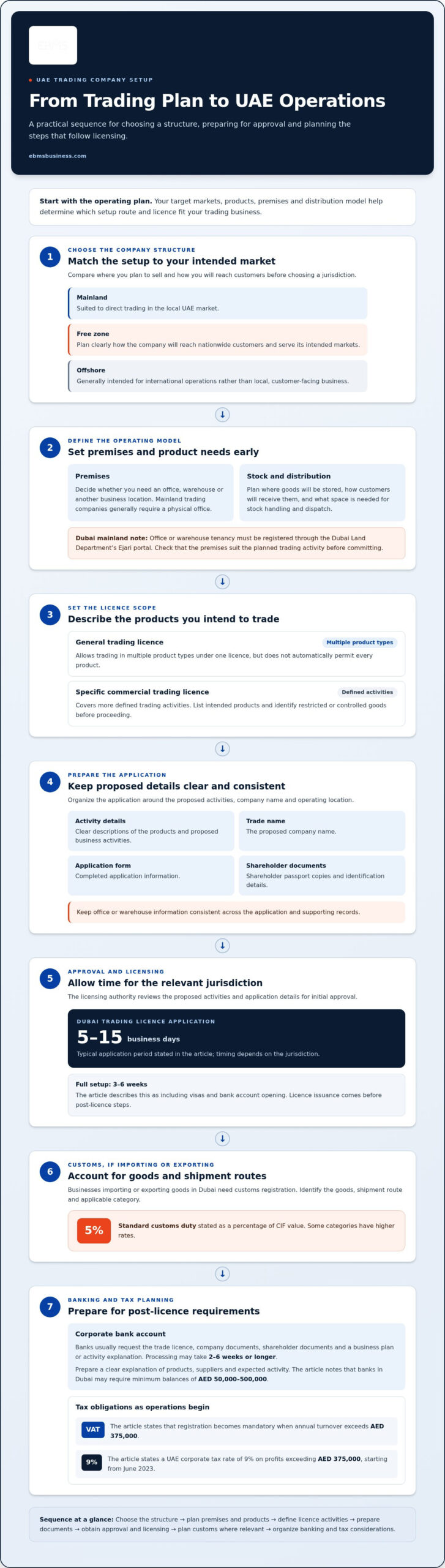
- Match the premises to your operating model. Decide whether you need an office, warehouse or another business location before applying. Mainland trading companies generally need a physical office, while offshore structures are intended mainly for international operations. Your location needs help determine which setup route fits your plans.
- Prepare the application in sequence. Set out the proposed activities, choose a trade name, and prepare the application form and shareholder passport copies. The licensing authority reviews the proposed activities and application details for initial approval. Clear product descriptions help align the requested licence with your intended business.
- Plan for the licensing timeline. A Dubai trading licence application typically takes 5 to 15 business days, depending on the jurisdiction. Full setup, including visas and bank account opening, takes 3 to 6 weeks. These are different stages: licence issuance comes before post-licence steps, and bank processing can affect the overall setup schedule.
- Prepare for customs and clearance. Businesses importing or exporting goods in Dubai need customs registration. Standard customs duty is 5% of the CIF value, although some categories have higher rates. Identify the goods, shipment route and applicable category before arranging imports or exports, so customs requirements are considered alongside the trading licence.
- Organise corporate banking after licensing. UAE banks usually request the trade licence, company documents, shareholder documents and a business plan or activity explanation. A corporate bank account supports company transactions and customer payments. Banks may take 2-6 weeks or longer to process applications, so prepare a clear explanation of products, suppliers and expected business activity.
- Address tax obligations as operations begin. According to the Federal Tax Authority, UAE VAT registration becomes mandatory when annual turnover exceeds AED 375,000. The UAE corporate tax rate is 9% starting from June 2023, according to the UAE Ministry of Finance; the 9% rate applies to profits exceeding AED 375,000.
Can a free zone trading company sell directly to UAE customers?
A free zone company can serve UAE customers, but its licence does not make it a mainland company. Before choosing a setup, map where goods will be stored, how customers will receive them and whether mainland sales are central to your plan.
- Choose the sales route before the workspace. Decide whether you’ll sell from the free zone to international buyers, UAE businesses or individual customers. A mainland company allows direct trading in the UAE market. If direct mainland sales are essential, compare that structure with free zone options before signing a lease or submitting an application. The right choice depends on your activities and distribution model.
- Match the premises to your stock and operations. An online seller holding no inventory may need different facilities from an importer storing cartons or equipment. List the space required for administration, stock handling and dispatch. Then compare those needs with the premises available through the relevant free zone or mainland arrangement. Your licence and location should support your actual activities, not just provide a registered address.
- Budget for a mainland office and Ejari. A mainland business generally needs a physical office. In Dubai, the tenancy contract for office or warehouse space must be registered through the Dubai Land Department’s Ejari portal. Check that the premises suit your trading activity before committing.
- Prepare formation documents around the proposed activity. Organize shareholder identification, company details, the application and a clear description of business activities. Keep proposed office or warehouse information consistent across the application and supporting records. If a government authority requests clarification, accurate documents make it easier to explain your intended operations and the role of each location.
- Plan for banking and workspace costs together. UAE banks usually request a trade licence, company documents, shareholder documents and a business plan or activity explanation. Banks in Dubai may require minimum balances of AED 50,000-500,000. Include those banking expectations in your cash-flow planning alongside rent, storage and logistics infrastructure. A workspace that supports the stated activity also helps keep the bank application consistent with the company’s operating plan.
Use this comparison to decide whether a free zone location supports your customer route or mainland incorporation better suits direct domestic trading. Map the premises, licensed activity and payment flow before registering the company.
Dubai mainland DET versus free zone setup
Compare the licensing authority, permitted activities, operating location and cost components before choosing a route. The right option depends on where you’ll trade and how your business will operate.
- Match the jurisdiction to your customers. A mainland company suits businesses planning direct trading in the UAE market. A free zone company may better suit operations based in that zone or focused on international trade. First map your customers, suppliers and distribution route. This helps you identify which authorities and regulations apply to your proposed activities.
- Check the exact activity before applying. The Dubai Department of Economy and Tourism (DET) lists over 2,100 approved trading activities. Identify the activity that best describes your products and sales model, rather than relying on a broad label. If you plan to import goods or add product categories later, include those plans in your review before submitting the licence application.
- Reserve a trade name and plan the sequence. Dubai trade name approval typically takes 1 to 2 business days. Treat name approval as an early step, then prepare the activity details and application for the relevant authority. A name that doesn’t reflect the proposed business can create avoidable revisions, so align it with your company’s intended trading scope.
- Compare realistic setup timelines. A mainland general trading licence takes approximately 5 to 10 working days when documentation is complete and an Ejari-registered office is ready. Dubai free zone trading licences can sometimes be issued within 3 to 7 working days. These are licence timelines, not a promise that every incorporation task will finish within the same period.
- Build a full cost checklist rather than comparing licence fees alone. Separate initial charges for the licence, activity, trade name, initial approval and incorporation documents. Then account for workspace, warehouse needs and renewals. A mainland office can add a significant ongoing commitment, while a free zone package may combine different facilities and licence elements. Compare equivalent activities and premises before assessing the total.
- Avoid choosing only for speed or headline cost. A common planning mistake is selecting a free zone before mapping mainland customers, stock storage and delivery. Another is applying with vague activity descriptions or leaving out planned product categories. Write down your operating model, premises and sales route, then check that each matches the licence application and the relevant authority’s requirements.
Initial approval and incorporation documents
- Set out the ownership and business plan. List each shareholder, their proposed ownership share and the trading activities the company intends to conduct. Describe products clearly, such as packaged food or electronic components, instead of relying only on broad descriptions. This gives the application a consistent foundation and helps the authority assess the proposed activities against the company structure.
- Choose and reserve a suitable trade name. Select a name that fits your planned trading business, then follow the relevant authority’s reservation process. Keep the spelling consistent across the application and supporting documents. Reserving a name is an early step, not the trading licence itself, so have your activity selection and ownership details ready for the next stage.
- Assemble the core application documents. A Dubai general trading licence application usually includes shareholders’ passport copies, an application form, business activity details and initial approval from the authority. Check that passport copies are readable and names match the application. A complete, consistent file makes it easier to address questions about shareholders or the proposed trading scope.
- Request initial approval before moving to licensing. At this stage, the authority reviews the proposed company and its activities before issuing a licence. Keep the proposed activities precise, especially if the business plans to trade several product types. If the authority asks for clarification, use the same descriptions in the form and supporting documents rather than introducing unrelated activities.
- Prepare structure-specific incorporation papers. Final documents depend on the chosen jurisdiction and company form. For a mainland setup, organize the ownership and company details required for incorporation. For a free zone, follow that zone’s application format and facilities requirements. Some UAE free zone applications may require audited financial reports covering two years or a bank reference certificate, so prepare relevant records where requested.
- Review every document before submission. Compare shareholder names, ownership details, trade name and activity descriptions across the file. If a memorandum of association is part of your chosen structure, make sure its ownership terms match the application. Keep copies of submitted documents and record any authority correspondence. This helps you track approval conditions and prepare for the next incorporation stage.
- Move from approval to licence and incorporation. Once initial approval is issued, follow the authority’s instructions to complete the licence application and remaining incorporation steps. Keep the company’s declared activities aligned with its intended trading operations. Following a clear sequence, from name reservation and application to approval and licence processing, helps avoid inconsistencies between ownership records and the approved business scope.
Mainland, free zone and offshore company structures
Choose a structure based on your customers, trading activities, premises and growth plans. Most trading activities allow 100% foreign ownership, particularly in free zones and many mainland activities; local partner requirements depend on the activity and jurisdiction.
-
Choose a Company Structure
Compare mainland, free zone and offshore structures against your actual trading model. A mainland company suits direct trading in the UAE market, while a free zone company may suit businesses focused on that zone or international sales. An offshore company is mainly used for international operations without a physical office. Offshore incorporation is not suited to a business that needs local premises or direct domestic operations.
-
Confirm Ownership and Partner Requirements
Check the ownership rules for the specific activity and authority before submitting initial approval. Free zone companies offer 100% foreign ownership, and 100% foreign ownership is available for most mainland commercial activities under the 2021 UAE commercial law reforms. This does not mean every activity follows identical conditions. Confirm the activity-specific position before recording ownership arrangements in incorporation documents.
- Match the structure to your sales route. List where your customers are based, how they’ll receive goods and whether you’ll sell directly in the UAE. Mainland companies support direct UAE-market trading. A free zone setup needs a clear plan for serving mainland customers. For example, a business importing stock for domestic distribution should assess its sales and delivery route before choosing a jurisdiction.
- Plan premises around the activity. Record whether you need an office, warehouse or storage facilities, and match these needs to your chosen structure. Mainland trading companies generally require a physical office. Offshore companies are mainly intended for international operations without one. Warehouse requirements can affect a jurisdiction’s practical suitability, so include storage and dispatch in your operating plan.
- Choose for the business you intend to build. Project how your trading company may operate in two or three years. Consider new product categories, additional customer markets and whether distribution will remain within one emirate. A structure suited to a small international trading operation may not suit later domestic sales. Compare your future plans with the activities and premises available through each jurisdiction.
- Align approval documents with the selected route. Once you choose a structure, keep the proposed activity, ownership details and premises consistent in your initial approval application. A mismatch, such as describing international wholesale while planning local retail, can prompt avoidable questions. Review the application against your intended sales route before submission, then use the approved structure to guide incorporation and licensing.
EBMS Business Services LLC: Free Zone Company Setup
EBMS Business Services LLC can help you move from comparing company structures to planning incorporation. Its Free Zone Company Setup suits trading models that fit a free zone, while Mainland Company Setup and Offshore Company Setup support different operating needs.
Consider support when you’re ready to align your proposed activities, ownership structure and target market with a setup route. EBMS also provides UAE Golden Visa Processing for entrepreneurs and investors seeking this service. The next step depends on the structure and support you need.
Contact EBMS Business Services LLC to discuss your Dubai business setup, or visit ebmsbusiness.com.
Turn your trading plan into a clear next step
A trading idea is easier to act on when you clearly define your products, customers and operating model. Use those details to choose a company structure that supports your current plans and allows for the direction your business may take as it grows. This gives you a practical starting point for planning approvals and incorporation.
If you’re weighing how to start a trading company in Dubai, EBMS Business Services LLC offers Free Zone Company Setup, Mainland Company Setup and Offshore Company Setup. The right route depends on your activities and where you plan to trade. EBMS can help you identify a setup path that aligns with those plans.
For guidance on your proposed structure and the next steps, contact EBMS Business Services LLC. A thoughtful setup decision can give your trading business a stronger foundation for moving forward.
Frequently Asked Questions
How Much Does It Cost to Start a Trading Company in Dubai?
The total cost depends on the jurisdiction, licensed activities, workspace and operational needs. Build a budget that separates licence and incorporation expenses from office or warehouse commitments, banking arrangements, staffing and renewals. The cost of a specific setup depends on the case and is provided after a quote request. Key factors include the chosen structure, activity scope, facilities and services required.
Mainland vs Free Zone: Which Option Is Right for You?
Choose mainland if direct trading in the UAE market is central to your model; consider a free zone if its jurisdiction and sales route fit your plans. For example, a distributor supplying domestic retailers should examine how the company will handle local sales and stock movement. An exporter focused on overseas buyers may weigh facilities and international operations differently. Base your decision on customers, goods and distribution, not the label alone.
What Happens After You Receive Your Trading License?
After licensing, move from formation to operational readiness. A company can apply for an establishment card, investor visa and employee visas if required. Prepare a clear explanation of business activities for banking and organize company and shareholder records for the application. Then set up practical processes for issuing invoices, recording transactions and tracking stock. These steps connect the licence’s approved activities with day-to-day trading.
What is a general trading license in Dubai?
A general trading licence allows a business to trade multiple product types under one licence. It can suit a company handling varied goods, such as furniture and household accessories, when those activities fit the approved scope. It does not automatically authorize every product or replace permissions that may apply to controlled goods. Before applying, prepare a product list and make sure the licence activities reflect your intended trade.
What are the steps to start a trading company in Dubai?
Start by defining your products, customers and sales channels, then select a company structure and jurisdiction. Choose the relevant trading activities, reserve a suitable trade name and submit the application documents for initial approval. Complete incorporation and licensing, then arrange operational essentials such as premises, banking and any required immigration steps. A clear sequence helps keep the company’s stated activities aligned with its trading model.
What documents are required to register a trading company in Dubai?
Common application documents include shareholder passport copies, a completed application form, proposed business activity details and initial approval. Keep names and activity descriptions consistent across forms and supporting documents. Depending on the jurisdiction and company structure, incorporation documents and premises information may also be required. If shareholders are companies rather than individuals, prepare the relevant corporate records for the authority’s application process.
How much does it cost to set up a trading company in Dubai in 2026?
There is no single setup amount that applies to every trading company. The cost of a specific setup is provided after a quote request and depends on jurisdiction, activities, premises, ownership structure and operational requirements. For a useful comparison, request the same scope across the options you’re considering, including renewals and workspace needs. This makes mainland and free zone budgets easier to assess on equivalent terms.
What are the differences between Dubai mainland and free zone trading licenses?
A mainland licence suits direct trading in the UAE market, while a free zone licence covers operations under a particular free zone’s jurisdiction. This distinction affects your operating model, premises and route to customers. Before choosing, compare the approved activities with your products and sales plans. If you’re unsure how to start a trading company in Dubai, first map your customer locations and distribution route.