
What if the 0% tax rate you’ve been promised in a free zone actually costs your business more in lost mainland opportunities than the 9% corporate tax ever would? For many entrepreneurs, the choice between a mainland vs free zone company in the UAE used to be a simple decision based on ownership. However, with 100% foreign ownership now common across the mainland and new corporate tax layers in effect for 2026, the old rules of thumb no longer apply.
At EBMS Business Services LLC, we understand that the current regulatory environment can feel like a maze of conflicting claims about tax exemptions and trading restrictions. You might be worried about whether your free zone license will block you from lucrative government contracts or if the 9% tax threshold of AED 375,000 will eat into your profits. This comprehensive guide is designed to clear that fog. You’ll discover the critical differences in ownership, tax, and trading rights required to select the ideal UAE jurisdiction for your specific goals. We will compare setup costs, visa quotas, and the latest Emiratisation requirements to ensure your foundation is both compliant and profitable.
Key Takeaways
- Understand how trading rights differ, specifically how mainland licenses allow direct access to the local UAE market while free zones focus on international operations.
- Learn how 100% foreign ownership rules have evolved in the mainland vs free zone company in dubai debate, allowing you to maintain full control regardless of your chosen jurisdiction.
- Navigate the 2026 corporate tax landscape by identifying the specific criteria for “Qualifying Free Zone Person” status to maintain a 0% tax rate on qualifying income.
- Compare physical office mandates and visa quotas to determine which setup aligns best with your team’s expansion plans and long-term operational budget.
- Apply a strategic framework to decide which license type supports your specific goals, whether you’re targeting government contracts or global e-commerce hubs.
Understanding the Fundamentals: Mainland and Free Zone Defined
Choosing the right jurisdiction is the most consequential decision any entrepreneur makes when entering the UAE. It sets the stage for where you can trade, who you can hire, and how you’ll be taxed. While the choice of a mainland vs free zone company in dubai used to be dictated solely by who owned the shares, the current environment focuses more on your operational footprint and digital transparency.
The Role of the Department of Economy and Tourism (DET)
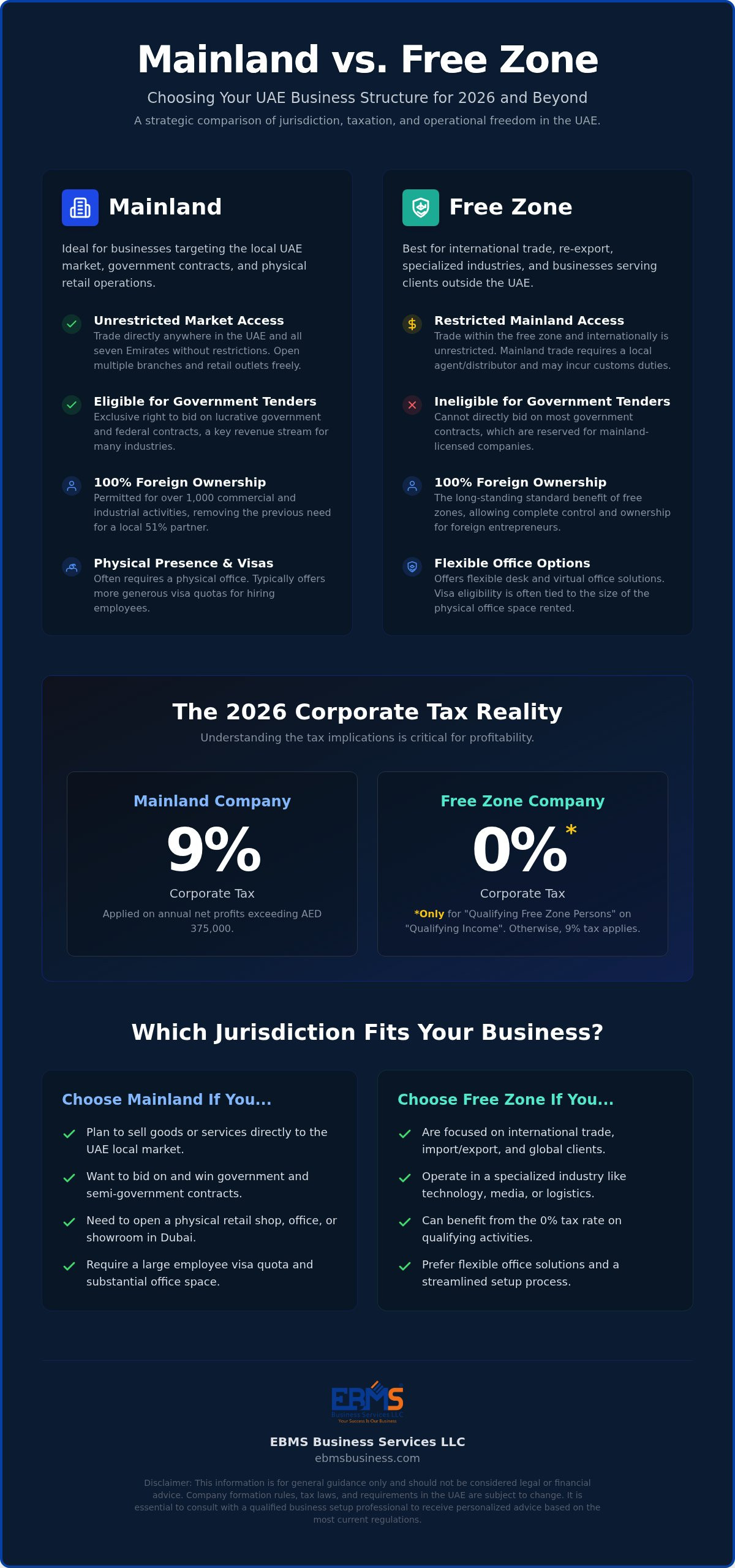
Mainland companies, also known as onshore entities, are licensed by the Department of Economy and Tourism (DET). This body governs business activities across the city’s commercial and residential areas. Unlike the older, more rigid structures, the DET has streamlined the path for Dubai mainland company formation, making it faster to obtain professional or commercial licenses. The most significant shift occurred in June 2021, when the UAE allowed 100% foreign ownership for over 1,000 commercial and industrial activities. This removed the requirement for a local Emirati partner to hold 51% of shares in most cases, effectively leveling the playing field with free zones.
The Free Zone Ecosystem: Specialized Hubs
Free zones are designated economic areas that operate under their own specific regulatory frameworks, independent of the DET. There are numerous free zones across the UAE, each tailored to specific industries like technology, logistics, or media. If your business focuses on international trade or specialized consulting, an Ultimate Guide to UAE Free Zone Company Formation offers a plug and play environment with dedicated infrastructure. However, these zones come with a geographic boundary; your license generally restricts you from trading directly with the mainland market without a local distributor or a mainland branch.
The 2026 business environment prioritizes transparency through digital platforms like “Invest in Dubai,” ensuring that every entity maintains accurate records and meets substance requirements. Modern entrepreneurs must now consider two key factors:
- Tax Compliance: Determining if your income is “qualifying” under free zone rules or subject to the standard 9% rate.
- Digital Integration: Utilizing unified government portals for renewals and visa processing.
This evolution means the mainland vs free zone company in dubai decision isn’t just about where you sit, but how you plan to scale within the UAE’s increasingly sophisticated financial ecosystem.
Operational Scope: Where and How Can Your Business Trade?
Where do your primary customers live? This simple question often dictates the outcome of the mainland vs free zone company in dubai comparison. If your business model relies on selling goods directly to local residents or bidding for federal projects, the mainland is your primary path. Mainland entities can trade anywhere in the UAE without geographic restrictions, including direct-to-consumer retail and B2B services across all seven Emirates.
Companies situated in free zones are technically considered “offshore” regarding customs and local trade. These zones are designed for export-oriented businesses or those targeting international markets. To sell physical goods on the mainland, a free zone entity must typically appoint a local distributor or agent. This process usually involves paying a 5% customs duty on goods entering the local market. Service-based firms like IT consultants or digital agencies often have more flexibility; they can work with mainland clients as long as the service is delivered from the zone, though physical work on mainland premises generally requires a mainland permit.
Bidding on Government Tenders
Mainland companies hold the exclusive right to bid on lucrative government contracts. Many high-value tenders in 2026 require a “Local Content” certificate, which prioritizes businesses that contribute significantly to the local economy through local hiring and procurement. For industrial, construction, or specialized engineering firms, having a mainland license is a strategic necessity to access these stable, high-volume revenue streams.
Retail and Physical Presence
A mainland license gives you the freedom to open multiple branches or retail outlets across the UAE under a single legal umbrella. This is ideal for restaurants, clinics, or retail chains that need to be close to their customers. In contrast, free zone companies are restricted to their specific zone’s boundaries. While they can open a mainland branch to expand their reach, this involves a separate registration process with the DET. Dual licensing is a specific arrangement where certain free zones allow their members to apply for an additional mainland permit from the DET without the need for separate physical office space.
Choosing the right structure depends entirely on your intended revenue sources. If you’re unsure which path fits your 2026 growth plan, discussing your specific trade activities with a consultant can prevent costly licensing errors later. We focus on ensuring your license matches your operational reality from day one.
Ownership, Visas, and Office Requirements in 2026
Navigating the administrative maze of a mainland vs free zone company in dubai requires a clear understanding of your long-term staffing needs. While free zones are famous for their “plug-and-play” office solutions, the mainland offers a more traditional path that scales with your physical presence. Your choice here determines not just where you work, but how many people you can legally employ. In 2026, the focus has shifted from finding a local partner to finding the right physical footprint to support your growth.
On the mainland, your visa quota is strictly linked to the size of your office. The general rule remains one visa for every 100 square feet of leased space. This means if you plan to hire a team of ten, you’ll need at least 1,000 square feet of office space registered with an Ejari (the official mainland lease registration). Free zones provide more flexibility for startups, often offering “flexi-desk” or “coworking” packages that include two or three visa allocations without the need for a private physical office. However, once you outgrow these small quotas, free zone office costs can sometimes exceed mainland equivalents.
The End of the Local Sponsor Requirement
The most significant shift in the last few years is the near-total removal of the local sponsor requirement for mainland commercial entities. You no longer have to give up 51% of your company’s shares to a UAE National for most trading and industrial activities. However, professional licenses, such as those for doctors, lawyers, or specialized consultants, still require a Local Service Agent (LSA). The LSA doesn’t own any part of your business; they receive a fixed annual fee for facilitating government relations. We act as a strategic facilitator in these arrangements, ensuring your legal documents clearly protect your 100% operational control and ownership rights.
Residency and the UAE Golden Visa
Setting up a business is a primary gateway to long-term residency in the UAE. For high-value investors and entrepreneurs, business setup can pave the way for the UAE Golden Visa, which provides a 10-year residency permit and the ability to sponsor family members and domestic staff without a local employer. Even with a standard two-year investor visa, you gain the right to live and work in the country. Managing these applications across different government portals requires precision. Specialized PRO services are essential here, as they handle the coordination between the Ministry of Human Resources and Emiratisation (MOHRE) and the Federal Authority for Identity and Citizenship to ensure your Emirates ID and visa stamping are processed without delays.
Taxation and Financial Compliance: The 2026 Reality
The introduction of federal corporate tax has fundamentally changed the mainland vs free zone company in dubai equation. For mainland entities, the rules are clear and predictable. A 9% federal corporate tax applies to annual taxable profits exceeding AED 375,000. If your business earns less than this threshold, your tax rate remains 0%. This system is designed to support startups and SMEs while ensuring larger enterprises contribute to the nation’s infrastructure. Both mainland and free zone entities must also manage 5% Value Added Tax (VAT) if their taxable supplies and imports exceed the mandatory registration threshold of AED 375,000.
Financial compliance in 2026 isn’t just about paying what’s owed; it’s about maintaining a digital paper trail. The UAE authorities now prioritize transparency, making robust accounting software a necessity rather than an option. Whether you’re onshore or in a specialized hub, your financial records must reflect your operational reality to avoid steep penalties during government audits.
Maintaining 0% Tax in Free Zones
Free zone entities can still enjoy a 0% corporate tax rate, but this benefit is no longer automatic. To qualify, a company must achieve “Qualifying Free Zone Person” (QFZP) status. This requires maintaining adequate substance in the UAE, which includes having enough full-time employees and incurring sufficient operating expenses within the zone. Most importantly, only “Qualifying Income” is eligible for the 0% rate. Income derived from transactions with the mainland is generally taxed at the standard 9% rate. Compliance requires meticulous record-keeping and the submission of audited financial statements. Many entrepreneurs utilize professional VAT registration services to ensure their tax filings align with these complex QFZP requirements.
Corporate Banking and Financial Setup
Establishing a reliable banking relationship is often the final hurdle in your setup journey. Mainland companies typically find it easier to open corporate bank accounts because their physical presence and local licensing provide a higher level of perceived transparency for compliance departments. Some free zone licenses, particularly those in high-risk sectors or virtual setups, can face longer processing times or more intensive documentation requests. We provide dedicated corporate bank account assistance to help you navigate these banking requirements with confidence. If you’re concerned about how your chosen jurisdiction might impact your financial operations, it’s best to consult with an advisor before finalizing your license to ensure a smooth path to account approval.
Choosing Your Path: The EBMS Strategic Framework
Deciding on a mainland vs free zone company in dubai requires looking at your three-year roadmap rather than just your first-year budget. While the initial setup costs are often the first point of comparison, the long-term value of your jurisdiction depends on your revenue sources. If your primary goal is to bid for government tenders or open a retail storefront in a popular mall, the mainland is your only viable path. Conversely, if you operate as an international consultant or a global e-commerce hub, a free zone offers a specialized ecosystem that prioritizes speed and international trade efficiency.
Many successful entrepreneurs now utilize a “Hybrid Strategy” to balance cost and market access. This involves starting with a free zone setup to take advantage of lower initial overhead and then scaling to a mainland branch once the business establishes a local customer base. This approach allows you to test the market without committing to the higher physical office requirements of a mainland license on day one. We specialize in managing these transitions, ensuring that your corporate structure remains compliant as your operational footprint grows.
The Decision Matrix for 2026
When evaluating your options, you must weigh long-term scalability against your immediate administrative capacity. Mainland licenses offer unlimited visa quotas based on office size, which is essential for labor-intensive industries. Free zones provide more modest visa packages but often feature faster processing times and lower initial capital requirements. You must also consider the “substance” requirements mentioned in previous sections; maintaining a 0% tax rate in a free zone requires a higher level of documented local operation than a standard mainland entity might need. Selecting the precise activity code during the initial application is the single most important factor in avoiding future license amendments or banking rejections.
Next Steps for Your Business
Choosing the wrong jurisdiction can lead to restricted trading rights or unexpected tax liabilities that are difficult to reverse. We recommend starting with a customized feasibility study that aligns your business activities with the latest 2026 regulations. This process removes the guesswork from your setup and provides a clear breakdown of all government fees and timeline expectations. Transparency is the foundation of our partnership, and we ensure you understand every step of the licensing process before you make a financial commitment.
Ready to establish your presence in the UAE market? Contact EBMS Business Services LLC today for a tailored consultation and let our team guide you through the complexities of jurisdiction selection with ease and precision.
Secure Your UAE Business Future
Choosing between a mainland vs free zone company in dubai is no longer a simple matter of ownership. It’s a strategic decision that defines your commercial reach and long-term tax efficiency. We’ve explored how mainland licenses unlock the entire UAE market and government tenders; meanwhile, specialized free zones provide targeted hubs for international trade. Navigating the 2026 tax landscape requires a proactive approach to maintain your profit margins and ensure full compliance with evolving substance requirements.
With over a decade of UAE market expertise since 2015, EBMS Business Services acts as your trusted navigator. We provide transparent fee structures and multilingual support to ensure global investors can move forward with total confidence. Our goal is to remove the administrative stress so you can focus on scaling your operations in one of the world’s most dynamic economies. Your vision for a successful UAE venture is within reach, and we’re here to help you build it on a foundation of clarity and precision.
Get a Personalized Business Setup Consultation
Frequently Asked Questions
Can a free zone company do business in mainland Dubai?
A free zone company cannot trade directly with the mainland market without a local distributor or agent. To sell physical goods or provide local services onshore, you would typically need to establish a mainland branch or utilize a third-party intermediary. While certain service providers can work with mainland clients remotely, any physical work or retail activities on the mainland require a Department of Economy and Tourism license.
Is a local sponsor still required for a mainland company in 2026?
A local sponsor is no longer required for most commercial and industrial activities on the mainland. Since June 2021, the UAE has allowed 100% foreign ownership for over 1,000 business activities. However, professional licenses still require a UAE National to act as a Local Service Agent (LSA). The LSA facilitates government relations for a fixed annual fee without owning any shares in your company.
Which is cheaper to set up: mainland or free zone?
Free zones are generally more cost-effective for initial setup because they offer flexible office solutions like coworking desks. Mainland setups often involve higher upfront costs due to the mandatory requirement for a physical office space and the associated Ejari registration. However, when comparing a mainland vs free zone company in dubai, you should consider that mainland entities often avoid the 5% customs duty on local sales, which can lead to long-term savings.
Do free zone companies pay corporate tax in the UAE?
Free zone companies pay the standard 9% corporate tax on profits exceeding AED 375,000 unless they meet the criteria for a Qualifying Free Zone Person (QFZP). To maintain a 0% tax rate, the entity must earn “qualifying income” and maintain adequate substance within the UAE. This includes keeping audited financial records and ensuring their primary operations stay within the zone’s regulatory boundaries.
Can I switch from a free zone to a mainland license later?
You cannot directly convert a free zone license into a mainland one; instead, you must register a new mainland entity or open a branch of your existing free zone company. This “hybrid approach” is common for businesses that start small in a zone and eventually need to target the broader UAE market. We can assist with the legal transition to ensure your residency visas and bank accounts remain stable during the process.
What is the minimum office space required for a mainland company?
The minimum office space requirement for a mainland company is typically 200 square feet. This physical premise must be registered with the DET through an Ejari certificate. Your staff capacity is directly linked to this square footage, as the general quota allows for one residency visa for every 100 square feet of office space you lease. Some activity-based exemptions may apply for instant licenses.
How many visas can I get with a free zone license?
The number of visas available depends on the specific license package and office type you select. Most flexi-desk or coworking packages in free zones allow for one to three visas. If you require a larger team, you will need to lease a physical office within the zone, where the quota is determined by the size and category of the premises. Each zone has its own specific allocation rules.
Do I need a physical office for a free zone company?
You don’t always need a private physical office for a free zone company, as many zones offer virtual office or flexi-desk options. These solutions are ideal for startups and remote consultants who don’t require a full-time workspace. However, if you plan to apply for more than three visas or need to meet specific substance requirements for corporate tax benefits, a private office may become a mandatory requirement. Your choice here impacts the mainland vs free zone company in dubai decision significantly.