

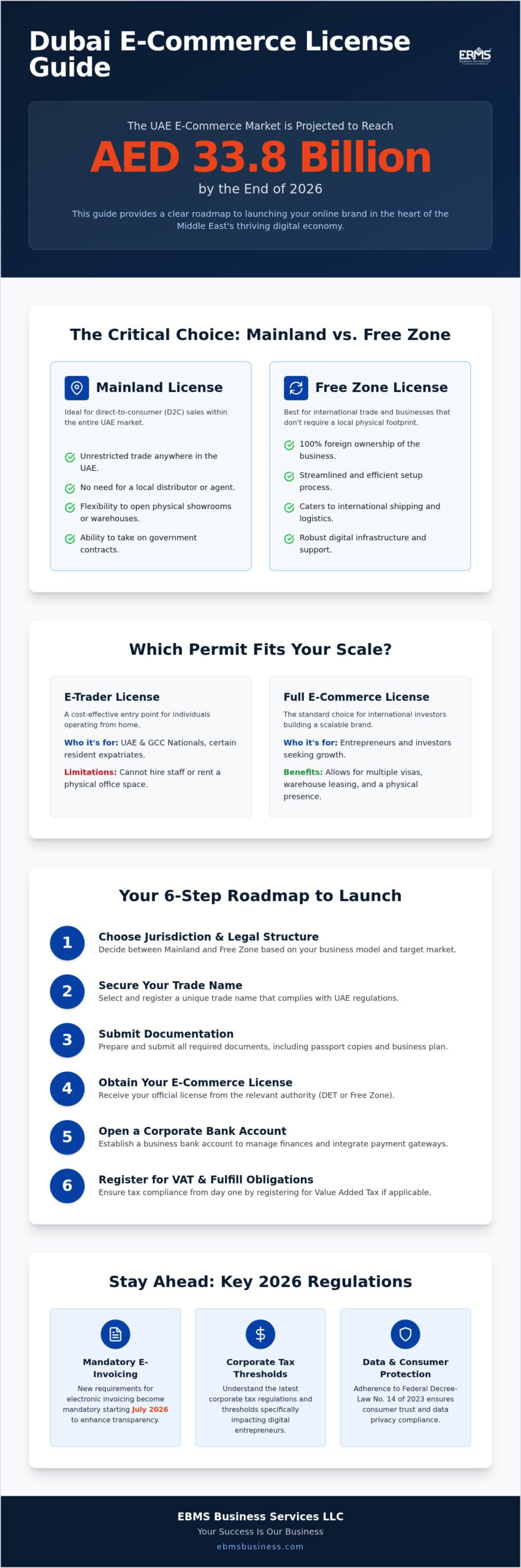
Did you know the UAE’s e-commerce market is projected to reach a staggering AED 33.8 billion by the end of 2026? It’s an incredible time to launch a digital venture, yet we know that securing an e-commerce license often feels like navigating a maze of conflicting advice. You might be struggling to choose between an E-trader permit and a full commercial setup; perhaps you’re even anxious about meeting the new mandatory e-invoicing requirements starting in July 2026. It’s completely natural to feel overwhelmed by the technicalities of corporate tax and bank account approvals when you just want to start selling.
This comprehensive guide from EBMS Business Services LLC is designed to remove those obstacles and provide the clarity you need to move forward with confidence. You’ll discover the exact requirements, transparent cost structures, and the strategic jurisdictional choices essential for a legal and successful online business. We’ll break down the differences between Free Zone and Mainland options, explain the 2026 tax landscape, and outline the steps to access international payment gateways. By the end of this article, you’ll have a clear, stress-free roadmap to launching your brand in the heart of the Middle East’s digital economy.
Key Takeaways
- Learn why choosing between a Mainland and Free Zone setup is the most critical decision for your business reach and ownership structure.
- Follow a clear, step-by-step roadmap to secure your e-commerce license dubai while ensuring your trade name and legal structure meet all 2026 regulatory standards.
- Demystify the process of opening corporate bank accounts and understanding your VAT obligations to maintain full compliance from day one.
- Discover how professional PRO services and strategic consultation can simplify complex government documentation and streamline your market entry.
- Stay ahead of the latest 2026 regulations, including mandatory e-invoicing and the newest corporate tax thresholds for digital entrepreneurs.
Understanding the E-commerce License Landscape in Dubai
An e-commerce license dubai is the legal foundation that allows you to sell goods or services through digital platforms. In the UAE, this framework ensures that your business operates within the bounds of federal law, providing protection for both the merchant and the customer. Whether you’re operating a B2C (Business-to-Consumer) model selling retail goods or a B2B (Business-to-Business) model offering specialized corporate software, having the correct permit is non-negotiable. Without it, you’ll find it impossible to integrate with local payment gateways, and reputable logistics partners will decline to handle your shipments. As the global e-commerce market continues to evolve, Dubai has positioned itself as a central hub by streamlining these administrative paths.
The regulatory environment is split between two primary types of authorities. The Department of Economy and Tourism (DET) oversees mainland licenses, which are ideal if you want to trade directly with the local UAE market without restrictions. Conversely, various Free Zone authorities offer specialized packages that cater to international trade and often provide 100% foreign ownership. Choosing between these depends on your target audience and your long-term growth strategy.
E-trader vs. E-commerce License: Which is for You?
Choosing the right permit depends largely on your nationality and your business scale. The E-trader license, issued by the DET, is specifically designed for UAE and GCC nationals, as well as certain resident expatriates, who wish to conduct business from their homes. It’s a cost-effective entry point but comes with strict limitations; you cannot hire staff or rent a physical office. If you’re an international investor looking to build a scalable brand, a standard e-commerce license dubai is the better choice. This commercial entity allows you to apply for multiple visas, lease warehouse space, and establish a more robust physical presence in the market.
The Legal Framework for Digital Trade in 2026
The UAE’s commitment to a digital-first economy is reflected in Federal Decree-Law No. 14 of 2023. This law focuses on technology-based trade, ensuring that online retailers adhere to strict consumer protection standards and transparent pricing. As we move through 2026, compliance has become more sophisticated, with new requirements for electronic invoicing and data privacy. These regulations are designed to foster trust and stability in the digital ecosystem.
Securing your e-commerce license is the essential gateway to accessing the UAE’s projected 33.8 billion dirham digital market.
Choosing the Right Jurisdiction: Mainland vs. Free Zone
Deciding where to anchor your digital storefront is perhaps the most significant strategic choice you’ll make. It dictates your operational reach and your relationship with logistics providers. For instance, the e-commerce market in the UAE is highly sophisticated, and your jurisdiction determines how easily you can tap into local last-mile delivery networks versus global shipping routes. While both options allow you to obtain an e-commerce license dubai, they serve very different business trajectories. Choosing the wrong one early on can lead to unnecessary customs duties or restricted access to certain customer segments.
Your choice also impacts your physical infrastructure. If you plan to hold significant inventory or want a flagship showroom to complement your online presence, the mainland offers unmatched flexibility. Free Zones, on the other hand, are designed for efficiency and speed, providing a streamlined environment for those who may not need a local physical footprint but require 100% foreign ownership and robust digital support.
Benefits of a Mainland E-commerce License
If your business model focuses on direct-to-consumer (D2C) sales within the Emirates, a mainland setup is often the superior choice. This structure allows you to trade anywhere in the UAE without needing a local distributor or facing customs barriers. It also provides the flexibility to open physical showrooms or large-scale warehouses in any commercial district, which is vital for brands that want a “phygital” presence. For those targeting government tenders or massive corporate contracts, Dubai Mainland company formation offers the necessary legal standing to compete at the highest levels.
Top Free Zones for E-commerce Startups
For entrepreneurs eyeing the global stage, a Freezone business setup remains a popular path. These jurisdictions offer 100% foreign ownership and are often optimized for tax efficiency. Certain zones have become specialized hubs for digital pioneers. For example, Meydan Free Zone provides a premium address near Downtown Dubai and an environment specifically tailored to digital businesses. Alternatively, IFZA is widely recognized for offering some of the most cost-effective and scalable packages for solo entrepreneurs and startups.
Your choice of jurisdiction also significantly impacts your logistics. Mainland companies can partner with any local courier for seamless door-to-door delivery. Free Zone companies, while excellent for re-export and international shipping, may face specific customs requirements when moving goods into the UAE mainland. This is where professional guidance becomes invaluable to ensure your supply chain remains efficient. If you’re unsure which path aligns with your 2026 goals, our team can help you evaluate the best jurisdiction for your specific niche.
Step-by-Step Process to Secure Your E-commerce License
Once your structure is defined, you’ll need to register your trade name. This isn’t just a branding exercise; it’s a legal requirement governed by specific UAE guidelines. Your proposed name must be unique and cannot contain offensive language or references to religious or political groups. If you choose to name the business after a person, it must be their full name without abbreviations. After your name is reserved, you’ll apply for Initial Approval. This is the government’s preliminary “green light” indicating that they have no objection to you starting a business in your chosen niche.
The final step in the licensing phase involves securing a physical or virtual address. In the mainland, you’re required to have a commercial lease and an Ejari certificate. If you’re establishing your business in a Free Zone, you can often take advantage of a Flexi-desk or “smart office” solution. These options provide a legal business address required for the license without the high overhead costs of a traditional office space.
Document Requirements for Entrepreneurs
To ensure a smooth application, you’ll need to have your documentation in order before you begin. While specific authorities might ask for additional paperwork, the standard requirements include:
- Clear passport copies for all shareholders and appointed managers.
- Proof of your current UAE visa status or a copy of your entry stamp.
- A comprehensive list of your business activities to ensure they match the license’s permitted scope.
- A No Objection Certificate (NOC) if you’re currently employed in the UAE and starting a business on the side.
Timeline and Approval Stages
The time it takes to get your business up and running varies based on your chosen jurisdiction and the complexity of your activities. Free Zone licenses are frequently processed with greater speed because they operate under a single authority’s internal systems. Mainland applications may involve coordination between several government departments, which can extend the timeline. Engaging professional PRO services is often the best way to navigate these approval stages quickly, as they handle the government documentation on your behalf.
While some licenses can be issued in 48 hours, the full operational setup usually requires 2-4 weeks. This timeframe accounts for the necessary steps beyond the license itself, such as corporate structuring and initial registrations.
Operational Essentials: Banking, VAT, and Logistics
Securing your e-commerce license dubai is a milestone, but it’s the operational infrastructure that truly brings your business to life. Transitioning from a legal entity to an active merchant requires a robust financial and logistical backbone. You’ll need to integrate reliable payment gateways such as Stripe, Telr, or Amazon Payment Services to accept customer payments securely. Additionally, if you’re importing physical goods, you must account for a standard customs duty of 5% on the CIF (Cost, Insurance, and Freight) value of your shipments. These elements must work in harmony to ensure your customers enjoy a seamless experience from checkout to delivery.
Corporate Bank Account Assistance
Opening a business bank account is often cited as the most significant challenge for digital entrepreneurs in the UAE. Banks utilize rigorous compliance checks to evaluate e-commerce startups, often focusing on the source of funds and the nature of transactions. To improve your chances of approval, it’s vital to present a solid business plan accompanied by transparent financial projections. We provide specialized corporate bank account assistance to help you navigate these requirements, ensuring your documentation meets the specific standards of local and international banks operating in Dubai.
Tax and Compliance in 2026
The regulatory environment in 2026 demands a proactive approach to tax compliance. While the UAE remains a tax-friendly jurisdiction, you must adhere to the mandatory VAT registration threshold of AED 375,000 in annual turnover. Even if you haven’t reached this limit, voluntary registration is available once your turnover exceeds AED 187,500. Furthermore, the corporate tax framework is now firmly in place. Most businesses benefit from a 0% rate on taxable income up to AED 375,000, with a 9% rate applied to profits exceeding that amount. All entities must register for corporate tax, regardless of their profit levels.
Compliance requirements are also evolving with technology. Starting July 2026, electronic invoicing will become mandatory for all business-to-business (B2B) transactions. This move toward digital transparency means your accounting systems must be capable of generating compliant e-invoices. Utilizing professional VAT registration services can help you manage these filings accurately and avoid costly penalties for late or incorrect submissions.
Managing these operational layers can be complex, but you don’t have to do it alone. If you’re ready to build a compliant and scalable foundation for your digital brand, contact our consultants today for expert guidance on banking and tax setup.
How EBMS Facilitates Your E-commerce Success
Launching a digital venture in a dynamic market requires more than just administrative filing; it demands a strategic partnership that understands the nuances of local regulations. At EBMS Business Services LLC, we position ourselves as your trusted navigator, guiding you from the initial consultation through to the final issuance of your e-commerce license dubai. Our decade of experience in the UAE market allows us to anticipate potential hurdles before they arise, ensuring your path to market entry is clear and efficient. We don’t just provide a service; we act as a strategic facilitator for your long-term stability.
One of the most critical value additions we offer is our deep expertise in selecting the right jurisdiction for your specific niche. Whether your business requires the global reach of a RAKEZ setup or the premium digital environment of Meydan Free Zone, we analyze your business model to find the most cost-effective solution. Beyond the license, we provide the essential digital infrastructure support, including domain registration and professional email hosting, to ensure your brand is ready to go live the moment your legal documents are ready.
A Solution-Oriented Approach
We believe that transparency is the foundation of trust. That’s why we provide clear, upfront communication regarding all government fees and realistic timelines, so there aren’t any surprises during the setup process. Our team handles the heavy lifting of government documentation through our comprehensive PRO services, allowing you to focus on your marketing and product development. We also offer personalized assistance for residency requirements, including investor and employee visas. For high-net-worth entrepreneurs looking for long-term security, we provide expert guidance on UAE Golden Visa processing to anchor your future in the Emirates.
Start Your Journey with EBMS LLC
Your vision for a successful online brand deserves a foundation built on expert knowledge and local insight. If you’re ready to turn your digital business concept into a reality, contact EBMS LLC today for a personalized e-commerce consultation and take the first step toward your UAE success story.
Ready to Launch Your Digital Brand in Dubai’s Growing Economy?
The journey to securing your e-commerce license dubai is the first step toward tapping into one of the world’s most vibrant digital markets. We’ve explored how the right jurisdiction choice between Mainland and Free Zone creates a foundation for your logistics, and how understanding the 2026 tax landscape ensures your long-term compliance. While the administrative path may seem complex, it’s entirely manageable with the right strategic facilitator by your side. Success in this region depends on getting the legal structure right from day one.
Since 2015, EBMS Business Services has helped thousands of entrepreneurs navigate the UAE’s regulatory environment with transparency and precision. Our multilingual team of business setup consultants is dedicated to removing the obstacles that often stall new ventures, specifically offering specialized corporate bank account opening assistance to bridge the gap between licensing and active trading. We take pride in being the honest advisor you need to turn a business concept into a thriving, legally sound reality.
If you’re ready to move from planning to action, secure your e-commerce license with EBMS Business Services today. We look forward to helping you build a successful future in the heart of the Middle East.
Frequently Asked Questions
How much does an e-commerce license in Dubai cost in 2026?
Costs vary significantly based on your chosen jurisdiction and business scale. A DED Trader license for home-based setups begins at approximately AED 1,070 plus membership fees. For a more robust Free Zone setup, prices typically start from AED 5,750 in Sharjah or around AED 12,900 in Dubai. Mainland commercial licenses often range between AED 15,000 and AED 30,000 for the first year, depending on office requirements and specific activity types.
Can I get an e-commerce license in Dubai without a physical office?
You can absolutely obtain an e-commerce license dubai without a traditional physical office by utilizing “Flexi-desk” or “Smart Office” solutions in various Free Zones. These options provide a legal business address required for licensing while keeping overhead low. However, if you choose a mainland license, you’ll generally need a physical space with a registered Ejari certificate to meet Department of Economy and Tourism requirements.
Do I need a UAE national partner for an e-commerce business?
No, you don’t need a UAE national partner to own 100% of your business in most cases. Following Federal Decree-Law No. 32 of 2021, expatriates can now enjoy full ownership of mainland Limited Liability Companies (LLCs) for the majority of commercial activities. Free Zones have always offered 100% foreign ownership, making both jurisdictions highly attractive for international investors and solo entrepreneurs looking to retain full control.
Can I sell products internationally with a Dubai e-commerce license?
Yes, a Dubai-based license allows you to sell products and services to customers across the globe. While your license is issued in the UAE, you can integrate with international shipping partners to reach global markets. It’s important to remember that selling to international customers may involve different tax regulations and customs duties in their respective countries, so staying informed on destination-specific rules is essential for sustainable global growth.
Is an e-commerce license required for selling on Amazon or Noon?
Both Amazon and Noon require sellers to provide a valid UAE trade license to register as a professional merchant on their platforms. Whether you opt for a mainland or a free zone setup, having a legal e-commerce license dubai is mandatory to access their seller portals and logistics networks. This requirement ensures that all vendors on these platforms are legally compliant and registered with the relevant UAE authorities.
What is the difference between a portal license and an e-commerce license?
A portal license is for businesses that act as intermediaries or marketplaces, connecting buyers and sellers without owning the inventory themselves. In contrast, an e-commerce license is specifically for merchants who sell their own products or services directly to consumers online. Choosing the correct activity is vital because it dictates your legal liability and the type of payment gateways you can integrate with your website.
Can I apply for a Golden Visa through my e-commerce business?
You can potentially qualify for a Golden Visa if your e-commerce business meets specific investment or revenue criteria set by the government. Generally, entrepreneurs with a project valued at AED 2 million or those who have achieved significant annual turnover may be eligible for this long-term residency. Since requirements can vary based on the specific category, we recommend consulting with a specialist to evaluate your business’s eligibility under the latest 2026 guidelines.
How do I open a corporate bank account for my online store?
Opening a corporate bank account requires presenting your valid trade license, Memorandum of Association, and a comprehensive business plan to your chosen bank. Financial institutions in the UAE conduct thorough background checks and require transparency regarding your expected transaction volumes and target markets. While the process can be rigorous for digital businesses, having professionally prepared documentation and a clear financial trail significantly increases your chances of a successful application.