

Will your chosen business activity code meet the UAE’s 2026 regulatory standards, or is your setup process at risk of a sudden, expensive halt? Securing a trade license dubai is no longer just about filling out forms; it’s a strategic alignment of your business goals with an evolving legal framework. It’s natural to feel anxious about the complexities of choosing between Mainland and Free Zone jurisdictions or the notorious delays often associated with opening corporate bank accounts. You want a foundation that’s stable, compliant, and ready for growth without the stress of administrative setbacks.
We’ve designed this expert-verified checklist to remove the guesswork and provide the clarity you need to move forward. By following this roadmap, you’ll navigate the legal requirements efficiently and gain the confidence to handle every regulatory hurdle with precision. This guide takes you through the entire journey, from securing initial approvals and selecting the correct activity codes to ensuring your company is fully operational and compliant. Let’s explore the essential steps to turn your entrepreneurial vision into a fully licensed reality in the heart of the Middle East.
Key Takeaways
- Identify the strategic differences between Mainland and Free Zone jurisdictions to choose the right foundation for your business goals.
- Master the 2026 documentation requirements to ensure your application for a trade license dubai moves forward without administrative delays.
- Follow a logical step-by-step guide from trade name reservation to notarizing legal agreements with confidence.
- Prepare for essential post-licensing tasks like VAT registration and corporate bank account opening to maintain full regulatory compliance.
- Learn how professional PRO services can handle complex government liaisons, allowing you to focus on your company’s growth.
Choosing Your Business Jurisdiction and Activity Codes
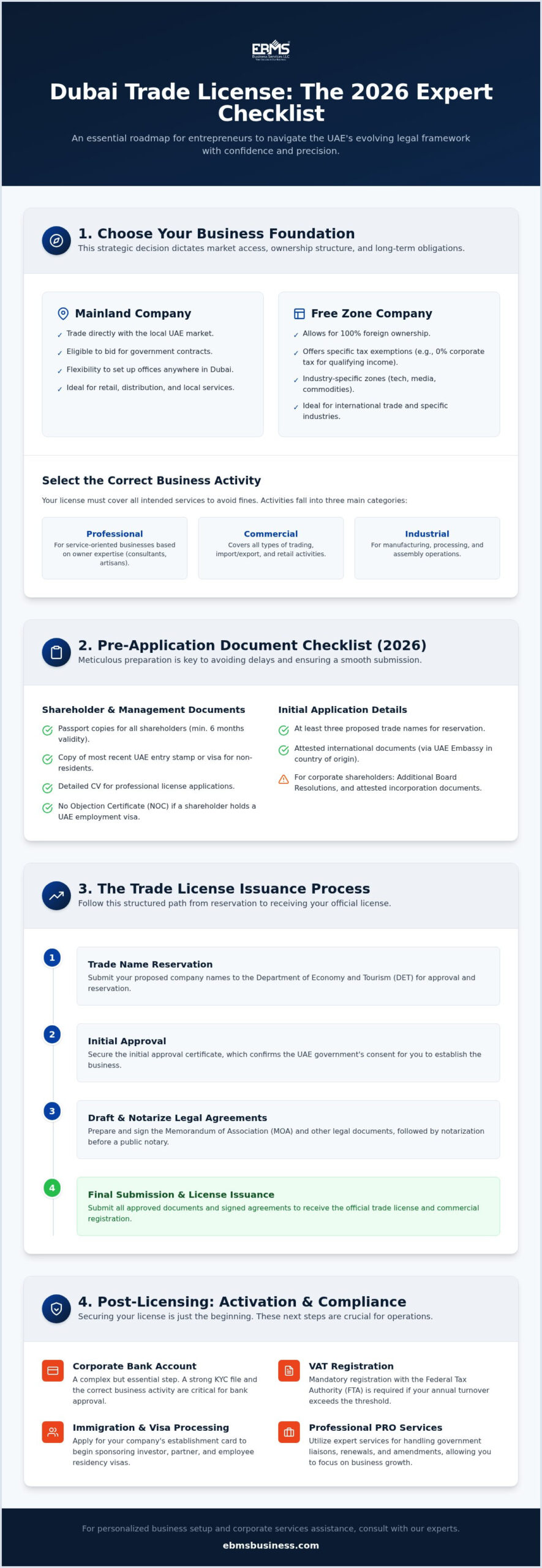
How do you ensure your business foundation is built on the right ground? The first step in obtaining a trade license dubai involves more than just picking a name; it requires a strategic evaluation of where your business will live and exactly what it will do. This decision dictates your market access, ownership structure, and long-term tax obligations. Choosing incorrectly at this stage can lead to restricted growth or the need for expensive license amendments later.
Mainland vs. Free Zone: A Decision Framework
Choosing between these two paths depends entirely on your target audience and operational needs. You should consider Dubai mainland company formation if you intend to trade directly with the local UAE market or bid for government contracts without restrictions. Mainland companies offer the flexibility to set up offices anywhere in the emirate, providing a broad geographic reach that Free Zones cannot match for local retail or distribution.
Conversely, you might explore freezone business options for 100% foreign ownership and specific tax exemptions. Free Zones are often grouped by industry, such as technology or media, offering a community of like-minded entrepreneurs. However, it’s vital to check the requirements for a physical office versus a flexi-desk setup. While a virtual desk might suffice for a startup, some jurisdictions require a minimum square footage for certain license types or to secure a higher number of residency visas. EBMS acts as a navigator here, helping you weigh the long-term costs of physical space against your immediate setup budget.
Selecting the Correct Activity Group
The Department of Economy and Tourism (DET) maintains an extensive list of thousands of activities. You must review the DED activity list carefully to ensure your license covers all intended services. Choosing the wrong code can lead to significant fines or the inability to open certain bank accounts, as banks often view specific activity codes as high risk.
Licenses generally fall into three categories: professional, commercial, or industrial. Professional licenses are for service-oriented businesses where the owner’s expertise is the product. Commercial licenses cover trading activities, and industrial licenses are for manufacturing. You also need to identify regulated activities that require additional NOCs from ministries. For example, a healthcare clinic requires approval from the Dubai Health Authority, and a transport business needs clearance from the RTA. Assessing these requirements early prevents your trade license dubai application from stalling during the final stages of government approval.
Pre-Application Checklist: Required Documentation for 2026
Is your paperwork truly ready for submission, or will a missing attestation stall your progress? Preparing for a trade license dubai is a meticulous process where attention to detail pays dividends in speed. The 2026 regulatory environment demands high levels of transparency, making your initial document file the most critical asset in your setup journey. Missing even a single stamp can lead to rejected applications and lost time.
Start by proposing at least three trade names for reservation. The registry is vast, and your first choice might already be taken or conflict with naming conventions. Avoid names that are religiously sensitive or imply government affiliation, as these will be rejected immediately. If any shareholder is currently under a UAE employment visa, you’ll need a No Objection Certificate (NOC) from their current employer. For investors outside the UAE, ensuring all international documents are attested by the UAE Embassy in the country of origin is a non-negotiable step. Without this, your application cannot proceed to the final approval stage.
Shareholder and Management Documentation
Every legal representative must provide a passport copy with at least six months of validity. If you’re applying for a professional license, you should prepare a detailed CV and professional profile to demonstrate your expertise to the relevant authorities. For shareholders residing outside the UAE, a copy of the most recent entry stamp or visa is required to verify legal status during the application. These documents form the core of your KYC (Know Your Customer) file, which is essential for both the license and future banking steps.
Specialized Requirements for Corporate Shareholders
When the owner of the new entity is another company, the documentation requirements become more complex. You must provide a formal Board Resolution authorizing the new company formation, along with the parent company’s Certificate of Incorporation and Memorandum of Association (MOA). These corporate documents must be translated into Arabic by certified legal translators in the UAE to meet the Department of Economy and Tourism’s standards. If the parent company is based outside the UAE, the entire chain of documents requires attestation. If this administrative burden feels heavy, consulting with a navigator can ensure your file is audit-ready before you even begin the submission. Ensuring these papers are in order early prevents the anxiety of last-minute delays while you’re trying to secure your trade license dubai.
Step-by-Step Guide to the Trade License Issuance Process
Once you’ve gathered your documents, the path to obtaining a trade license dubai moves from preparation to active execution. This phase requires precise coordination between various government entities. It’s not just about submitting files; it’s about following a sequential narrative that moves your business from a concept to a legal entity. Many entrepreneurs find this stage the most energetic, as the company’s identity begins to take a formal shape through official recognition.
Trade Name Reservation and Initial Approval
Your first milestone is securing a trade name that complies with UAE naming conventions. You should avoid restricted terms, religious references, or names of countries and regions, as these often lead to immediate rejection. The name must clearly reflect your primary business activity to prevent confusion during the regulatory review. Once the name is reserved, you’ll apply for the Initial Approval certificate. This document is the government’s confirmation that they’ve no objection to you starting a business in the UAE. It’s a crucial checkpoint that allows you to proceed with legal drafting and lease negotiations without the fear of your business concept being rejected later.
Legal Drafting and Office Registration
With initial approval in hand, you move to the legal core of your setup. You’ll need to draft and notarize the Memorandum of Association (MOA) or a Local Service Agent agreement, depending on your structure. This document defines the shareholding structure and the management powers of the directors. Notarization can often be handled digitally or through a public notary, ensuring that the rights of all partners are protected under UAE law. It’s a foundational step that provides the stability needed for long-term growth.
Whether you choose a physical presence in a Mainland area or a Free Zone, your office space is the next priority. For mainland licenses, you must register your commercial lease through the Ejari system. This digital registration is mandatory to finalize your trade license dubai issuance and is often required for subsequent visa applications. In the final step, you’ll submit the notarized MOA and Ejari certificate along with your initial approval to the relevant authority. After paying the required issuance fees, you’ll receive your final certificate and the corporate register. This moment marks your official entry into the market, allowing you to begin the transition toward operational readiness.
Post-Licensing Requirements: Banking, VAT, and Compliance
You finally hold your trade license dubai. While this is a significant milestone, it doesn’t mean your administrative journey is over. Transitioning from a legal entity to an operational business requires a sharp focus on financial and administrative compliance. Neglecting these post-licensing steps can lead to severe penalties or, worse, the inability to trade with local partners. Obtaining your trade license dubai is just the beginning of your journey in the UAE market; now you must build the infrastructure to support it.
Financial and Tax Compliance in 2026
Opening a business account is frequently cited as the most challenging step for new entrepreneurs. You should initiate your corporate bank account opening in UAE as soon as your license is in hand. Banks require a high level of transparency and detailed documentation regarding your business activities and source of funds. Simultaneously, you must evaluate your eligibility for VAT registration services in Dubai. If your taxable turnover exceeds the mandatory threshold of 375,000 AED, registration with the Federal Tax Authority is compulsory.
The 2026 tax landscape also requires strict adherence to the 9% Corporate Tax law for profits exceeding the 375,000 AED limit. You’ll need to set up professional accounting software from day one to track your income and expenses accurately. Maintaining proper financial records isn’t just good practice; it’s a legal requirement that protects your business during future audits. These foundations ensure your company remains in good standing as you scale.
Visa Processing and Residency
Once your license is active, you can apply for your establishment card. This document allows your company to register with the Ministry of Human Resources and Emiratisation and begin the visa process. Depending on your investment level or professional background, you might qualify for the Golden Visa, which offers long-term residency and greater flexibility. For most shareholders, the standard process involves a medical fitness test and Emirates ID registration. You’ll also need to manage employment visa quotas if you plan to hire staff. Each of these steps requires coordination with various government departments. If you want to ensure your compliance is handled with precision, contact our experts today to streamline your post-licensing journey.
Strategic Advantages of Professional Business Setup Support
Why risk your capital on a trial-and-error approach when the legal landscape is so specific? While the steps to obtain a trade license dubai might seem straightforward on paper, the nuances of execution often determine whether you launch in weeks or months. Professional support isn’t just about outsourcing paperwork; it’s about strategic alignment. By partnering with experts for your business setup in Dubai, you can avoid common company formation mistakes that often lead to rejected applications or unexpected government fees. This ensures your business structure is optimized for future growth and international expansion from the very first day. Experts help you choose the right legal form, which is vital for future share transfers or bringing on new investors.
Why Experience Matters in UAE Formations
Experience is the most valuable currency in the UAE’s administrative environment. EBMS Business Services LLC was founded in 2015, and since then, we’ve acted as a trusted navigator for thousands of entrepreneurs. Our deep local knowledge allows us to anticipate regulatory shifts before they impact your application. You’ll benefit from transparent communication regarding exact timelines and documentary requirements, removing the anxiety of the unknown. We provide end-to-end support, moving from the initial consultation through to operational digital hosting. This holistic approach means you’re never left to figure out the next step alone. Whether you’re a solo startup or a scaling SME, having a partner who understands the history of the local market provides a significant competitive edge.
The Role of PRO Services in Long-Term Stability
Your relationship with the government doesn’t end once you receive your trade license dubai. Maintaining continuous compliance requires constant vigilance over renewal dates and regulatory updates. Professional PRO services allow you to outsource government approvals and document attestations, ensuring you never miss a deadline. Timely license renewals are essential to avoid heavy penalties or the sudden suspension of your business activities. We also manage complex immigration and labor department requirements seamlessly, from processing staff visas to managing work permits and quotas. This allows you to focus entirely on your core operations while we handle the administrative lifecycle of your company. It’s about creating a stress-free experience where your business can thrive without the weight of bureaucratic hurdles. With an expert handling your government liaisons, you gain the freedom to innovate and grow while your foundations remain secure and compliant.
Building Your Future in Dubai with Confidence
Securing your trade license dubai is the essential first step toward establishing a successful presence in one of the world’s most dynamic markets. As we’ve explored, the journey involves more than just administrative filings; it requires a strategic choice of jurisdiction and a disciplined approach to 2026 compliance standards. From the initial name reservation to the complexities of corporate tax registration and bank account opening, each phase demands precision to avoid costly delays. By following a structured roadmap, you move from the uncertainty of entry to the stability of an operational business.
Founded in 2015, EBMS Business Services LLC provides end-to-end business setup support to ensure your company formation is seamless. Whether you need expert PRO and visa assistance or guidance through the latest regulatory requirements, our team acts as your trusted navigator. Contact EBMS today for a personalized consultation on your Dubai trade license and take the first step toward your entrepreneurial goals. We’re here to turn the complexity of the UAE’s legal landscape into a clear, achievable path for your business growth.
Frequently Asked Questions
How long does it take to get a trade license in Dubai in 2026?
Obtaining a trade license dubai typically takes anywhere from a few days to several weeks, depending on the jurisdiction and the complexity of the business activity. Mainland instant licenses can often be processed within 24 hours for certain activities, while Free Zone setups might take longer due to internal administrative checks. It’s best to confirm current processing times with a consultant, as government timelines can fluctuate based on seasonal demand or regulatory updates.
Can I get a trade license in Dubai without a physical office?
Yes, you can obtain a license without a traditional physical office through various Free Zone packages that offer flexi-desk or virtual office solutions. On the Mainland, the Instant License option allows businesses to operate for the first year without a physical lease agreement. However, you should keep in mind that a physical office address is often a mandatory requirement for opening a corporate bank account or applying for multiple employee visas for your staff.
What is the difference between a professional and a commercial license?
A professional license is for individuals or companies providing services based on specific expertise, such as consultancy or engineering. In contrast, businesses involved in trading goods, including import and export, must obtain a commercial license. While professional licenses often allow 100% ownership by the practitioner, commercial licenses on the mainland are now also eligible for full foreign ownership for most business activities under recent legislative changes that simplified the setup process for international investors.
Is it possible to 100% own a mainland company in Dubai?
Investors can now enjoy 100% ownership of a mainland company for over 1,000 commercial and industrial activities. This major regulatory shift, which came into effect in 2021, removed the previous requirement for a UAE national to hold 51% of the shares. While some strategic sectors still require local partnership, the vast majority of entrepreneurs can now maintain full control over their mainland business operations and profits without needing a local partner or national sponsor.
What happens if I operate without a valid trade license in the UAE?
Operating without a valid trade license dubai is a serious legal offense that carries heavy financial penalties and the risk of business suspension. Authorities conduct regular inspections, and companies found in violation may face immediate closure or blacklisting. Additionally, individuals involved could face legal action or deportation. Maintaining a valid license is the only way to ensure your business remains compliant and enjoys the legal protections offered by the UAE government for established companies.
How much does a trade license in Dubai cost for a small business?
The cost of a trade license varies significantly based on factors like the chosen jurisdiction, business activities, and visa quotas. Fees typically include government registration, trade name reservation, and initial approval costs. Small businesses might find Free Zone packages more cost-effective due to bundled services, while Mainland setups involve different fee structures related to office space and local service agents. You should request a detailed quote from a consultant to understand the full investment required for your company.
Can I apply for a Dubai trade license while residing outside the UAE?
You can certainly initiate the application for a trade license while residing outside the country. Many Free Zones and the Department of Economy and Tourism offer digital portals for remote registration and document submission. However, you’ll eventually need to visit the UAE to complete the medical fitness test and Emirates ID process for your residency visa. Utilizing professional PRO services helps manage the local administrative tasks on your behalf while you’re currently residing in another country.
Is a trade license mandatory for freelance work in Dubai?
Yes, a license is mandatory for anyone wishing to conduct freelance work legally within the UAE. Freelancers can apply for a specific Freelance Permit offered by various Free Zones, which acts as a trade license for individuals. This permit allows you to issue invoices to clients and apply for a residency visa. Operating as a freelancer without this legal authorization can lead to fines and may prevent you from opening a local business bank account in the Emirates.