

Treating your trade license renewal Dubai process as a routine administrative fee is one of the easiest ways to disrupt your business. In reality, annual renewal functions as a full operational compliance audit. A single oversight, whether an unlinked tenancy contract or a delayed municipal sign-off, can quickly trigger an AED 250 monthly penalty, corporate bank account freezes, or an AED 5,000 fine for operating without valid commercial registration.
Keeping up with procedural differences between the Dubai Department of Economy and Tourism (DET) and various free zone authorities can feel overwhelming, particularly when lease renewals and regulatory clearances must align simultaneously. You don’t have to face that uncertainty. By understanding the exact documentation and sequential approvals required, you can complete your renewal smoothly without administrative penalties, operational pauses, or visa disruptions.
Here is your comprehensive 2026 business compliance checklist, detailing every document, digital submission channel, and post-renewal step necessary to maintain uninterrupted corporate standing.
Key Takeaways
- Understand the precise timelines, grace periods, and submission requirements that govern the annual trade license renewal dubai process.
- Identify the core procedural differences between Department of Economy and Tourism (DET) mainland approvals and free zone authority protocols.
- Prepare the essential renewal documentation early, including verified partner identification, business registration forms, and an active Ejari lease contract.
- Follow a clear, sequential submission workflow across digital channels to complete your renewal without administrative fines or operational interruptions.
- Complete critical post-renewal updates with corporate banks, immigration registries, and tax portals to protect ongoing business compliance.
Understanding Trade License Renewal in Dubai: Cycles, Regulations, and Grace Periods
Every commercial entity operating in Dubai must renew its trade license annually. Far from a simple procedural filing, your renewal affirms your company’s legal authorization to trade, employ staff, and engage contracts within the dynamic economic landscape of Dubai. Mainland commercial licensing falls under the jurisdiction of the Department of Economy and Tourism (DET), while free zone authorities govern companies registered within their distinct economic enclaves under independent regulatory frameworks.
The Legal Framework Governing Dubai Business Licenses
Under the UAE Commercial Companies Law, corporate personality is tied directly to an active commercial license. Both mainland and free zone entities utilize the Dubai Unified Licence (DUL) identifier, a centralized digital identity system that tracks commercial status across government databases. Allowing your license to expire compromises this corporate personality. Without active commercial registration, legal contracts become vulnerable, commercial leases lose standing, and the firm forfeits its right to execute enforceable transactions.
Renewal Deadlines and Statutory Grace Periods
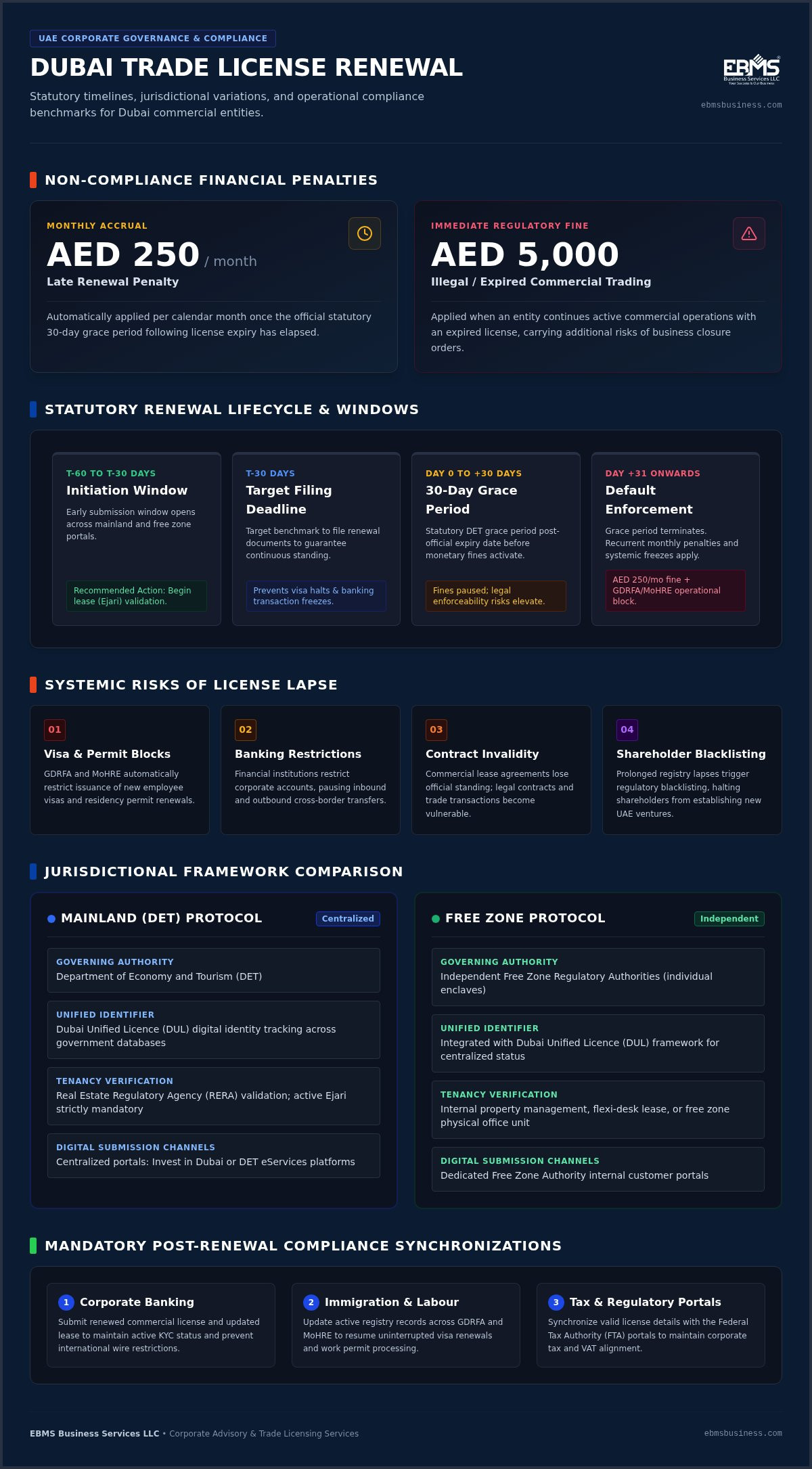
Authorities typically allow companies to initiate their renewal submissions up to 30 to 60 days before the expiration date. While the DET generally extends a 30-day statutory grace period following the official expiry date, relying on this window carries risk:
- Proactive Filing: Initiating the trade license renewal dubai workflow at least 30 days prior prevents unnecessary disruptions.
- Late Renewal Fines: Once the grace period expires, authorities apply standard fines of AED 250 per month of delay.
- Illegal Trading Penalties: Actively trading with an expired trade license risks an immediate regulatory penalty of AED 5,000 alongside potential business closure orders.
Operational Risks of Delayed Renewal
What happens if your renewal timeline slips? The cascading impact begins almost immediately. The General Directorate of Residency and Foreigners Affairs (GDRFA) and the Ministry of Human Resources and Emiratisation (MoHRE) automatically block the issuance of new employee visas or the renewal of existing residency permits. Continued delays can lead to regulatory blacklisting, which prohibits shareholders from establishing new corporate ventures.
Financial institutions also monitor registry status closely. When corporate records reflect an expired trade license, banks must restrict incoming and outgoing cross-border transfers to comply with federal compliance mandates. If your enterprise is navigating specialized operational structures, such as a cleaning business license that demands distinct municipality inspections, unexpected renewal delays can pause your entire service fleet. Treating renewal as an ongoing governance priority safeguards your banking facilities, employee sponsorships, and legal standing across the UAE market.
Mainland vs. Free Zone License Renewal: Key Regulatory Differences
Operating jurisdictions in Dubai dictate distinct compliance pathways. While mainland firms answer directly to the Department of Economy and Tourism (DET), free zone businesses interact with independent administrative authorities. As highlighted in historical benchmarks from the World Bank’s Doing Business report, regulatory clarity across jurisdictions underpins commercial ease in the UAE. Understanding these structural variations is vital for a smooth trade license renewal dubai workflow.
Dubai Mainland (DET) Renewal Architecture
Mainland commercial renewals center on a synchronized verification model. Rather than processing your company in isolation, the DET system requires cross-agency validation before issuing the commercial renewal payment voucher:
- Real Estate Validation: The Real Estate Regulatory Agency (RERA) system must confirm an active Ejari contract before your submission advances.
- Digital Portals: Applications run through centralized government platforms, such as Invest in Dubai or the DET eServices system.
- Entity Alignment: Any commercial activity adjustments must match the standards outlined in the foundational mainland corporate framework.
Free Zone Authority Renewal Frameworks
Free zones operate autonomous digital registries tailored to their business clusters. Entrepreneurs licensed through hubs like Dubai Multi Commodities Centre (DMCC), Dubai Silicon Oasis (DSO), or Meydan must submit documents via dedicated internal portals rather than the DET system. Commercial office mandates also differ significantly.
Instead of requiring an independent Ejari-registered commercial lease, free zones generally allow businesses to renew flexi-desk allocations, shared workstations, or private executive offices through internal lease agreements managed directly by the zone authority. If your business model involves an IFZA company setup, you follow their centralized portal requirements for workstation allocations and operational clearances.
Audit and Financial Reporting Obligations
Financial reporting rules create another clear distinction between jurisdictions. While standard mainland commercial licenses do not always require audited accounts for basic annual renewal, several established free zones mandate that companies submit an annual audit report prepared by an approved UAE auditor before releasing the renewal license.
Keeping corporate accounting records aligned with your licensing timeline prevents unexpected holds. If you want experienced oversight to coordinate your lease agreements, external clearances, and cross-jurisdictional filings, consider booking guidance through our team at EBMS Business Services to keep your company fully compliant year-round.
The Essential Document Checklist for Dubai Trade License Renewal
Preparing the correct records well in advance eliminates rejected portal uploads and administrative delays. While digital government initiatives have made submission faster than ever, the authorities still enforce rigorous documentary criteria. Approaching your trade license renewal dubai with an organized paperwork stack ensures compliance across every municipal and federal touchpoint.
Corporate Identity and Constitutional Documents
Before initiating your renewal filing, verify that personal and corporate records remain legally active. Outdated identification creates immediate system holds:
- Shareholder and Manager Credentials: Clear passport copies and valid Emirates IDs for all listed shareholders, partners, and the appointed General Manager. Passports must maintain at least six months of validity.
- Constitutional Framework: The existing Memorandum of Association (MOA) alongside any notarized amendments, share transfer instruments, or power of attorney updates enacted during the previous operational year.
- Corporate Shareholder Resolutions: If your company operates as a subsidiary of a corporate entity, provide an attested board resolution authorizing the license renewal and confirming the manager’s signing authority.
- Application Form: A completed and signed BR/1 renewal form where manual submissions or non-automated amendments are processed.
Tenancy Contracts and Ejari Validation Requirements
For mainland entities, real estate validation remains a non-negotiable prerequisite. Your tenancy agreement must be registered through the Land Department’s system, incurring standard administrative fees of approximately AED 220 for the Ejari certificate.
Crucially, the DET portal requires your Ejari certificate to remain valid for at least one full month beyond the date of your renewal submission. If your tenancy contract expires alongside your trade license, renew the lease first. Common pitfalls include unmapped commercial sub-properties, expired building ownership titles, or unapproved commercial warehouse subleasing. Ensure your landlord registers the updated tenancy contract directly on the system so the government database reflects active status automatically.
External Ministry and Sector-Specific Clearances
Commercial activities categorized as regulated require formal approval or a No Objection Certificate (NOC) from governing ministries before the DET or free zone releases the renewal voucher. Depending on your business scope, you may need annual approvals from the Dubai Health Authority (DHA) for healthcare clinics, the Roads and Transport Authority (RTA) for transport and logistics firms, or the Knowledge and Human Development Authority (KHDA) for educational centers.
Similarly, specialized operational categories like cleaning business licenses demand dedicated municipal hygiene clearances and equipment storage inspections before licensing systems allow final fee settlement.
Step-by-Step Procedure to Renew Your Dubai Trade License in 2026
Completing your renewal is a predictable, sequential workflow once your core records are organized. Today, streamlined digital channels handle the bulk of the submission, but executing each stage in order prevents administrative rejections. Following this structured roadmap ensures your trade license renewal dubai moves quickly from lease validation to final issuance.
Tenancy Agreement Renewal and Ejari Authentication
Mainland businesses must secure an updated tenancy contract before opening the renewal portal. Your landlord must register the contract with the Dubai Land Department (DLD) via the Ejari system. Confirm that the trade name, location details, and plot number match your commercial license records precisely. For free zone companies, finalize your flexi-desk lease extension or office agreement directly with the zone administration to avoid system validation delays.
Application Submission and External Approvals Processing
Log into the Invest in Dubai portal or the DET eServices platform using your UAE Pass credentials. The portal automatically checks your authenticated Ejari data against your trade license profile. If your activities don’t require structural changes or external departmental clearances, eligible entities can even trigger an instant payment voucher through the DET SMS service by texting the license number to 6969.
However, if your commercial activity requires specialized oversight, upload your valid No Objection Certificates (NOCs) alongside your application. The system routes these documents to the relevant ministries before generating final payment approvals.
Voucher Settlement and Commercial License Issuance
Once regulatory checks clear, the licensing portal issues an electronic payment voucher detailing statutory administrative fees, including standard Knowledge and Innovation surcharges of AED 10 each. Settle the payment online via credit card, approved banking channels, or at an authorized service center.
Immediately after payment confirmation, download your official renewed trade license alongside your updated Dubai Chamber of Commerce membership certificate. If you want to streamline this entire process and avoid procedural bottlenecks, reach out to EBMS Business Services for dedicated PRO support and document clearing.
Post-Renewal Protocols: Maintaining Banking, Tax, and Corporate Standing
Receiving your newly validated trade license is a major milestone, but your administrative responsibilities don’t end once you download the official PDF. Downstream government authorities, commercial registries, and financial institutions maintain separate records that require immediate updates. Completing your post-renewal obligations protects your operational continuity and guarantees that the benefits of your trade license renewal dubai carry through your entire corporate structure.
Corporate Bank Account Compliance and KYC Updates
UAE financial institutions operate under strict Central Bank Know Your Customer (KYC) and Anti-Money Laundering (AML) standards. Most commercial banks provide a brief grace period to submit updated corporate records. Once that internal grace period lapses without updated documentation, automated risk controls trigger restrictive account freezes.
Send an electronic package containing your renewed commercial license, updated Dubai Chamber of Commerce membership certificate, and current shareholder Emirates IDs to your relationship manager immediately. Companies managing ongoing bank account opening and maintenance know that proactive compliance prevents paused merchant gateways, delayed supplier remittances, and frozen payroll processing.
Tax and Immigration Registry Synchronization
Federal regulatory portals require timely synchronization with your updated commercial status:
- Federal Tax Authority (FTA): Update your business profile on the EmaraTax portal. Maintaining active records supports ongoing corporate tax compliance and obligations managed under VAT registration services, avoiding avoidable audit flags.
- Ministry of Human Resources and Emiratisation (MOHRE): Verify that your establishment card connects cleanly with your new licensing validity dates so work permit quotas remain open.
- General Directorate of Residency and Foreigners Affairs (GDRFA): Confirm your updated immigration profile is clear, enabling uninterrupted residency visa sponsorship for directors, staff, and family members.
Streamlining Compliance with Dedicated PRO Support
Tracking overlapping renewal dates across municipal offices, immigration authorities, commercial registries, and tax portals can easily overwhelm internal administrative resources. An overlooked verification or mismatched corporate document can stall daily operations without warning.
Working alongside experienced corporate advisors keeps your compliance cycle organized and fully aligned. Operating since 2015, EBMS Business Services LLC supports mainland and free zone enterprises with tailored PRO solutions, corporate banking assistance, and licensing management. Connecting with dedicated corporate specialists ensures your annual business filings remain reliable, accurate, and completely stress-free.
Mastering Your Annual Compliance with Confidence
Approaching your trade license renewal dubai as a structured corporate audit rather than a rushed administrative fee safeguards everything you’ve built. Verifying lease agreements early, securing necessary external ministry approvals, and immediately synchronizing post-renewal credentials with corporate banks and tax portals keeps your business fully protected against operational penalties or frozen accounts.
Navigating these regulatory touchpoints doesn’t have to distract you from business growth. Operating since 2015, EBMS Business Services delivers transparent, end-to-end corporate management across Dubai Mainland, diverse UAE Free Zones, and offshore registries. We manage complex documentation pipelines, active visa sponsorships, and banking compliance requirements so your leadership team can focus entirely on commercial expansion.
Take control of your annual compliance calendar before deadlines approach. To eliminate procedural stress and ensure uninterrupted corporate standing, connect with the specialists at EBMS Business Services today. Your enterprise deserves a reliable foundation for long-term success in the UAE market.
Frequently Asked Questions
Can I renew my Dubai trade license without a valid tenancy contract or Ejari?
No, mainland commercial licenses cannot be renewed without an active Ejari registered with the Dubai Land Department. The licensing system automatically validates your tenancy contract against municipal registries before proceeding. While special government economic relief initiatives have occasionally allowed temporary deferrals for select commercial sectors, standard protocol requires your Ejari to remain valid for at least one month beyond your submission date. Free zone entities rely on internal facility leases instead.
What is the standard grace period for trade license renewal in Dubai?
The Department of Economy and Tourism (DET) generally provides a 30-day statutory grace period following your license expiration date. During this window, you can finalize your trade license renewal dubai without incurring late administrative penalties. Operating commercially after expiration remains illegal and risks an immediate AED 5,000 fine. Once the 30-day grace period concludes, an ongoing penalty of AED 250 per month accumulates until the license is renewed or liquidated.
What happens to my company bank account if my trade license expires in Dubai?
UAE commercial banks will place operational restrictions or full freezes on corporate accounts once an expired license passes internal compliance thresholds. Central Bank regulations require institutions to maintain updated KYC documentation for every corporate client. If you fail to submit your renewed trade license, the bank will block outgoing wire transfers, debit card access, and salary payments through the Wages Protection System (WPS). Promptly submitting updated documents restores banking operations.
How does free zone trade license renewal differ from mainland DET renewal?
Mainland renewals require direct processing through the DET alongside synchronized Ejari verification, whereas free zone renewals are managed directly by each independent free zone authority. Free zone companies typically renew flexible desk agreements or executive office leases internally rather than through municipal land department portals. Additionally, specific free zones require companies to submit audited financial statements prepared by an approved auditor before approving their annual renewal, which is not standard for mainland entities.
Can business owners change commercial activities or company partners during renewal?
Yes, business owners can modify commercial activities, add or remove partners, or update company managers simultaneously during the annual renewal cycle. Combining structural amendments with your annual filing saves administrative time, but it requires additional documentation. You must submit amended Memorandums of Association (MOA), attested board resolutions, and updated identification records. Adding regulated activities introduces external government department clearances, which will extend the overall approval timeframe beyond standard renewal processing.
What government authorities require external approvals before license renewal?
Regulated commercial activities require formal approval from specific federal ministries or municipal departments before the licensing portal issues a renewal payment voucher. Healthcare facilities require clearances from the Dubai Health Authority (DHA), commercial transport businesses need sign-offs from the Roads and Transport Authority (RTA), and educational ventures must obtain approval from the KHDA. Specialized trades, such as industrial or cleaning operations, also require municipal safety and hygiene inspections.
Is corporate tax registration or VAT compliance checked during the renewal process?
While licensing authorities don’t automatically halt standard renewals solely for tax audits, tax compliance and licensing records are increasingly interconnected across UAE federal databases. Businesses subject to mandatory VAT registration or UAE Corporate Tax must maintain active commercial registrations to update their profiles on the FTA’s EmaraTax portal. Operating with an expired trade license creates compliance discrepancies during corporate tax filings or refund requests, potentially triggering administrative reviews by tax auditors.